SEOUL, South Korea — All six crew members of a KC-135 refueling aircraft supporting operations against Iran are dead, the U.S. military said Friday, after their plane crashed in western Iraq.
The U.S. Central Command, which oversees the Middle East, said the crash followed an unspecified incident involving two aircraft in “friendly airspace,” and that the other plane landed safely.
The crash brings the U.S. death toll in Operation Epic Fury to at least 13 service members, seven of whom were killed in combat. About 140 U.S. service members have been injured, including eight severely, the Pentagon said earlier this week.
Here's what is known so far about the tanker, which is the fourth publicly acknowledged U.S. aircraft to crash during the war against Iran:

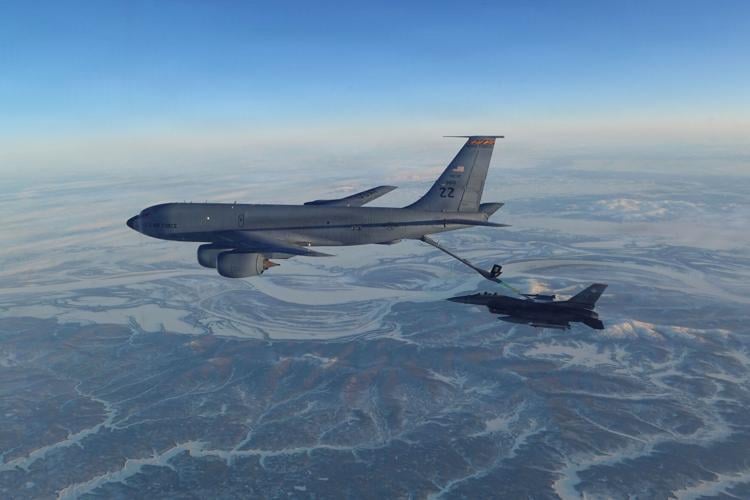
This photo provided by the U.S. Department of Defense shows a North American Aerospace Defense Command F-16 fighter refueling from a KC-135 Stratotanker over western Alaska on Feb. 19.
Cause of crash not immediately known
People are also reading…
The U.S. Central Command said all six crew members on board the crashed KC-135 have been confirmed dead. It said the circumstances of the crash are under investigation, but that the loss of the aircraft was “not due to hostile or friendly fire.”
A U.S. official, who also spoke on condition of anonymity to discuss the developing situation, said the other plane involved was also a KC-135. Yechiel Leiter, the Israeli ambassador to the U.S., wrote on X that the other plane landed safely in Israel.
Yang said it would be rare for a refueling tanker to be downed by enemy fire because such operations are usually conducted in the rear of combat zones.
The crash came after three U.S. F-15E fighter jets were mistakenly downed last week by friendly Kuwaiti fire.

The KC-135 is a long-serving tanker plane
The KC-135 Stratotanker is a U.S. Air Force aircraft used to refuel other planes in midair, allowing them to travel longer distances and maintain operations longer without landing. The plane is also used to transport wounded personnel during medical evacuations or conduct surveillance missions, according to military experts.
Based on the same design as the Boeing 707 passenger plane, the tanker has been in service for more than 60 years, supporting the U.S. Air Force, Navy and Marine Corps as well as allied aircraft, according to an Air Force description. The aging plane is set to be gradually phased out as more of the next-generation KC-46A Pegasus tankers enter service.
Despite upgrades over the years, the KC-135s’ age has fueled concern about their reliability and durability.
“The last of these planes were produced in the 1960s,” said Yang Uk, a security expert at South Korea’s Asan Institute for Policy Studies. He added that the transition to the KC-46A has progressed more slowly than expected.
According to the Congressional Research Service, the Air Force last year had 376 KC-135s, including 151 on active duty, 163 in the Air National Guard and 62 in the Air Force Reserve.
A basic KC-135 crew has three people: a pilot, co-pilot and boom operator. Nurses and medical technicians are added in aeromedical evacuation missions.
Refueling typically happens at the back of the plane, where the boom operator is located. A fuel boom is lowered to connect with fighters, bombers or other aircraft. On many of the planes, the boom operator works lying face down while looking out of a window on the underside of the plane.
Some KC-135s can also refuel planes from pods on their wings. The tankers also have room to carry cargo or passengers if needed.
Refueling tankers could play an increasingly important role if the Iran war drags on, as U.S. aircraft may need to fly longer missions to pursue Iranian forces retreating deeper into the country, said Yang.

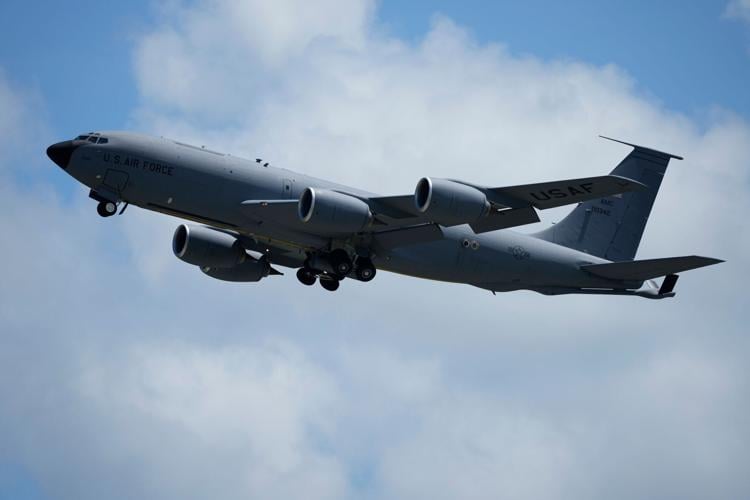
A U.S. Air Force KC-135 Stratotanker refueling tanker aircraft takes off from the Kadena Air Base airfield in Kadena town, west of Okinawa, southern Japan, Wednesday, Aug. 30, 2023.
Past accidents
KC-135s have previously been involved in several fatal accidents. The most recent occurred on May 3, 2013, when a KC-135R crashed after takeoff south of Chaldovar, Kyrgyzstan, while supporting the war in Afghanistan.
In that crash, the crew experienced problems with the plane's rudder, according to a U.S. Air Force investigation. While they struggled to stabilize the plane, the tail section broke away and the plane exploded midair, killing all three crewmembers onboard.
The most serious mid-air collision involving the plane happened in 1966, when a B-52 bomber carrying nuclear bombs struck a tanker near Palomares, Spain.
The accident caused the tanker to crash, killing four onboard. The disaster led to an extensive decontamination effort to clean up nuclear material dispersed when conventional explosives in the hydrogen bombs detonated after hitting the ground.
Photos from Middle East in the 2nd week of the Iran war

U.S. embassy personnel inspect the damage caused by a bombing in Baghdad, Saturday, March 14, 2026. (AP Photo/Hadi Mizban)

A woman sits on rubble across from a residential building damaged last Sunday during the U.S.-Israeli air campaign in Tehran, Iran, Thursday, March 12, 2026. (AP Photo/Vahid Salemi)

Residents inspect damage which according to them was caused by fragments of an intercepted Iranian rocket that landed on a Palestinian three story building, in West Bank town of Biddya, west of Salfit, Wednesday, March 11, 2026. (AP Photo/Majdi Mohammed)

Smoke rise from an Israeli airstrike in Dahiyeh, Beirut's southern suburbs, at sunset in Beirut, Lebanon, Tuesday, March 10, 2026. (AP Photo/Bilal Hussein)

A boy runs inside cement pipe turned into a bomb shelter as air raid sirens warn of incoming Iranian missile strike in Michmoret, Israel, Tuesday, March 10, 2026. (AP Photo/Ariel Schalit)

Smoke rise from an Israeli airstrike in Dahiyeh, Beirut's southern suburbs, Monday, March 9, 2026. (AP Photo/Hassan Ammar)

A man passes in front of a destroyed building that housed a branch of Al-Qard Al-Hassan, a non-bank financial institution run by Hezbollah, which was hit by an Israeli airstrike in Dahiyeh, Beirut's southern suburbs, Lebanon, Tuesday, March 10, 2026. (AP Photo/Hussein Malla)

People walk past closed shops at the nearly empty traditional main bazaar in Tehran, Iran, Tuesday, March 10, 2026. (AP Photo/Vahid Salemi)

Motorbikes drive past a billboard depicting Iran’s late Supreme Leader Ayatollah Ali Khamenei, center, handing the country’s flag to his son and successor Ayatollah Mojtaba Khamenei, right, as the late revolutionary founder Ayatollah Ruhollah Khomeini stands at left, in a square in downtown Tehran, Iran, Tuesday, March 10, 2026. (AP Photo/Vahid Salemi)

Flames rise after an Israeli airstrike in Dahiyeh Beirut's southern suburbs, Monday, March 9, 2026. (AP Photo/Hassan Ammar)

A man holds a poster of Ayatollah Mojtaba Khamenei, the successor to his late father Ayatollah Ali Khamenei as supreme leader, during a rally to support him in Tehran, Iran, Monday, March 9, 2026. (AP Photo/Vahid Salemi)

People wave Iranian flags as they hold posters of the late Supreme Leader Ayatollah Ali Khamenei, showing him at different ages, during a rally to support his son Ayatollah Mojtaba Khamenei, who succeeds his father as the new supreme leader, in Tehran, Iran, Monday, March 9, 2026. (AP Photo/Vahid Salemi)

People gather in a rally to support Ayatollah Mojtaba Khamenei, the successor to his late father Ayatollah Ali Khamenei as supreme leader, in Tehran, Iran, Monday, March 9, 2026. (AP Photo/Vahid Salemi)

The coffin of Mehdi Hosseini, a man killed in a U.S.-Israeli strike, is carried for burial at Behesht-e Zahra cemetery in Tehran, Iran, Monday, March 9, 2026. (AP Photo/Vahid Salemi)

A girl displaced by Israeli airstrikes, looks on at a school used as a shelter in Beirut, Lebanon, Monday, March 9, 2026. (AP Photo/Hassan Ammar)

Relatives mourn over the flag draped coffin of Mehdi Hosseini who was killed in a U.S.-Israeli strike during his burial ceremony at Behesht-e Zahra cemetery in Tehran, Iran, Monday, March 9, 2026. (AP Photo/Vahid Salemi)

Israeli security forces and ZAKA rescue service members carry the body of a man killed in an Iranian missile strike in Yehud, Israel, Monday, March 9, 2026. (AP Photo/Ohad Zwigenberg)

Two women from the Iranian Red Crescent Society stand as a thick plume of smoke from a U.S.-Israeli strike on an oil storage facility late Saturday rises in the sky in Tehran, Iran, Sunday, March 8, 2026. (AP Photo/Vahid Salemi)

A woman walks past a cordoned-off area damaged during an Iranian strike in Tel Aviv, Israel, Sunday, March 8, 2026. (AP Photo/Ohad Zwigenberg)

Mourners carry the bodies of Hezbollah fighters who were killed by Israeli airstrikes during their funeral procession in Khraibeh village, eastern Lebanon, Sunday, March 8, 2026. (AP Photo/Bilal Hussein)

Residents look on and take pictures as flames and smoke rise from an oil storage facility struck as attacks hit the city during the U.S.–Israeli military campaign in Tehran, Iran, Saturday, March 7, 2026. (Alireza Sotakbar/ISNA via AP)

Residents flee the site of an Israeli airstrike that hit an apartment building in the southern port city of Sidon, Lebanon, Friday, March 13, 2026. (AP Photo/Mohammed Zaatari)

A cleric chants slogans during the annual anti-Israeli Quds Day, or Jerusalem Day rally in support of Palestinians in Tehran, Iran, Friday, March 13, 2026. (AP Photo/Vahid Salemi)

People inspect the site of a destroyed branch of Al-Qard Al-Hassan, a non-bank financial institution run by Hezbollah, which was hit by an Israeli airstrike in central Beirut, Thursday, March 12, 2026. (AP Photo/Hussein Malla)

An Israeli army strike explodes next to a tent camp after residents were given a warning to evacuate before the strike in Gaza City, Wednesday, March 11, 2026. (AP Photo/Yousef Al Zanoun)

A woman gathers belongings from her family's home after it was damaged by a projectile launched from Lebanon, in Haniel, central Israel, Thursday, March 12, 2026. (AP Photo/Baz Ratner)

Israeli authorities inspect homes damaged by a projectile launched from Lebanon, in Haniel, central Israel, Thursday, March 12, 2026. (AP Photo/Baz Ratner)

Smoke and flames rise from buildings following an Israeli airstrike in Dahiyeh, Beirut's southern suburbs, Lebanon, Wednesday, March 11, 2026. (AP Photo/Bilal Hussein)

Rescue workers gather at the site where Israeli airstrikes hit apartments in Beirut, Lebanon, Wednesday, March 11, 2026. (AP Photo/Hussein Malla)

People take cover in an underground bomb shelter as air raid sirens warn of incoming Iranian missile strike, in Ramat Gan, Israel, Wednesday, March 11, 2026. (AP Photo/Oded Balilty)

Smoke rises from buildings following an Israeli airstrike in Dahiyeh, Beirut's southern suburbs, Lebanon, Wednesday, March 11, 2026. (AP Photo/Bilal Hussein)

A man walks along the shore as oil tankers and cargo ships line up in the Strait of Hormuz, as seen from Khor Fakkan, United Arab Emirates, Wednesday, March 11, 2026. (AP Photo/Altaf Qadri)

Residents look on and take pictures as flames and smoke rise from an oil storage facility struck as attacks hit the city during the U.S.–Israeli military campaign in Tehran, Iran, Saturday, March 7, 2026. (Alireza Sotakbar/ISNA via AP)

A man stands atop the rubble as smoke rises from a building destroyed in an Israeli airstrike in Dahiyeh, Beirut's southern suburbs, Lebanon, Saturday, March 14, 2026. (AP Photo/Hassan Ammar)

Rescue workers inspect an apartment damaged in an Israeli airstrike as thick smoke fills the building in the southern port city of Sidon, Lebanon, Saturday, March 14, 2026. (AP Photo/Mohammad Zaatari)

A girl walks inside a cement pipe turned into a bomb shelter as air raid sirens warn of incoming Iranian missile strike in Michmoret, Israel, Saturday, March 14, 2026. (AP Photo/Ariel Schalit)

Fire and plumes of smoke rise from an oil facility in Fujairah, United Arab Emirates, Saturday, March 14, 2026. (AP Photo/Altaf Qadri)
Schreck reported from Bangkok. AP writers Ben Finley and Konstantin Toropin in Washington contributed.