JAMESTOWN, St. Helena — Whale sharks shouldn't be hard for scientists to find.
They are enormous — the biggest fish in the sea — and found in warm oceans all around the world. By shark standards, they are slow swimmers.
But they somehow manage to also be very private: Scientists don't know where they mate, and have never observed it before.

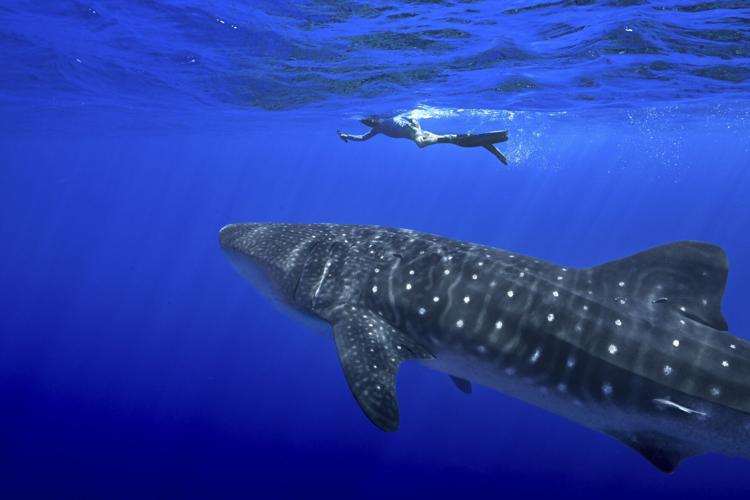
A person swims near a whale shark in February off the coast of St. Helena in the South Atlantic.
There are finally some clues, though. Scientists suspect the magic may be happening in the waters around St. Helena, a remote volcanic island in the South Atlantic Ocean where Napoleon Bonaparte was once exiled and died.
People are also reading…
It's the only place in the world where adult male and female whale sharks are known to regularly gather in roughly equal numbers — and food doesn't seem to be the main attraction.
Kenickie Andrews, the marine conservation project manager at the St. Helena Trust says he's seen male sharks chasing females, nibbling on their pectoral fins and "displaying themselves" to the female sharks, akin to mating rituals observed in other sharks including great whites.
"What we've seen here is classic shark courtship behavior," he said. "To this day we haven't seen successful copulation, but it is proof (whale sharks) are in our waters trying out these behaviors."

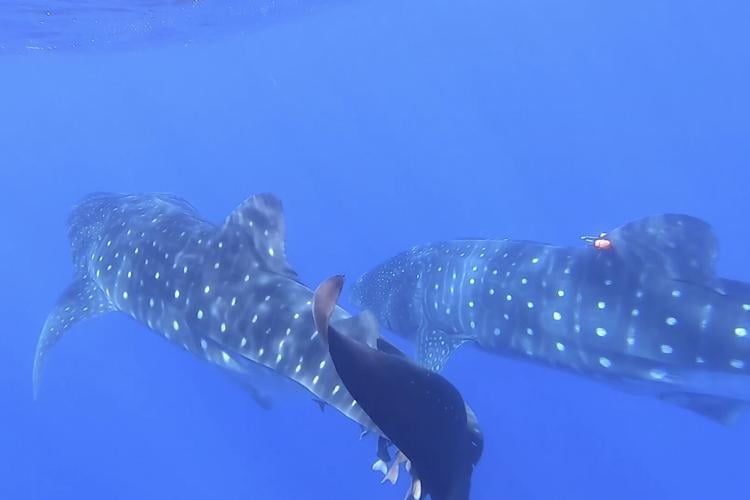
Whale sharks swim near each other Feb. 25 off the coast of St. Helena in the South Atlantic.
Whale sharks typically measure from 39 to 59 feet, weigh up to 14 tons and are plankton eaters; all sharks have a unique pattern of white spots on their upper side.
Scientists say they need to know where the sharks are mating and giving birth so they can protect those areas, possibly by creating marine reserves where threats like fishing are banned.
Whale sharks are designated as endangered by the International Union for Conservation of Nature; the group says their population was "largely depleted."
Simon Pierce, who has studied whale sharks globally, said he photographed suspected mating scars on female sharks in St. Helena, probably from when male sharks bit their pectoral fins to hold onto them and get into mating position.
Suspected whale shark mating behavior also was reported in Australia and the sharks also gather in places like Mexico, the Arabian Sea and the Maldives, but that seems to amount to male harassment of immature females, explains Pierce, executive director and co-founder of the charity Marine Megafauna Foundation.
That's not the case in St. Helena, where adult males and adult females are present.

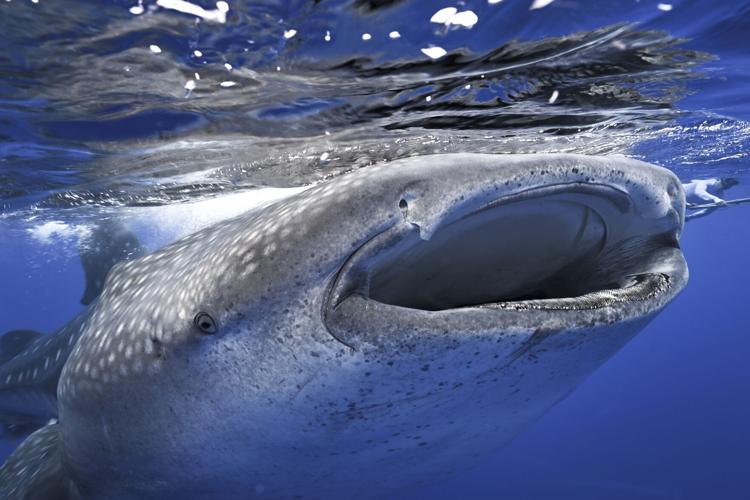
A whale shark swims in February off the coast of St. Helena in the South Atlantic.
Fisheries experts in St. Helena have also provided eyewitness accounts of what they said were instances of whale sharks mating. Officials described a lot of thrashing at the water's surface by two enormous sharks touching belly to belly, but those sightings were not captured on video and are not considered sufficient proof by scientists.
Cameron Perry, a research scientist at the Georgia Aquarium in Atlanta, has been working with colleagues on the island to attach camera tags to investigate what the whale sharks are doing, but ran into some technical difficulties: the sharks dive deeper than 6,561 feet and the tags can't withstand the pressure.
"We have some very tantalizing and teasing video," Perry said. "We have two sharks about to make contact, and then our camera falls off."
Perry isn't sure what the sharks might be doing far below the surface, but hopes new technology being developed will help answer that question. "It's just a numbers game in terms of how often we can get in the water."

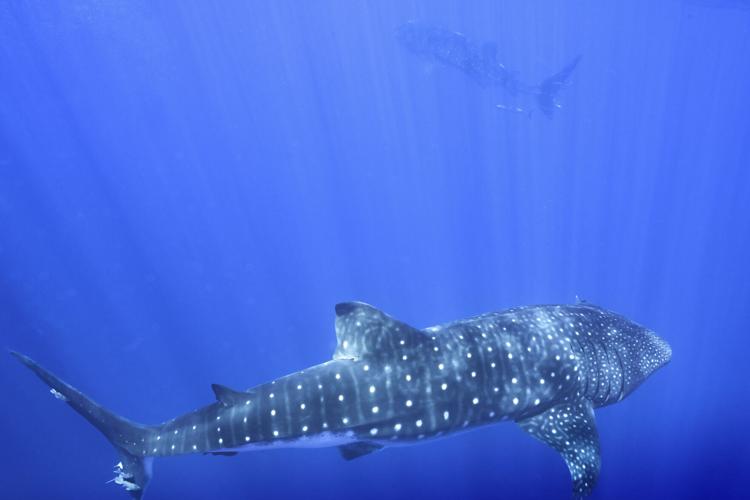
Whale sharks swim in February off the coast of St. Helena in the South Atlantic.
Alistair Dove, who previously conducted research in St. Helena, said he's seen male whale sharks soliciting contact from adult female sharks, including rotating their claspers, or sexual organs, in what he said was "the sharky equivalent of an erection."
"These sexual behaviors are very, very rare in whale sharks," said Dove, now CEO of the Museum of Science & History in Jacksonville, Florida.
"This is one of the huge, unanswered questions about the biggest fish in the world," he said.
Andrews said he was hopeful someone might be able to capture video evidence of whale sharks mating, but acknowledged the researchers' presence and tagging efforts might inadvertently alter the sharks' mating practices.
"Maybe they don't want to be seen," he said. "Maybe, like everyone else, they need privacy."
New gear could keep California crab fishermen on the water longer, and whales safer

James Sanders loads crab traps onto the boat Pale Horse at Pier 45 in San Francisco, Thursday, April 10, 2025. The boat's crew is trying out pop-up gear aimed at preventing whale entanglements. (AP Photo/Emily Steinberger)

Pop-up gear that aims to prevent whale entanglements, right, is loaded onto the boat Pale Horse at Pier 45 in San Francisco, Thursday, April 10, 2025. (AP Photo/Emily Steinberger)

James Sanders, left, and Brand Little, load crab traps onto Little's boat Pale Horse at Pier 45 in San Francisco, Thursday, April 10, 2025. Little is part of a pilot program trying out gear that prevents whale entanglements. (AP Photo/Emily Steinberger)

Hunter Nguyen, top, and Jonathan Tin, load pop-up gear that prevents whale entanglements onto the boat Pale Horse at Pier 45 in San Francisco, Thursday, April 10, 2025. (AP Photo/Emily Steinberger)

James Sanders, left, and Brand Little, load rope onto Little's boat Pale Horse at Pier 45 in San Francisco, Thursday, April 10, 2025. Little is part of a pilot program using pop-up gear to protect whales. (AP Photo/Emily Steinberger)

San Francisco Dungeness crab fisherman Brand Little wears a sweatshirt featuring his boat, Pale Horse, as he loads rope onto his boat at Pier 45 in San Francisco, Thursday, April 10, 2025. Little is part of a pilot program using pop-up gear to protect whales. (AP Photo/Emily Steinberger)

Hunter Nguyen, center right, and Jonathan Tin, load crab traps onto the boat Pale Horse at Pier 45 in San Francisco, Thursday, April 10, 2025. The boat's crew is trying out pop-up gear aimed at preventing whale entanglements. (AP Photo/Emily Steinberger)

Pop-up gear meant to prevent whale entanglements while crabbing sits at Pier 45 before being loaded onto the boat Pale Horse in San Francisco, Thursday, April 10, 2025. (AP Photo/Emily Steinberger)

A bird's shadow is cast on the ground of a storage area as Brand Little, background, loads crab traps onto his boat Pale Horse at Pier 45 in San Francisco, Thursday, April 10, 2025. Little is part of a pilot program trying out pop-up gear that prevents whale entanglements. (AP Photo/Emily Steinberger)