SCARBOROUGH, Maine — Rick Clough spent some four decades fishing for lobsters and sea urchins off the Maine coast before spotting one of the ocean’s most recognized predators: a great white shark.

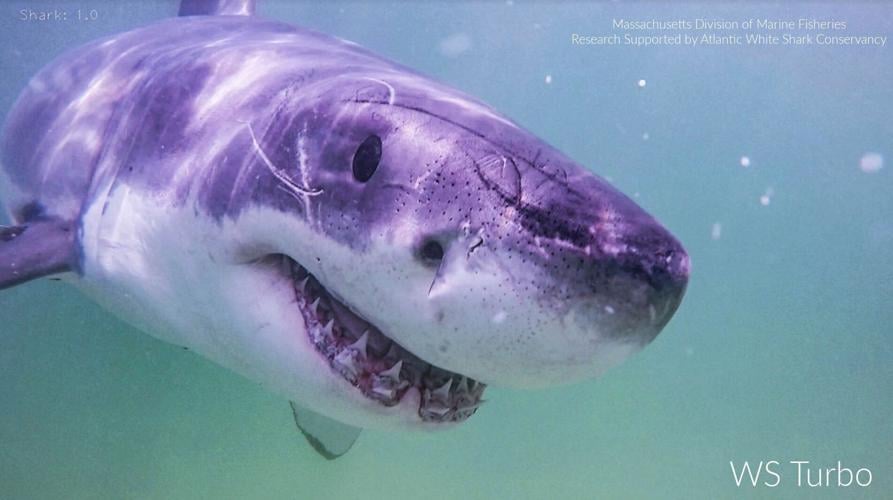
This undated image shows a great white shark, a species being seen more often in the chilly waters of New England and Canada.
The approximately 8-foot shark, seen off the beach town of Scarborough in July, surprised Clough but didn’t make him fear the ocean — though he admitted, “I’m not sure I’d want to go urchin diving now.”
Boaters, beachgoers and fishermen like Clough who spend time in the chilly waters of New England and Atlantic Canada are learning to live with great white sharks, the creatures made famous by the 1975 film “Jaws.” Sightings of the apex predators are up in places like Maine, where they were once very rarely seen.
Scientists link the white shark sightings to increased availability of the seals the sharks feast on, and say beachgoers are generally safe from shark bites. The sharks can grow close to 20 feet long, though most don’t get that big.
People are also reading…

David Lancaster, an avid fisherman who recently captured drone footage of a white shark off of Scarborough, Maine, motors out to sea Aug. 13 in Scarborough.
David Lancaster, a commercial clam digger in Scarborough, used a drone to get a look at an approximately 12-foot shark near the town’s famed beaches earlier this month. He described the animal as “magnificent” and “really amazing” to see. But he also said the shark’s presence reminded him that swimmers need to look out for the big fish.
Sightings of great whites off Cape Cod, Massachusetts, have become increasingly frequent in recent years, and the Atlantic White Shark Conservancy has documented hundreds of the animals over more than a decade. But new data shows the sharks are heading even farther north into New Hampshire, Maine and beyond, said Greg Skomal, a senior fisheries biologist with the Massachusetts Department of Marine Fisheries and a veteran white shark researcher.
The number of white sharks detected off Halifax, Nova Scotia, increased about 2.5 times from 2018 to 2022, according to a paper published by Skomal and others in May in the journal Marine Ecology Progress Series. Even farther north, the number detected in the Cabot Strait that separates Nova Scotia and Newfoundland increased nearly four times over, the paper said.

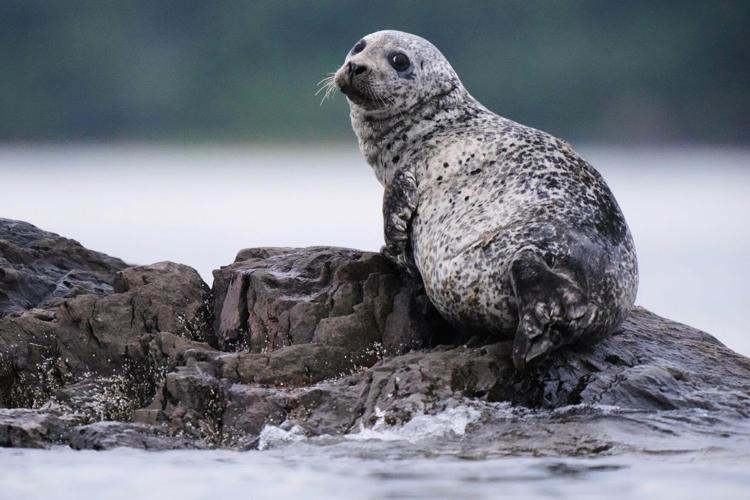
A harbor seal, a species favored by white sharks, rests on a small island Aug. 20 off of Portland, Maine.
Skomal said the average residency in these northern waters has also increased from 48 days to 70 days, suggesting that white sharks appear to be increasingly comfortable farther north.
A key reason for the shift seems to be the successful conservation of seals off New England and Canada via laws such as the Marine Mammal Protection Act, which allowed seals to thrive and provide a food source for the predatory sharks, Skomal said.
“It could be a function of a growing prey base,” Skomal said. “And that would be seals.”
Great white sharks also benefit from protections, including a ban on fishing for them in U.S. federal waters that has stood since 1997. They are still considered vulnerable by the International Union for the Conservation of Nature.
In Massachusetts, the marine fisheries department said it strengthened its fishing laws after fishermen in 2024 chose to target white sharks anyway. The state prohibited the use of certain kinds of heavy fishing gear in shoreline areas where white sharks are most commonly found.

Visitors enjoy the summer weather not far from recent sightings of white sharks Aug. 13 in Scarborough, Maine.
“We believe here in Massachusetts that targeting white sharks from the beach is not a safe practice,” Skomal said. “Not only because it could result in the death of the shark, but because it could be a public safety issue.”
Despite the size and strength of the sharks, dangerous encounters between white sharks and humans are rare. Worldwide, there have been fewer than 60 fatal great white shark bites on humans in recorded history, according to the International Shark Attack File at the Florida Museum of Natural History.
The first recorded fatal shark attack in Maine happened in 2020 when a great white shark killed 63-year-old Julie Dimperio Holowach off Bailey Island.
“It’s an exceedingly rare event. But we’re providing all of this information to mitigate human behavior and hopefully reduce any negative encounters between humans and sharks,” said Ashleigh Novak, research coordinator with the Atlantic White Shark Conservancy.
The growth of social media has made shark sightings go viral in recent summers. A smartphone app called Sharktivity allows shark spotters to report their sightings.
Lancaster, a surfer, said living with great whites is just something people in New England are going to have to adjust to.
“It’s crazy that they are around, as fishermen and surfers, and something we have to accept,” Lancaster said. “It’s in the back of your head, but you have to accept it.”
5 things you might not know about sharks
1. Humans vs. sharks
When it comes to humans versus sharks, the numbers are staggering. An average of 6 humans are killed worldwide each year by sharks, while humans kill 100 million to 273 million sharks annually, selling their body parts in markets around the globe.

A surfer rides the waves along Mexico's Pacific Coast near El Rancho village, Wednesday, May 28, 2008. Sharks have attacked three surfers in the area in less than a month, two fatally. (AP Photo/Eduardo Verdugo)
2. They're old
Sharks were swimming in the ocean depths long before dinosaurs climbed onto land. Researchers say sharks date back 400 million years.

In this March 16, 2011, photo children look at the Shark Jaw of a Megalodon, a prehistoric shark, at the Museum of Nature and Science in Dallas. The jaw is 11 feet wide and almost 9 feet tall, it consists of 182 teeth collected from South Carolina rivers. (AP Photo/Rich Matthews)
3. 465 species
There are 465 known species of sharks, ranging from the tiny spined pygmy shark (about 8 inches long) to the whale shark (about 50 feet in length). Each of these sharks plays a role in keeping other fish populations in check, which is why hunting and killing of sharks can create great imbalances in ocean life.

A diver feeds fish to a male whale shark at the Hakkeijima Sea Paradise aquarium-amusement park complex in Yokohama near Tokyo, Saturday, June 11, 2011.(AP Photo/Itsuo Inouye)
4. Not a 'miracle of evolution'
Richard Dreyfuss' character in "Jaws" claimed that the shark is "a miracle of evolution," and that the only thing it does is "swim and eat and make little sharks, that's all." That's not exactly correct.
Sharks have to eat, like every other living organism, but they don't mate until they are 12 to 15 years old. The females give birth to one or two pups at a time, making it difficult for the sharks' reproduction rates to keep pace with the annual kill rates.

FILE - In this Tuesday, July 3, 2012 photo, Rima Jabado, a marine scientist and shark researcher pulls up a baby spottail shark from the water for the tagging off the Dubai coast, United Arab Emirates. (AP Photo/Kamran Jebreili, File)
5. A sixth sense
Sharks are extraordinary hunters, who use six senses. In addition to smell, hearing, touch, taste and sight, they also are gifted with electroreception — special pores around their faces detect electrical currents from other organisms and allow them to deftly hone in on their prey.

A Sand Tiger Shark swims in its aquarium at the Zoo-Aquarium in Berlin, Germany, Tuesday, Nov. 9, 2010. (AP Photo/Michael Sohn)
Visit The Mercury News (San Jose, Calif.) at www.mercurynews.com
Distributed by Tribune Content Agency, LLC.