

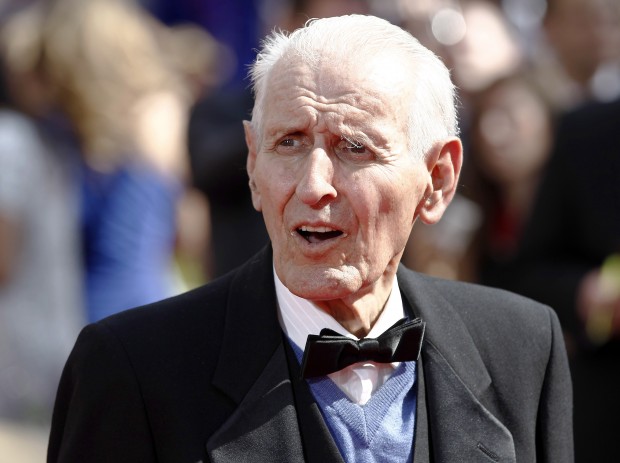
DETROIT - Jack Kevorkian, the audacious doctor who spurred on the national right-to-die debate with a homemade suicide machine that helped end the lives of dozens of ailing people, died Friday at a Detroit-area hospital after a brief illness. He was 83.
Kevorkian died at William Beaumont Hospital in Royal Oak, where he had been hospitalized since May with pneumonia and kidney problems. He suffered from a blood clot that traveled up from his leg, according to attorney Mayer Morganroth, who was present and said his friend was "totally in peace, not in pain."
"His medical directive was not to be given any CPR or continuing-life program." Morganroth said.
The retired pathologist, who said he injected lethal drugs that helped some 130 people die during the 1990s, likened himself to Martin Luther King and Gandhi and called prosecutors Nazis and his critics religious fanatics.
People are also reading…
He burned state orders against him, showed up at court in costume, called doctors who didn't support him "hypocritic oafs" and challenged authorities to stop him or make his actions legal.
"The issue's got to be raised to the level where it is finally decided," Kevorkian said during a broadcast of CBS' "60 Minutes" that aired a Lou Gehrig's disease patient's videotaped 1998 death as Kevorkian challenged prosecutors to charge him in the case that eventually sent him to prison.
Experts credit Kevorkian, who insisted that people had the right to have a medical professional help them die, with publicizing physician-assisted suicide. Even so, few states made it legal.
Laws went into effect in Oregon in 1997 and Washington state in 2009, and a 2009 Montana Supreme Court ruling effectively legalized the practice in that state.
"Somebody has to do something for suffering humanity," Kevorkian once said. "I put myself in my patients' place. This is something I would want."
In the end, however, he was too weak to take advantage of the option he offered others, said Geoffrey Fieger, Kevorkian's former attorney.
"If he had enough strength to do something about it, he would have," Fieger said at a news conference in Southfield. "Had he been able to go home, Jack Kevorkian probably would not have allowed himself to go back to the hospital."
The former prosecutor whose office convicted Kevorkian of second-degree murder said he found a trace of hypocrisy in Kevorkian's death.
"I assumed that someday he'd commit suicide and tape it and air it for the world to see," said David Gorcyca, who oversaw prosecutions in the Detroit suburbs of Oakland County.
People who died with Kevorkian's help suffered from cancer, Lou Gehrig's disease, multiple sclerosis, paralysis. They died in their homes, an office, a Detroit island park, a remote cabin and the back of Kevorkian's van.
Nicknamed "Dr. Death," Kevorkian catapulted into public consciousness in 1990 when he used his homemade "suicide machine" in his rusted Volkswagen van to inject lethal drugs into an Alzheimer's patient who sought his help in dying.
For nearly a decade, he escaped authorities' efforts to stop him. His first four trials, all on assisted suicide charges, resulted in three acquittals and one mistrial.
Murder charges in earlier cases were thrown out because Michigan at the time had no law against assisted suicide; the Legislature wrote one in response to Kevorkian. He also was stripped of his medical license.
Devotees filled courtrooms wearing "I Back Jack" buttons. But critics questioned his publicity-grabbing methods, aided by Fieger until the two parted ways before the 1999 trial in which Kevorkian was convicted of second-degree murder.
Fieger said Friday that Kevorkian didn't accept money and "never gained any wealth" for assisting in suicides, and he was sorry to see him imprisoned for his actions.


