

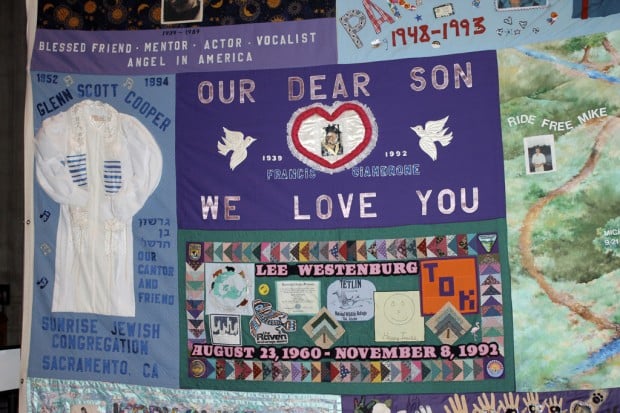
WASHINGTON - It's won an Oscar and was nominated for a Nobel Peace Prize. At 1.3 million square feet, it would take up nearly half the office space in the new One World Trade Center tower in lower Manhattan. It received a "Save America's Treasures" federal grant to preserve it for future generations.
When the AIDS Memorial Quilt was first displayed on the National Mall in October 1987, it included 1,920 panels. Now the quilt is too large to display in its entirety, and will be shown throughout the capital this week during the International AIDS Conference in Washington.
Each of its 3-by-6-foot panels - about the size of a human grave - tells the story of a person's life with the smallest biographical details. Favorite pieces of clothing. Stuffed animals. Poems. Paintings. Photographs.
But sewn together, the quilt's 48,000 panels convey the enormity of an epidemic that has killed hundreds of thousands of Americans over three decades - and millions more worldwide.
People are also reading…
Julie Rhoad, the executive director of the NAMES Project Foundation, an Atlanta-based nonprofit organization that serves as the quilt's custodian, calls it "the original piece of social media."
By literally stitching together the stories of people who died of AIDS, it brought together families and friends to bond over their shared grief and to create a lasting memorial.
"In fabric and thread, we connected people and built community," Rhoad said in an interview in the cavernous Washington National Cathedral, one of 50 locations around the nation's capital where the public can view the quilt. "Hopefully, it will inspire the next generation of this movement to end AIDS."
Much has changed in 25 years. When the quilt project began, few Americans understood that HIV, the virus that causes AIDS, was transmitted not through casual contact, but through unprotected sex, transfusions of HIV-tainted blood or injection with HIV-contaminated needles, or from an infected mother to her baby. And many mistakenly thought AIDS was a disease that affected only gay men and drug users.
Now, the treatments allow people to live for years with HIV at undetectable levels in their systems. The FDA this month approved a drug that has been shown to prevent HIV transmission. And researchers and activists are hopeful that a vaccine is not far away.
But as the AIDS Memorial Quilt demonstrates, it's taken an enormous toll. More than 600,000 Americans have died of AIDS, according to the national Centers for Disease Control and Prevention - as many people as there are residents of the nation's capital. More than 1 million Americans live with HIV. And while better treatments have made the disease more manageable, it killed more than 17,000 Americans in 2009, the most recent figure available.
Despite U.S. initiative, Uganda needs help / A23


