

It was the largest naval operation in history, an extraordinary assemblage of more than 1,000 combat ships and 124,000 U.S. sailors and Coast Guardsmen determined to wrest France back from the Nazis.
By the evening of the June 6, 1944, D-Day landing on the French beaches, after hours of hellish fighting, U.S. forces were firmly rooted on dry ground thanks in large measure to the guns of American destroyers blasting away at the Germans' formidable defenses.
"Thank God for the United States Navy" was the first message U.S. Army Maj. Gen. L.T. Gerow sent to Lt. Gen. Omar Bradley, a key Army invasion commander, after Gerow managed to plant his headquarters on Omaha Beach after that day's ferocious combat.
But as the 62nd anniversary of the pivotal Normandy invasion dawns today, there still exists no monument to the overall contributions of the U.S. Navy in turning the tide against Adolf Hitler's army, or to the 1,000 U.S. sailors who lost their lives in doing so.
People are also reading…
Long heralded for its pivotal role in the Pacific portion of World War II, the Navy has gotten far less note for its efforts on the opposite side of the world.
The Naval Order of the United States, a fraternal society of veterans of America's sea services and others, is determined to change that.
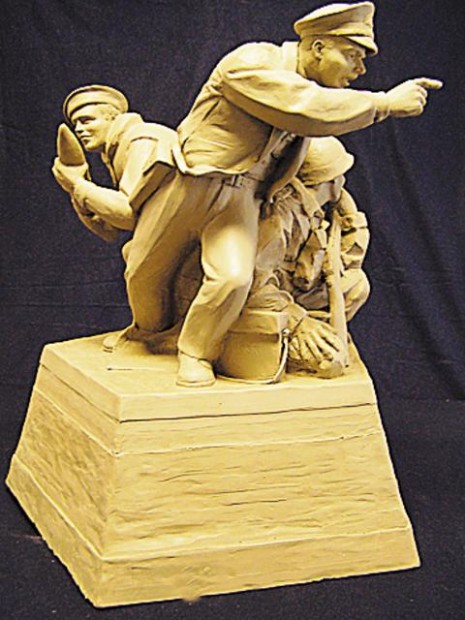
Now under way is a campaign to raise $500,000 for the U.S. Navy D-Day Monument, a 12-foot-tall bronze sculpture to be placed at a spot reserved for it by France at Utah Beach in Normandy, one of five sites stormed by Allied forces that day.
"It will bring long-overdue attention to the United States Navy's sacrifices on behalf of the troops that landed on D-Day . . . (and) focus attention on the heroic risks undertaken," said William Dudley, formerly the Navy's top historian.
The Navy assembled tens of thousands of U.S. sailors on hundreds of combat ships, 3,500 landing craft and at bases in advance of D-Day. They formed the bulk of the largest armada ever assembled.
Their job was to transport troops, artillery and vehicles from England to France, and then to shore at heavily fortified and mined beaches. After the invasion, as the fighting progressed inland, they kept the U.S. soldiers going with supplies, ammunition and other materiel, and shuttled the wounded to Navy hospital ships.
World War II historians credit the Navy with providing the firepower that helped defeat the Germans at Normandy — a battle that became the beginning of the end of Hitler's drive to dominate Europe.
Key were the actions of U.S. destroyers, which risked disaster on the offshore shoals to come within visual distance of German gun emplacements on land and batter the enemy with 5-inch guns.
Naval underwater demolition teams were equally pivotal — and little heralded, historians said. These sailors were among the first to hit the beaches, racing under heavy German fire to clear pathways through the deadly obstacles placed by German troops along the coastline. At Omaha Beach, these teams suffered a 52 percent casualty rate.
In all, the Navy ship toll included 148 landing craft, a troop transport, two destroyers, a destroyer escort and a mine-sweeper.
To honor these contributions and losses, the Navy D-Day monument will feature three realistic figures: a Navy captain taking charge, with charts and code books at his feet; a sailor holding a 5-inch shell; and a demolition team member carrying a rifle.
On the base of the monument will be the names of all Navy vessels that participated in the invasion.
Artist Stephen Spears of Fair Hope, Ala., designed the sculpture at his own expense. The son of a U.S. Air Force career airman, he said he is pouring his heart and soul into his work.
"It's an incredible honor to be part of it," Spears, 50, said.
If all goes as planned, the sculpture will be shipped to Normandy for a June 6, 2008, dedication. France will take care of the monument, paying for upkeep and repair.
Daniel Felger, a retired Navy commander and head of the fund-raising effort, said the project is infused with a sense of urgency, given the dwindling number of Navy and other World War II veterans.
"We've got to get this done before all of this generation passes," Felger said.
Naval Order of the United States, www.navalorder.org


