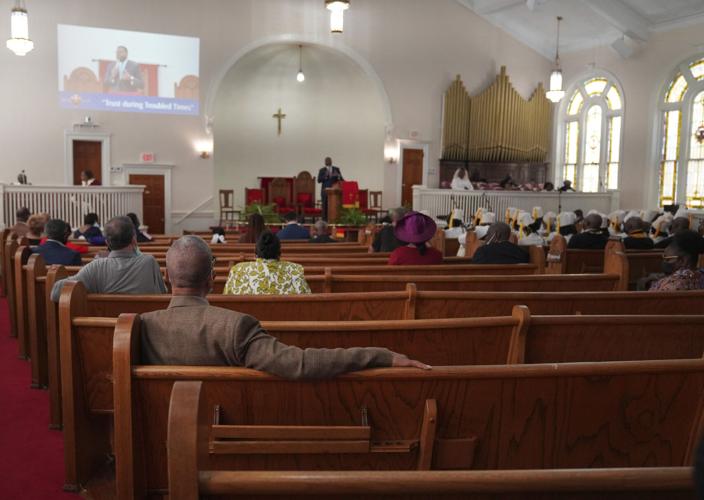
COLUMBIA, S.C. — The wide empty spaces in pews between parishioners at a Sunday service at Zion Baptist Church in South Carolina’s capital highlight a post-pandemic reality common among many Black Protestant churches nationwide.
At its heyday in the 1960s, more than 1,500 parishioners filled every seat at Zion. But membership at the historic church — a crucial meeting point for many during the Civil Rights Movement — dwindled over recent decades.

Congregants sit in largely empty pews during a service at Zion Baptist Church on April 16 in Columbia, S.C.
The trend has been accelerated by the COVID-19 pandemic, which infected and killed Black Americans at a disproportionate rate. Zion’s attendance dropped from 300 parishioners before the outbreak to 125 now.
Founded in 1865, Zion still has a choir capable of beautiful singing, but it also shrunk by more than half. The stomping of feet and the call-and-response of the leader and congregation have dimmed from what they were before the pandemic.
People are also reading…
“It saddens my heart,” said Calvernetta Williams, who has worshipped at Zion for 40 years. “The pastor has a lot of outreach to do, and so do we … because it’ll never be the same.”
Zion’s shrinking attendance is in line with a recent Pew Research Center survey; it found significant attendance drop among Black Protestants that is unmatched by any other major religious group. The number of Black Protestants who say they attend services monthly has fallen from 61% in 2019 to 46% now, said Pew, and they are the only group in which more than half (54%) attend services virtually.

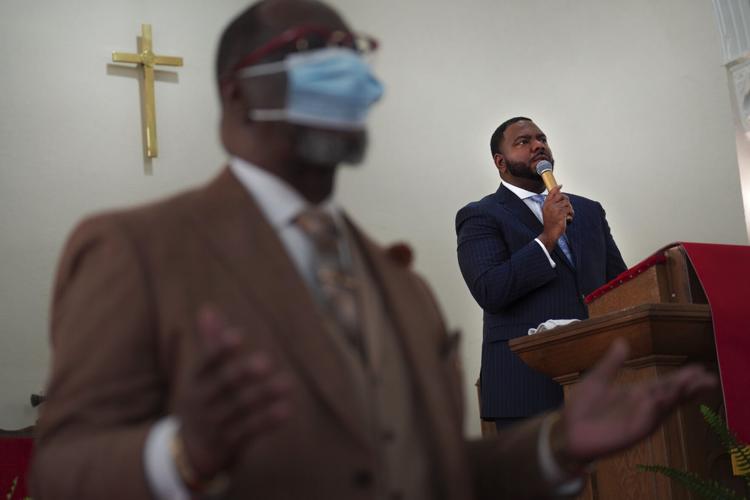
The Rev. M. Andrew Davis, right, leads worship service at Zion Baptist Church on April 16 in Columbia, S.C.
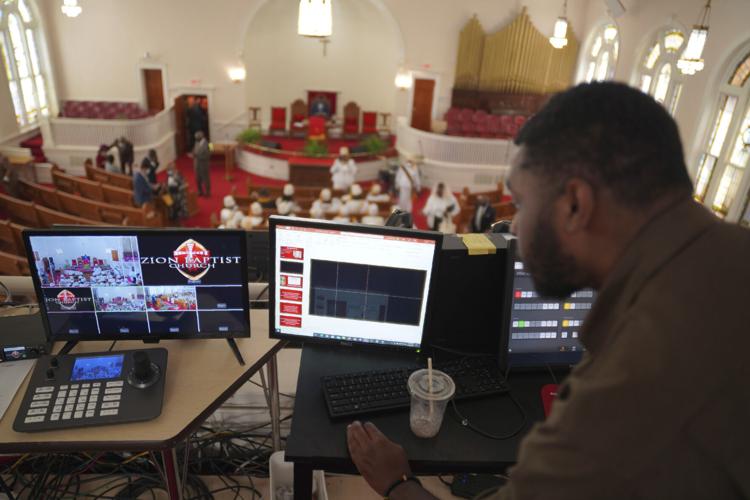
Zion broadcasts services online, produces digital content and is active on social media. But the Rev. M. Andrew Davis said his church’s virtual experience can’t match in-person interactions, including the smiles of children, and how sometimes older congregants share testimonials about how God healed them.
Davis’ sermon on a recent Sunday was titled: “Trust during times of trouble.” He recalled the pandemic as one the most challenging times in his church’s history – and offered words of hope. “We may not ever go back to the way it was, but we can do better,” Davis told parishioners.
Black Americans — two-thirds of whom are Protestant — attend church more regularly than Americans overall, and pray more often, surveys show. But patterns of worship are shifting across generations: younger Black adults attend church less often than their elders, and those who attend are less likely to do so in a predominantly Black congregation.
“It’s imperative that we get our young people back,” said Donnie Mack, a deacon at Zion. “As we say in old churches — if you don’t see any young people, if you don’t hear any babies crying, then, you’re at a dying church.”
Several Black church leaders said it’s proved difficult to convince members to return for in-person worship. They note that many congregants are older, have inadequate access to health care, and hesitate to return to church for fear of catching a contagious illness.
Black adults also suffer from higher rates of obesity, diabetes and asthma, making them more susceptible. They are also more likely to be uninsured.

Adrian Williams works as media tech for Zion Baptist Church on April 16 in Columbia, S.C.
Additionally, many Black working people had jobs deemed essential and were less able to work from home during the pandemic, raising concerns about exposing others in their often crowded households to the virus.
“The pandemic exasperated that,” said the Rev. Quardricos Driskell, pastor at Beulah Baptist Church in Alexandria, Virginia.
Attendance at his 160-year-old church dropped from a peak of more than 200 people who met in two Sunday services in the early 2000s, to less than half that at a single service. “We’re lucky if we have 100 on any given Sunday,” Driskell said.
Despite the attendance drop, academics, pastors and parishioners agree that churches remain fundamental to Black communities, providing refuge and hope.
“No pillar of the African American community has been more central to its history, identity, and social justice vision than the ‘Black Church,’” Harvard scholar Henry Louis Gates Jr. wrote in ‘The Black Church,’ his companion volume to the PBS series.
“For a people systematically brutalized and debased by the inhumane system of slavery, followed by a century of Jim Crow racism, the church provided a refuge: a place of racial and individual self-affirmation, of teaching and learning, of psychological and spiritual sustenance, of prophetic faith.”
Although there’s broad respect for the historical role of Black churches, including their crucial role fighting for racial equality, polls show that there’s also a perception among Black Americans that they have lost influence in recent decades.
“It still functions in the same way: It’s a source of hope for people who cannot hold on to political promises, they can’t necessarily go to the law and get the things that we need and give them the safety that we need,” said Tamura Lomax, professor of religious studies at Michigan State University who specializes in the Black church.
But attendance had been dwindling — even before the pandemic and the 2020 protests over racial justice — because the way people connected to the church had changed, Lomax said. A pivotal moment came when the Black Lives Matter movement was founded. Its members, she said, embraced some of the African spirituality and religious practices that were taken from their ancestors during enslavement and rejected the Christ-centered movement that had been pivotal to the civil rights struggle.
“They didn’t want to carry the patriarchal kind of Black masculinity leadership model,” Lomax said.
Religion in America
Racial justice

Members of the clergy lead protesters in a June 2, 2020, Prayerful Protest march for George Floyd in the Brooklyn borough of New York. Floyd died after being restrained by Minneapolis police officers on Memorial Day.
During nationwide protests, leaders from many religious traditions spoke out to support the peaceful goals of demonstrators. But in the months since, some segments — particularly within Christianity — have taken notably different approaches.
Leaders of the six seminaries within the Southern Baptist Convention released a statement in November decrying critical race theory, a broad term often used to describe critiques of societal racism, as “incompatible with” central tenets of the faith.
Meanwhile, members of other Christian denominations, including Episcopalians and United Methodists, are exploring reparations to African Americans in greater depth.
Catholics and the president

Joe Biden bows his head in prayer as he visits Bethel AME Church in Wilmington, Del., on June 1, 2020. Biden will be just the second Roman Catholic president in U.S. history, after John F. Kennedy.
Joe Biden will be just the second Roman Catholic president in U.S. history, after John F. Kennedy. But he has been viewed cautiously by the U.S. Conference of Catholic Bishops over his support for abortion rights.
Some argue Biden should be barred from partaking in Holy Communion, and the bishops conference has formed a working group to study how to deal with him.
However, there has been a relatively positive response from Cardinal Wilton Gregory, the archbishop of Washington. He says he won’t prevent Biden from receiving Communion and looks forward to cooperating on social issues where the president-elect’s views mesh with church teaching.
White House faith office

In this June 1, 2020, photo, President Donald Trump holds a Bible during a visit outside St. John's Church across Lafayette Park from the White House in Washington.
Donald Trump built close ties to conservative evangelicals even before his 2016 election, but he didn’t establish a formal White House faith operation until more than a year after his inauguration. His Faith and Opportunity Initiative has been led by Florida-based televangelist Paula White, a longtime spiritual adviser to Trump who later campaigned for his reelection.
While it’s not yet clear how Biden will set up and staff his own White House faith office, his choices will shape his administration’s approach to religious outreach. A recent report by the nonpartisan Brookings Institution recommended focusing on helping the needy by forming religious and nonreligious alliances, rather than elevating specific faith-based groups.
LGBTQ rights

Protesters gather on Hollywood Boulevard for a June 14, 2020, march organized by black members of the LGBTQ community in the Hollywood section of Los Angeles.
Under Trump there have been some rollbacks in civil rights protections for LGBTQ people that Biden is vowing to restore and expand. But that may prove complicated if Republican lawmakers and the Supreme Court, now with a solid conservative majority, endorse the arguments of religious conservatives that some of those protections infringe on religious liberty.
One example: a pending Supreme Court case in which a Catholic social services agency says it should be able to turn away same-sex couples who want to be foster parents while still receiving local government funding.
Religious conservatives also vow to oppose efforts by Democrats in Congress to pass the Equality Act, which would extend nationwide the comprehensive anti-bias protections already afforded to LGBTQ people in 21 mostly Democratic-governed states, covering such sectors as housing, public accommodations and public services.
Southern Baptists

Pastor Mike Leake of Calvary of Neosho, a Southern Baptist church, rests his head on his Bible as he prays during a Nov. 22, 2020, service in Neosho, Mo.
The Southern Baptist Convention, the country’s largest Protestant denomination, plans a national meeting in June after canceling it in 2020 due to COVID-19. A new SBC president will be elected at the meeting.
For now the only declared candidate is the Rev. Albert Mohler, president of the Southern Baptist Theological Seminary. He was critical of Trump in 2016 but gradually became a supporter as the president appointed conservative judges and advocated for religious liberty. Mohler is now warning that Biden’s administration will dismay many Southern Baptists with initiatives bolstering abortion rights and LGBTQ rights.
Disunited Methodists

A storm cloud approaches the Mequon United Methodist Church in Mequon, Wis., on Aug. 2, 2020.
The pandemic also forced the United Methodist Church to cancel a potentially momentous national meeting last May that’s now rescheduled for late August. The same topic will dominate the agenda: Whether America’s largest mainline Protestant denomination will split due to differences over inclusion of LGBTQ people.
Many congregations want to fully recognize same-sex marriage and ordain LGBTQ people as ministers, while conservatives want to maintain longstanding but sporadically enforced bans. Under one proposal, conservative congregations and regional bodies would be allowed to separate and form a new denomination while receiving $25 million in UMC funds and keeping their properties.
Muslim Americans' goals

In this June 5, 2020, photo, Muslim men pray at the Islamic Center of Greater Miami in Miami Gardens, Fla., social distancing and wearing masks, with some wearing gloves to guard against the new coronavirus.
Muslim American groups have lauded Biden’s plans to end Trump’s curbs on travel from several majority-Muslim nations. And after that, the nation’s diverse Muslim communities have other hopes for his administration.
Refugee admissions to the U.S. have plummeted, with a screening system led by several faith-based groups brought to a near halt as Trump slashed the annual refugee ceiling. Biden has pledged to raise it and to build a diverse administration that includes Muslim American voices.
The coronavirus

The Rev. Steven Paulikas, rector at All Saints Episcopal Church, delivers an evening prayer service over Facebook Live in the Brooklyn borough of New York on March 29, 2020. Even amid a mass coronavirus vaccine distribution effort, religious communities will continue to wrestle with the pandemic’s impact on in-person worship.
Even amid a mass vaccine distribution effort, religious communities will continue to wrestle with the pandemic’s impact on in-person worship.
Religious liberty advocates, particularly conservative ones, have criticized state and local restrictions as improperly hindering worship more than secular activities like shopping or dining. Other clerical leaders have embraced online services, saying keeping people safe should take precedence over traditions.
Biden illustrated the thorniness of the debate recently when he gave a short answer to a question about Americans’ ability to worship during the pandemic: That it should happen “safely.”