ATLANTA (AP) — They were led down a staircase into a garage beneath a downtown Atlanta courthouse, where officers with big guns were waiting. From there, they were ushered into vans with heavily tinted windows and driven to their cars under police escort.
For Emily Kohrs, these were the moments last May when she realized she wasn't participating in just any grand jury.
"That was the first indication that this was a big freaking deal," Kohrs told The Associated Press.
The 30-year-old Fulton County resident who was between jobs suddenly found herself at the center of one of the nation's most significant legal proceedings. She would become foreperson of the special grand jury selected to investigate whether then-President Donald Trump and his Republican associates illegally meddled in Georgia's 2020 presidential election. The case has emerged as one of Trump's most glaring legal vulnerabilities as he mounts a third presidential campaign, in part because he was recorded asking state election officials to "find 11,780 votes" for him.
People are also reading…

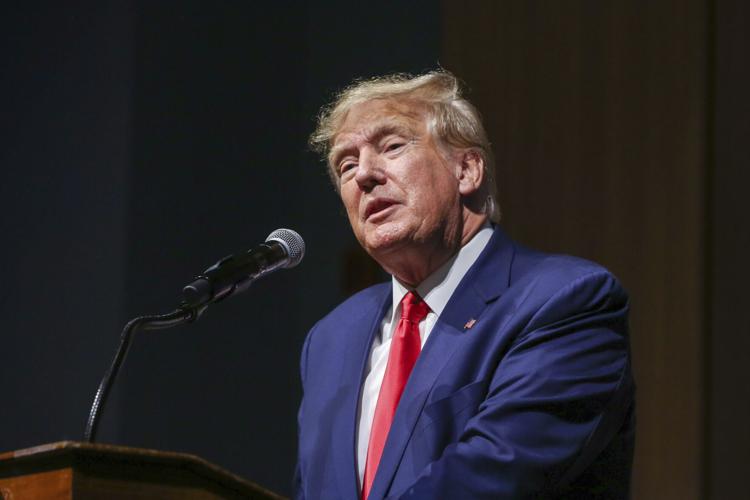
FILE - Former President Donald Trump speaks during the New Hampshire Republican State Committee 2023 annual meeting, Jan. 28, 2023, in Salem, N.H.
For the next eight months, Kohrs and her fellow jurors would hear testimony from 75 witnesses, ranging from some of Trump's most prominent allies to local election workers. Portions of the panel's final report released last Thursday said jurors believed that "one or more witnesses" committed perjury and urged local prosecutors to bring charges. The report's recommendations for charges on other issues, including potential attempts to influence the election, remain secret for now.
The AP identified Kohrs after her name was included on subpoenas obtained through open records requests. Fulton County Superior Court Judge Robert McBurney advised Kohrs and other jurors on what they could and could not share publicly, including in interviews with the news media.
During a lengthy recent interview, Kohrs complied with the judge's instructions not to discuss details related to the jury's deliberations. She also declined to talk about unpublished portions of the panel's final report.
But her general characterizations provided unusual insight into a process that is typically cloaked in secrecy.
Georgia Secretary of State Brad Raffensperger, who was on the receiving end of Trump's pressure campaign, was "a really geeky kind of funny," she said. State House Speaker David Ralston, who died in November, was hilarious and had the room in stitches. And Gov. Brian Kemp, who succeeded in delaying his appearance until after his reelection in November, seemed unhappy to be there.
Kohrs was fascinated by an explainer on Georgia's voting machines offered by a former Dominion Voting Systems executive. She also enjoyed learning about the inner workings of the White House from Cassidy Hutchinson, who Kohrs said was much more forthcoming than her old boss, former White House chief of staff Mark Meadows.

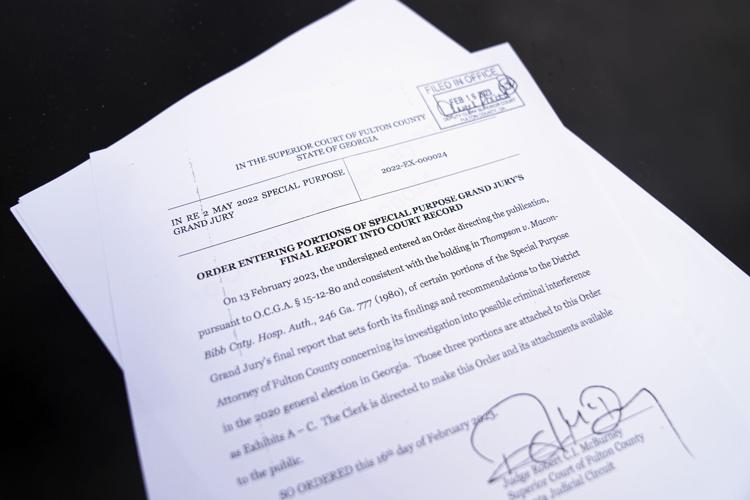
FILE - Portions of a report issued by a special grand jury looking into possible meddling in the 2020 election in Georgia are shown after being released on Feb. 16, 2023, in Atlanta.
Kohrs sketched witnesses in her notebook as they spoke and was tickled when Bobby Christine, the former U.S. attorney for Georgia's Southern District, complimented her "remarkable talent." When the jurors' notes were taken for shredding after their work was done, she managed to salvage two sketches — U.S. Sen. Lindsey Graham and Marc Short, who served as chief of staff to former Vice President Mike Pence — because there were no notes on those pages.
After Graham tried so hard to avoid testifying — taking his fight all the way to the U.S. Supreme Court — Kohrs was surprised when he politely answered questions and even joked with jurors.

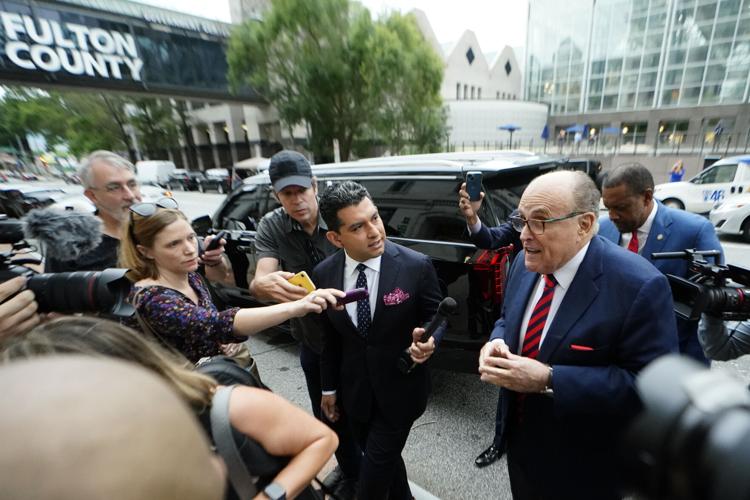
FILE - Rudy Giuliani arrives at the Fulton County Courthouse as a special grand jury looking into possible meddling in the 2020 election in Georgia continues on Aug. 17, 2022, in Atlanta.
Former New York mayor and Trump attorney Rudy Giuliani was funny and invoked privilege to avoid answering many questions but "genuinely seemed to consider" whether it was merited before declining to answer, she said.
When witnesses refused to answer almost every question, the lawyers would engage in what Kohrs came to think of as "show and tell." The lawyers would show video of the person appearing on television or testifying before the U.S. House committee that investigated the Jan. 6, 2021, riot at the U.S. Capitol, periodically asking the witness to confirm certain things. Then the scratching of pens on paper could be heard as jurors tallied how many times the person invoked the Fifth Amendment.
At least one person who resisted answering questions became much more cooperative when prosecutors offered him immunity in front of the jurors, Kohrs said. Other witnesses came in with immunity deals already in place.
Trump's attorneys have said he was never asked to testify. Kohrs said the grand jury wanted to hear from the former president but didn't have any real expectation that he would offer meaningful testimony.
"Trump was not a battle we picked to fight," she said.

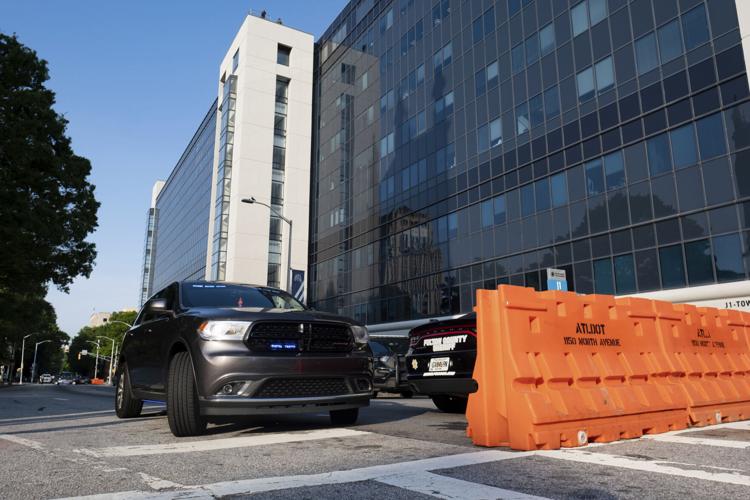
FILE - Roads around the Fulton County Courthouse in Atlanta are closed May 2, 2022, before the beginning of jury selection to seat a special purpose grand jury to look into possible meddling in the 2020 election in Georgia.
Kohrs didn't vote in 2020 and was only vaguely aware of controversy swirling in the wake of the election. She didn't know the specifics of Trump's allegations of widespread election fraud or his efforts to reverse his loss. When prosecutors played the then-president's phone call with Raffensperger on the first day the jurors met to consider evidence, it was the first time Kohrs had heard it.
"I just want to find 11,780 votes, which is one more than we have," Trump said on the call.
Though Kohrs said she tends to agree more with Democrats, Kohrs said she doesn't identify with any political party and prefers to listen to all opinions.
"If I chose a political party, it would be the not-crazy party," she said.
Kohrs called herself a "geek about the justice system" and noted the challenges some jurors faced balancing their responsibilities on the panel with outside duties. When she eagerly volunteered to be foreperson, she met no resistance from her fellow jurors, who were less enthusiastic about the time-consuming obligation stretching before them, she said.
One of her first duties as foreperson was to sign a big stack of subpoenas.
As the proceedings played out, one of her fellow jurors brought the newspaper every day and pointed out stories about the investigation. Prosecutors, Kohrs said, told jurors they could consume news coverage related to the case but urged them to keep an open mind.

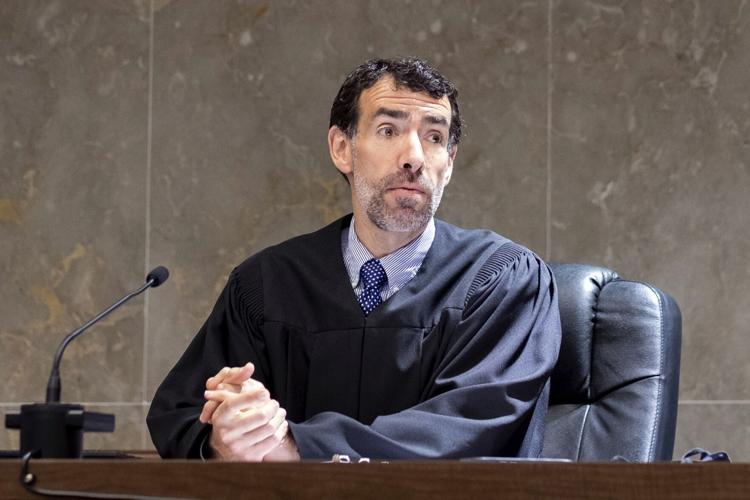
FILE - Fulton County, Ga., Superior Court Judge Robert McBurney instructs potential jurors during proceedings to seat a special purpose grand jury on May 2, 2022, in Atlanta.
Kohrs said she mostly avoided stories related to the proceedings to avoid forming an opinion.
"I didn't want to characterize anyone before they walked in the room," she said. "I felt they all deserved an impartial listener."
Of the 26 people on the panel — 23 jurors and three alternates — 16 had to be present for a quorum. There was a core group of between 12 and 16 who showed up almost every day they were in session, Kohrs said, and she could recall only one day when they couldn't proceed because not enough seats were filled. The most they ever had in the room was 22 — on the day Giuliani testified.
As the months passed, the grand jurors grew more comfortable with each other and with the four lawyers on Fulton County District Attorney Fani Willis' team who led the proceedings. But they're not all best friends now that it's over.
"We are not meeting up now. We don't have a group chat," Kohrs said.
While the jurors asked to hear from certain witnesses, most witnesses were decided upon by the district attorney's office. But Kohrs said she didn't feel as though prosecutors were trying to influence the jurors' final report.
"I fully stand by our report as our decision and our conclusion," she said.
* * *
11 searing moments of Jan. 6: From 'an attempted coup' to chaos
'An attempted coup'

The first hearing, aired in prime time and watched by more than 20 million viewers, set the stage for the next seven.
It laid out the conclusion that the panel would come back to in every hearing: that Trump conspired to overturn his own defeat, taking actions that sparked the violent insurrection at the Capitol on Jan. 6, 2021, when hundreds of his supporters beat police and broke through windows and doors to interrupt the certification of Biden’s victory.
“January 6th was the culmination of an attempted coup, a brazen attempt, as one rioter put it shortly after January 6th, to overthrow the government,” said the committee chairman, Rep. Bennie Thompson, D-Miss. “The violence was no accident. It represents seeing Trump’s last stand, most desperate chance to halt the transfer of power.”
'Carnage' at the Capitol

Capitol Police Officer Caroline Edwards (pictured), one of two witnesses at the first hearing, described what she saw outside the Capitol on Jan. 6 as a “war scene.” As some Republicans, including Trump, have tried to play down the violence of the insurrection, calling it “peaceful,” Edwards recalled the brutality she experienced on the front lines. She suffered a traumatic head injury that day as some of the first protesters barreled through the flimsy bike rack barriers that she and other officers were trying to hold.
“I couldn’t believe my eyes,” Edwards testified. “There were officers on the ground. You know, they were bleeding. They were throwing up. … It was carnage. It was chaos.”
'Detached from reality'

The committee has used clips of its interview with former Attorney General Bill Barr (pictured) in almost every hearing, showing the public over and over his definitive statements that the election was not stolen by Biden — and Barr's description of Trump’s resistance as he told the president the truth.
At the second hearing, the committee showed a clip of Barr recalling how he told Trump to his face that the Justice Department had found no evidence of the widespread voter fraud that Trump was claiming. Barr said he thought Trump had become “detached from reality” if he really believed his own theories and said there was “never an indication of interest in what the actual facts were.”
“And my opinion then and my opinion now is that the election was not stolen by fraud and I haven’t seen anything since the election that changes my mind on that,” Barr said.
A tense conversation

One question going into the hearings was what Trump and Vice President Mike Pence talked about in a phone call the morning of Jan. 6. The conversation came after Trump had pressured his vice president for weeks to try and somehow object or delay as he presided over Biden’s certification. Pence firmly resisted and would gavel down Trump's defeat — and his own — in the early hours of Jan. 7, after rioters had been cleared from the Capitol.
While only Trump and Pence were on the Jan. 6 call, White House aides filled in some details at the committee’s third hearing by recounting what they heard Trump say on his end of the line.
“Wimp is the word I remember,” said former Trump aide Nicholas Luna. “You’re not tough enough,” recalled Keith Kellogg, Pence’s national security adviser. “It became heated” after starting out in a calmer tone, said White House lawyer Eric Herschmann.
“It was a different tone than I’d heard him take with the vice president before,” said Ivanka Trump.
40 feet away

Encouraged by Trump’s tweet, after the attack had started, that Pence “didn’t have the courage to do what should have been done,” rioters at the Capitol singled out the vice president. Many chanted “Hang Mike Pence!” as they moved through the building. Pence evacuated the Senate just minutes before the chamber was breached, and later was rushed to safety as rioters were just 40 feet away.
Greg Jacob, the president’s lawyer, testified at the third hearing and said he had not known they were that close.
Jacob said Secret Service agents wanted them to leave the building but Pence refused to get in the car. “The vice president didn’t want to take any chance” that the world would see him leaving the Capitol, Jacob said.
'I will not break my oath'

At the committee’s fourth hearing, state officials detailed the extraordinary pressure the president put on them to overturn their states’ legitimate and certified results. Rusty Bowers (pictured), Arizona’s House speaker, told the committee how Trump asked him directly to appoint alternate electors, falsely stating that he had won the state of Arizona and not Biden.
Bowers detailed additional calls with Trump lawyer Rudy Giuliani. “I will not do it,” Bowers told him, adding: “You are asking me to do something against my oath, and I will not break my oath.”
Lives upended

Georgia election workers Wandrea “Shaye” Moss (left) and her mother, Ruby Freeman, also testified in the fourth hearing, describing constant threats after Trump and his allies spread false rumors that they introduced suitcases of illegal ballots and committed other acts of election fraud. The Justice Department debunked those claims.
The two women said they had their lives upended by Trump’s false claims and his efforts to go after them personally. Through tears, Moss told lawmakers that she no longer leaves her house.
In videotaped testimony, Freeman said there is “nowhere I feel safe” after the harassment she experienced.
Justice Department resists the scheme

When his efforts to overturn his defeat failed in the courts and in the states, Trump turned his focus to the leadership of the Justice Department.
Richard Donoghue (right), the acting No. 2 at the time, testified about his resistance to entreaties by another department official, Jeffrey Clark, who was circulating a draft letter recommending that battleground states reconsider the election results. Trump at one point floated replacing then-acting Attorney General Jeffrey Rosen (center) with Clark, but backed down after Donoghue and others threatened to resign.
“For the department to insert itself into the political process this way, I think would have had grave consequences for the country,” Donoghue testified. “It may very well have spiraled us into a constitutional crisis.”
'They're not here to hurt me'

In a surprise sixth hearing, former White House aide Cassidy Hutchinson (pictured) recounted some of Trump’s actions on Jan. 6, including his dismissive response when told that some in the crowd waiting for him to speak outside the White House were armed.
“I was in the vicinity of a conversation where I overheard the president say something to the effect of, ‘I don’t effing care that they have weapons,’” Hutchinson said. “'They’re not here to hurt me. Take the effin’ mags away. Let my people in. They can march to the Capitol from here.'”
Upset that the crowd didn’t appear larger, Trump told his aides to take the metal-detecting magnetometers away. In the coming hours, he would step on the stage and tell them to “fight like hell.”
Hutchinson also described Trump’s anger after security officials told him he couldn’t go to the Capitol with his supporters after he had told them he would. She said she was told that the president even grabbed the steering wheel in the presidential SUV when he was told he couldn’t go.
For the president to have visited the Capitol during Biden’s certification, and as his supporters descended on the building, would have been unprecedented.
'Unhinged' White House meeting

At its seventh hearing, the committee painstakingly reconstructed a Dec. 18 meeting at the White House where outside advisers to Trump pushing election fraud claims clashed with White House lawyers and others who were telling him to give up the fight.
The six-hour meeting featured profanity, screaming and threats of fisticuffs, according to the participants, as Trump lawyer Sidney Powell and others threw out conspiracy theories, including that the Democrats were working with Venezuelans and that voting machines were hacked. Pat Cipollone (pictured), the top White House lawyer, testified that he kept asking for evidence, to no avail.
Hours later, at 1:42 a.m., Trump sent a tweet urging supporters to come for a “big protest” on Jan. 6: “Will be wild,” Trump promised.
187 minutes

The final hearing focused on what Trump was doing for 187 minutes that afternoon, between his speech at the rally and when he finally released a video telling the rioters to go home at 4:17 p.m.
They showed that Trump was sitting at a dining room table near the Oval Office, watching Fox News coverage of the violence. But he made no calls for help — not to the Defense Department, the Homeland Security Department or the attorney general — even as his aides repeatedly told him to call it off.
In the video released at 4:17 p.m., as some of the worst of the fighting was still happening down the street, Trump told rioters to go home but said they were “very special.”
The committee showed never-before-seen outtakes of a speech Trump released on Jan. 7 in which he condemned the violence and promised an orderly transition of power. But he bristled at one line in the prepared script, telling his daughter Ivanka Trump and others in the room, “I don’t want to say the election is over.”