

WASHINGTON — Think it's hard for schools to get bad teachers out of the classroom? It turns out that teachers agree.
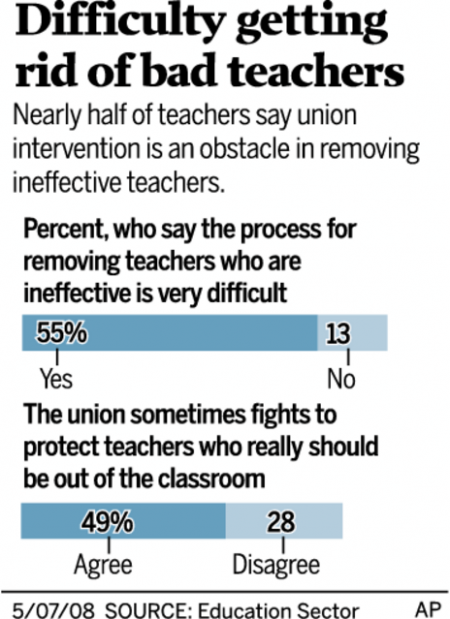
More than half of teachers believe it's too difficult to weed out ineffective teachers who have tenure, and nearly half say they personally know such a teacher, according to a survey released Tuesday evening by the Education Sector, a non-partisan think tank.
Tenure provides teachers with job security and generally is awarded a few years after educators enter the profession. It's supposed to ensure that teachers can't be fired at the whim of a principal or angry parent.
But it also can make it extremely difficult to fire a teacher who is doing a bad job, said Sabrina Silverstein, a Chicago pre-kindergarten teacher.
"Even in the best schools, you'll find one teacher who probably shouldn't be there. It takes a lot for a principal to get rid of a teacher," Silverstein said in an interview with The Associated Press.
People are also reading…
Most teachers think the evaluation process for new teachers should be strengthened, so that weak teachers don't become entrenched.
About 70 percent of teachers in the Education Sector survey said receiving tenure was just a formality that has little to do with teacher quality.
Only a quarter said their own most recent evaluation was "useful and effective."
Teachers are generally observed in class one or two times a year by busy administrators. In many districts, tenured teachers aren't observed annually.
Even when they occur, teachers say their evaluations are rarely rigorous.
A study of Chicago public schools last year found that more than 90 percent of teachers received one of the top two possible evaluation ratings — superior or excellent. Hardly any received the bottom two ratings — satisfactory or unsatisfactory.
Principals said they thought it was pointless to give critical judgments of tenured teachers. They also said they didn't want to deal with the grievance process that often accompanies poor evaluations, according to the report by the New Teacher Project, a non-profit organization focused on teacher quality.
The role of principals has to change if evaluations are to be improved, said Harvey Polansky, the school superintendent in Milford, Conn.
"Our principals must be instructional leaders rather than managers," he said in an interview. "Find someone else to deal with school lunches."
High school Principal Jill Martin of Colorado Springs, Colo., agrees. "There isn't adequate time to observe and really understand the full picture of what's happening in any given teacher's classroom," Martin said.
She and other administrators in her district have tried to address the problem by conducting regular classroom "walk-throughs" in which they randomly drop in on teachers for a few minutes at a time and offer feedback.
"Management by walking around is what you'd call it in the business world," she said.
In recent years, some educators have been looking to Toledo, Ohio — a district served by about 2,000 teachers — for ideas on how to make evaluations meaningful. There, experienced teachers evaluate first-year teachers and also help determine the fate of seasoned teachers who get poor reviews from their principals.
Dal Lawrence, a past president of the teachers association there, said that since the program was put in place in 1981, about 450 teachers have been dismissed after bad evaluations. Most were non-tenured teachers, but just under 100 had tenure, Lawrence said.
Lawrence said that is a higher dismissal rate than can be found in most other districts.


