Today, Muslims across the United States will begin observing another pandemic Ramadan.
But this year's holy month -- marked by fasting, prayer, reflection and community -- will be different than the last, as vaccines are now available and some Covid restrictions have been lifted.
Keep scrolling for photos from the start of Ramadan around the world
Still, health experts and community groups warn it's not completely safe to share suhoor, iftar and taraweeh with friends and family. They're urging followers to mark Ramadan with caution, and have even issued guidance.
Here's what they want you to know:
Vaccines are halal and won't break your fast
The National Muslim Task Force on COVID-19 (NMTF) and the National Black Muslim COVID Coalition (NBMCC) have issued a Ramadan advisory urging Muslims to continue vaccinations through the holy month. The advisory was signed by 24 Muslim community organizations.
People are also reading…
The three available vaccines -- Johnson & Johnson, Pfizer/BioNTech and Moderna -- are halal and will not break your fast, the organizations said in a joint news release.

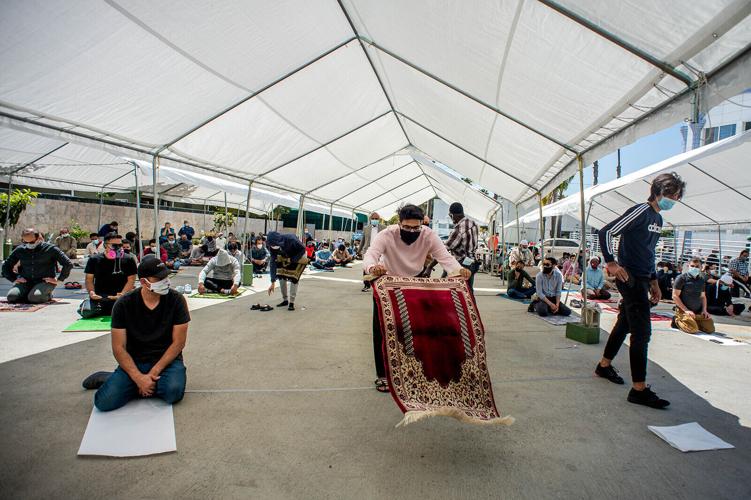
Men attend socially distanced Friday afternoon prayers in the parking lot of King Fahad Mosque in Culver City, California, on Friday, April 9, 2021.
Muslim scholars, including the Fiqh Council of North America and the Assembly of Muslim Jurists of America, have also ruled that vaccines will not invalidate fasts.
The Pfizer/BioNTech and Moderna vaccines do not contain pork or alcohol and were not made using aborted fetal stem cells, NMTF and NBMCC said in the release.
The Johnson & Johnson vaccine does use cell lines from aborted fetal stem cells, but many Islamic leaders have said its use is still permissible "given the societal and individual health needs to prevent the spread of the COVID-19 virus," according to the release.
Dr. Hasan Shanawani, president of American Muslim Health Professionals (AMHP), said Muslims should not delay their vaccinations, even if they believe it will break fast.
"If you still feel the vaccine will invalidate your fast, still get the vaccine, and then make up that lost day after Ramadan," Shanawani told CNN.
Only go to the mosque if you're vaccinated
Shanawani said only fully vaccinated people should attend mosque prayers.
Although AMHP has not urged mosques to require proof of vaccination, Shanawani believes it's a good idea.

Men attend socially distanced outdoor prayers in Culver City, California.
"I would personally advocate for vaccine passports at this time," he said. "Mosques should limit how many people are coming for group prayers by asking them to demonstrate that they've been vaccinated."
More than 187 million vaccine doses have been administered across the United States, according to the US Centers for Disease Control and Prevention (CDC). But until the country reaches herd immunity, the risk of infection remains a distinct possibility.
Dr. Anthony Fauci, director of the National Institute of Allergy and Infectious Diseases, has estimated herd immunity might be reached if 70%-85% of people are inoculated.
Complicating the matter are reports of new Covid variants. The B.1.1.7 variant, for example, is more contagious, may cause more severe disease and is also potentially more deadly.
Hosting large gatherings of unvaccinated congregants under such conditions is a "very big risk," Shanawani said.

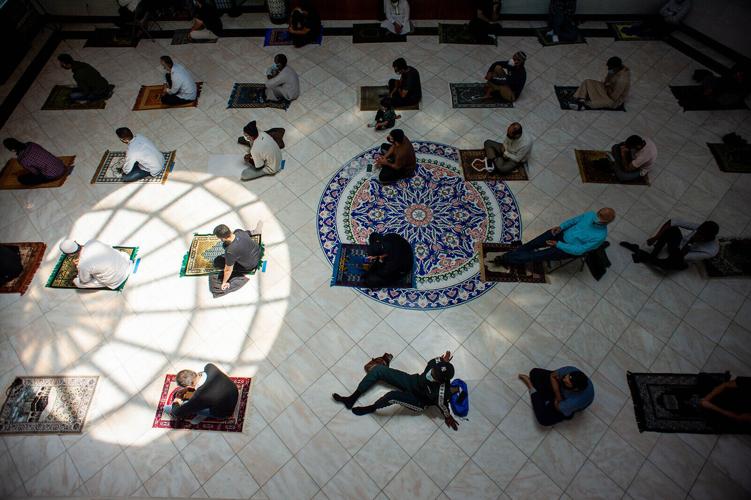
Men space out their prayer rugs during prayers at King Fahad Mosque in Culver City, California.
You can still gather for iftar and taraweeh
It's customary for Muslims to gather for suhoor (first meal of the day), iftar (first meal after sunset) and taraweeh (nightly communal prayers) with friends and family.
Health officials say it's still possible -- so long as you keep your circle small and follow health protocols.
According to CDC guidance, fully vaccinated people can:
- Visit other fully vaccinated people indoors without masks or physical distancing.
- Visit indoors with unvaccinated people from a single household without masks or physical distancing, if the unvaccinated people are at low risk for severe disease.
- Skip quarantine and testing if exposed to someone who has Covid-19 but is asymptomatic, but should monitor for symptoms for 14 days.
Still, fully vaccinated people must:
- Wear a mask and keep good physical distance around the unvaccinated who are at increased risk for severe Covid-19, or if the unvaccinated person has a household member who is at higher risk.
- Wear masks and physically distance when visiting unvaccinated people who are from multiple households.
Anyone not fully vaccinated should avoid gathering with people outside of their household, the CDC says.
If you do go to mosque, be smart about it
NMTF and NBMCC have issued guidance for Muslims -- unvaccinated and vaccinated -- who insist on attending mosque prayers and events during the pandemic.
It won't guarantee health and safety, but it is better than carrying on as if there's no risk.
The groups advise followers:
- Don't go the mosque if you feel sick or are at a higher risk for Covid-19.
- Make wudu (ablution) at home.
- Maintain six feet of social distancing at all times.
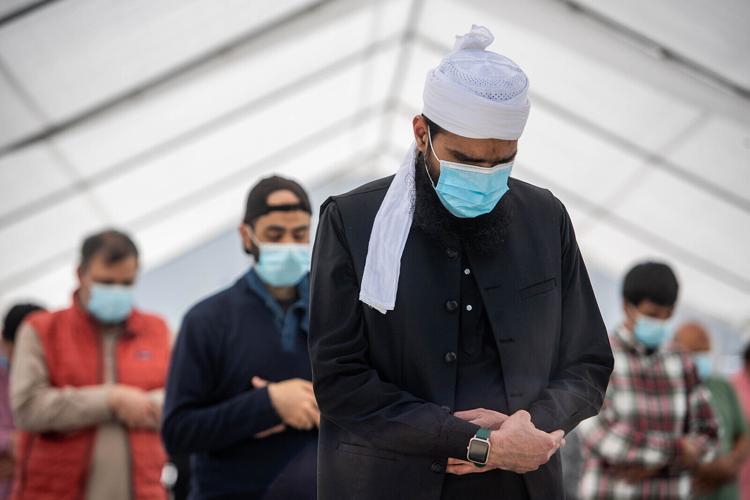
- Wear a face mask the entire time you're at the mosque.
- Regularly sanitize or wash your hands.
- Bring your own prayer rug.
- Pray outside when possible.
Shanawani said Muslims should remember that some of Ramadan's most important lessons are "patience and persistence."
"Muslims around the world have faced natural disasters, wars and huge displacement, and they lasted for much longer than a year," he said. "I know we want to go back to a sense of normalcy but we need to wait a little longer, even if it means another year of being at home during Ramadan."
Photos: The start of Ramadan around the world

A Muslim prays on the first day of the holy fasting month of Ramadan, at a mosque in Kabul, Afghanistan, Tuesday, April 13, 2021. Ramadan is marked by daily fasting from dawn to sunset, ending with the Islamic holiday of Eid al-Fitr. (AP Photo/Rahmat Gul)

Muslim pilgrims circumambulate around the Kaaba, the cubic building at the Grand Mosque, during the minor pilgrimage, known as Umrah, marking the holy month of Ramadan, in the Muslim holy city of Mecca, Saudi Arabia, Tuesday, April 13, 2021. During Ramadan, the holiest month in Islamic calendar, Muslims refrain from eating, drinking, smoking and sex from dawn to dusk. (AP Photo/Amr Nabil)

Women stand in line waiting their turn outside a government office to receive cash under the government's Ehsaas Emergency Cash program for families in need, ahead of the Muslim fasting month of Ramadan, in Peshawar, Pakistan, Tuesday, April 13, 2021. (AP Photo/Muhammad Sajjad)

A woman wearing a face mask as a precaution against coronavirus outbreak reads holy book of Quran while waiting for the time to break their fast during the first day of Ramadan, at a mosque in Jakarta, Indonesia, Tuesday, April 13, 2021. Muslims began marking Ramadan with communal prayers Tuesday in a socially distanced contrast to the empty mosques of a year ago when Islam's holiest month coincided with the start of the coronavirus pandemic. (AP Photo/Tatan Syuflana)

A man takes a nap on the floor of a mosque amid physical distancing markings while waiting for the time to break their fast during the first day of Ramadan in Jakarta, Indonesia, Tuesday, April 13, 2021. Muslims began marking Ramadan with communal prayers Tuesday in a socially distanced contrast to the empty mosques of a year ago when Islam's holiest month coincided with the start of the coronavirus pandemic. (AP Photo/Tatan Syuflana)

Indonesian men take a nap on the floor of a mosque amid physical distancing markings while waiting for the time to break their fast during the first day of Ramadan in Jakarta, Indonesia, Tuesday, April 13, 2021. Muslims began marking Ramadan with communal prayers Tuesday in a socially distanced contrast to the empty mosques of a year ago when Islam's holiest month coincided with the start of the coronavirus pandemic. (AP Photo/Tatan Syuflana)

A Muslim reads the Quran before an evening prayer called "tarawih" during the first evening of the holy fasting month of Ramadan at Chicago's Muslim Community Center on Monday, April 12, 2021. (AP Photo/Shafkat Anowar)

Muslims pray during the first dawn prayers of the Islamic holy month of Ramadan, around the Kaaba, the cubic building at the Grand Mosque, as they keep social distancing to help curb the spread of the coronavirus, in the Muslim holy city of Mecca, Saudi Arabia, Tuesday, April 13, 2021. During Ramadan, the holiest month in Islamic calendar, Muslims refrain from eating, drinking, smoking and sex from dawn to dusk. (AP Photo/Amr Nabil)

People pray at the Eyup Sultan Mosque, in Istanbul, Monday, April 12, 2021, a day before Ramadan. Turkey's President Recep Tayyip Erdogan was forced to announce renewed restrictions following a spike on COVID-19 cases, such as weekend lockdowns and the closure of cafes and restaurants during Ramadan, the holy Muslim month, starting on April 13. (AP Photo/Emrah Gurel)

People pray at the Eyup Sultan Mosque, in Istanbul, Monday, April 12, 2021, a day before Ramadan. Turkey's President Recep Tayyip Erdogan was forced to announce renewed restrictions following a spike on COVID-19 cases, such as weekend lockdowns and the closure of cafes and restaurants during Ramadan, the holy Muslim month, starting on April 13. (AP Photo/Emrah Gurel)

A Palestinian man holds a ladder for another man stringing colored lights on the eve of the Muslim holy month of Ramadan in the Old City of Jerusalem, Monday, April 12, 2021. (AP Photo/Maya Alleruzzo)

Customers enjoy their dinner specially constructed domes to ensure social distancing as a way to help stop the spread of the coronavirus, at a restaurant in Istanbul, Monday, April 12, 2021. Turkey has been posting record-high single-day COVID-19 cases for the past 10 days.Keen to minimise repercussions on its ailing economy and under intense pressure by services industry, Turkey's President Recep Tayyip Erdogan eased COVID-19 measures in early March. With the spike, he was forced to announce renewed restrictions, such as weekend lockdowns and the closure of cafes and restaurants during Ramadan, the holy Muslim month, starting on April 13.(AP Photo/Emrah Gurel)

A man wearing a face mask sits inside a restaurant with Ramadan decorations in Beirut, Lebanon, Monday, April 12, 2021. Muslims are facing their second Ramadan in the shadow of the pandemic. Many Muslim majority countries have been hit by an intense new coronavirus wave. While some countries imposed new Ramadan restrictions, concern is high that the month's rituals could stoke a further surge. (AP Photo/Hassan Ammar)

A Palestinian vendor hangs decorative lights in preparation for the holy Muslim month of Ramadan, at a shop in Jerusalem's Old City, Monday, April 12, 2021. (AP Photo/Mahmoud Illean)

In this photo taken using slow shutter speed, Muslim women offer an evening prayer called "tarawih" marking the first eve of the holy fasting month of Ramadan at Istiqlal Mosque in Jakarta, Indonesia. Monday, April 12, 2021. During Ramadan, the holiest month in Islamic calendar, Muslims refrain from eating, drinking, smoking and sex from dawn to dusk. (AP Photo/ Achmad Ibrahim)

Indonesian Muslims pray spaced apart as they practice social distancing to curb the spread of the new coronavirus during an evening prayer called "tarawih" marking the first eve of the holy fasting month of Ramadan at Istiqlal Mosque in Jakarta, Indonesia. Monday, April 12, 2021. During Ramadan, the holiest month in Islamic calendar, Muslims refrain from eating, drinking, smoking and sex from dawn to dusk. (AP Photo/ Achmad Ibrahim)

A child lies on the ground as Muslims pray during an evening prayer called "tarawih" marking the first eve of the holy fasting month of Ramadan at Chicago's Muslim Community Center on Monday, April 12, 2021. (AP Photo/Shafkat Anowar)
CNN's Jen Christensen contributed to this report.