

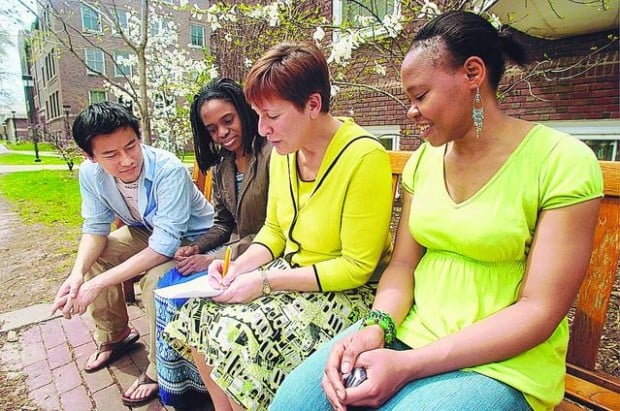
A week from Saturday, 453 new graduates will cross the commencement stage on the lawn of Macalester College in St. Paul, Minn. Among them: Nokuthula Sikhethiwe Kitikiti, Udochukwu Chinyere Obodo, and Baitnairamdal Otgonshar.
Jayne Niemi will be ready.
No-oo-TOOL-a SEE-kay-tee-way Ki-tee-ki-tee. Oo-DO-chu-koo CHIN-yea-ray Oh-boe-doe. Bat-NAI-ram-dal OT-gone-shar.
Niemi's job is to read out the graduates' names without mangling them.
"People invest a lot of time and money and commitment to be here at Macalester and get this education, and they get one day of celebration in the end," says Niemi, a college registrar who will spend several days studying pronunciation cards submitted by students. "Their families are here from all over the world. I don't want to embarrass them or the college."
People are also reading…
Niemi is part of a cadre of deans, professors and even outsourced professional public speakers that is gearing up to perform one of academia's quirkier, and tougher, jobs — getting every name right, so nobody leaves campus feeling angry or ungenerous toward his or her alma mater.
Their efforts are a big deal to students like Shadi Rajai Zumut. When he graduated from high school in Texas, the reader flubbed his name so badly his family didn't recognize it.
Now a senior at Baylor University, he recently e-mailed the officials planning the May 17 commencement there a pronunciation guide (SHAH-dee Rah-JAH-ee ZOO-muht), imploring them to get it right.
"I thought my name personified me. It was unique. It was different from everybody else," Zumut says, explaining why he resisted suggestions when he was younger to Americanize his name to something like "Chad," and why it's so important to him that Baylor say it correctly.
Some commencement name-readers volunteered for the job; others were volunteered by superiors. The job is no breeze. Reading out hundreds of even simple names over several hours, under a hot sun and in an academic gown, takes stamina. And nearly 600,000 foreign students are at U.S. colleges, along with an ever-more-diverse group of American students.
Pity James deJongh (pronounced dee-YUNG), a commencement reader at the fantastically diverse City College of New York. Among the names on his list this year: Agnieszka Wojcik-koba, Georges Ndbashimiye and Johana P. Ponikiewski. (That's VOY-chik-KO-ba, En-da-bashi-MEE-yeh, and Pon-yeh-CUE-ski.)
Niemi (that's pronounced NEE-mee) says Macalester faculty members actually take bets on which names will trip her up.
Sue Alexander, retiring dean of students at Wheaton College in Massachusetts who will perform her duties May 17 for the 21st and final time, prepares by walking beside the student lineup during rehearsal, calling out names and asking for help.
"Often they say something like, 'Never mind, it doesn't matter,' because they're so used to having it butchered over the years," she says. "I say, 'No, no, tell me how your mother or grandmother would pronounce it.' "
Technology can help. Marist College has deans record the names ahead of time, then uses sophisticated computer software to edit and broadcast them in sync with the students.
Technology has been a godsend for Gary Kates, a dean at Pomona College in California.
Pomona now has students pronounce their names on MP3 files, and Kates has several weeks to listen to them, which has lessened his anxiety.
Kates cites a searing experience of the sort that drives many name-readers to pursue perfection — a heartbreaking letter from a first-generation college student whose name he got wrong.
But the greatest anxiety often comes from Asian and African names, particularly in tongues such as Xhosa, a South African tribal language that uses a clicking sound most Westerners can't replicate.
"I was practicing in the shower, and I was practicing in the car," Macalester's Niemi says, recalling one student with such a name. But on the big day she froze up. She just couldn't summon the click.
"I just told him, 'Please come up here and say it yourself, so people can know how beautiful it is,' " she says.
The audience gave a big cheer.
On StarNet: Read more education coverage in StarNet's blog, "On Campus," at go.azstarnet.com/on campus


