

CAPE CANAVERAL, Fla. — Space shuttle Atlantis' 12-day mission was marked with exhausting days, minor aggravations and one big success: a 17 1/2-ton addition to the international space station, complete with an enormous new set of solar panels.
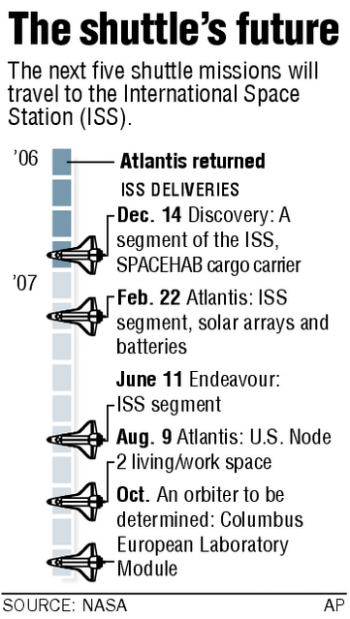
But the real payoff is coming up. With its first space station construction job since the Columbia disaster complete, NASA is on an ambitious schedule to perform 14 similar missions in just four years.
Atlantis and its six astronauts safely returned from a 12-day mission Thursday morning.
"We are rebuilding the kind of momentum that we had in the past and we're going to need if we're going to finish the space station because we have an awesome task ahead of us," said NASA Administrator Michael Griffin.
The setbacks NASA suffered when space shuttle Columbia broke apart on re-entry in 2003 have left work on the orbiting space lab on a tight schedule. NASA's three shuttles — the only spaceships cavernous enough to haul the multi-ton space station sections — will be retired in 2010, when NASA will begin focusing on sending humans to the moon and later to Mars.
People are also reading…
Space shuttle Discovery is set for liftoff in December on the next flight of a construction sequence that Griffin described as "a little simpler than building an aircraft while you fly it, but not a lot."
The shuttle landing was a day later than planned because NASA ordered up extra inspections after mysterious pieces of debris were spotted floating outside. Engineers had feared the spacecraft's heat shield had been damaged, but the inspections found nothing wrong, and the descent through the atmosphere was trouble-free.
"We were not very concerned," Jett said afterward. "We just assumed whatever objects we saw had come from the payload bay. What we were trying to do is make the folks on the ground comfortable."
NASA managers were impressed with how good Atlantis' heat shield looked after passing through the fiery heat and friction of Earth's atmosphere.
The success of Atlantis' flight may allow NASA to relax a requirement that shuttles be launched in daylight so that they can be photographed for any damage. The space agency may also reconsider the need for further design changes to the external fuel tank to prevent foam insulation from breaking off.
NASA has spent three years and two test flights trying to fix the foam — the very problem that doomed Columbia in 2003 — and the triumph of Atlantis shows that the space agency is "back into a more operational tempo," Griffin said.
Atlantis' flight was bookended by delays. The launch was scrubbed four times in two weeks because of a lightning bolt that hit the launch pad, Tropical Storm Ernesto and problems with the electrical system and a fuel gauge.


