

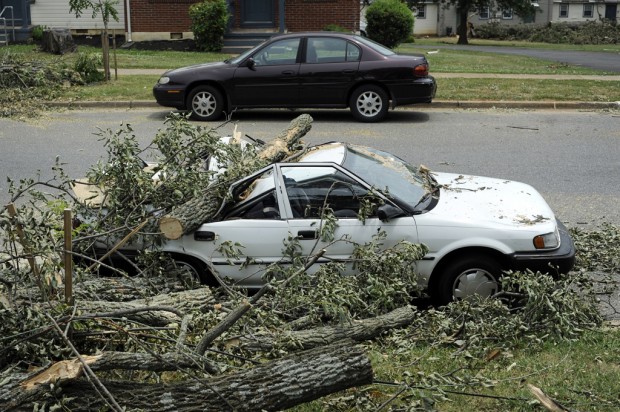
WASHINGTON - Is it just freakish weather or something more? Climate scientists suggest that if you want a glimpse of some of the worst of global warming, take a look at U.S. weather in recent weeks.
Horrendous wildfires. Oppressive heat waves. Devastating droughts. Flooding from giant deluges. And a powerful freak wind storm called a derecho.
These are the kinds of extremes experts have predicted will come with climate change, although it's far too early to say that is the cause. Nor will they say global warming is the reason 3,215 daily high temperature records were set in the month of June.
Scientifically linking individual weather events to climate change takes intensive study, complicated mathematics, computer models and lots of time. Weather is always variable; freak things happen.
So far this year, more than 2.1 million acres have burned in wildfires, more than 113 million people in the U.S. were in areas under extreme heat advisories last Friday, two-thirds of the country is experiencing drought, and earlier in June, deluges flooded Minnesota and Florida.
People are also reading…
"This is what global warming looks like at the regional or personal level," said Jonathan Overpeck, professor of geosciences and atmospheric sciences at the University of Arizona. "The extra heat increases the odds of worse heat waves, droughts, storms and wildfire. This is certainly what I and many other climate scientists have been warning about."
Kevin Trenberth, head of climate analysis at the National Center for Atmospheric Research in fire-charred Colorado, said these are the very record-breaking conditions he has said would happen, but many people wouldn't listen.
As recently as March, a special report an extreme events and disasters by the Nobel Prize-winning Intergovernmental Panel on Climate Change warned of "unprecedented extreme weather and climate events." Its lead author, Chris Field of the Carnegie Institution and Stanford University, said Monday, "It's really dramatic how many of the patterns that we've talked about as the expression of the extremes are hitting the U.S. right now."
"What we're seeing really is a window into what global warming really looks like," said Princeton University geosciences and international affairs professor Michael Oppenheimer. "It looks like heat. It looks like fires. It looks like this kind of environmental disasters."
Since Jan. 1, the United States has set more than 40,000 hot temperature records, but fewer than 6,000 cold temperature records, according to the National Oceanic and Atmospheric Administration. Through most of last century, the U.S. used to set cold and hot records evenly, but in the first decade of this century America set two hot records for every cold one, said Jerry Meehl, a climate extreme expert at the National Center for Atmospheric Research. This year the ratio is about 7 hot to 1 cold.
While at least 15 climate scientists told The Associated Press that this long hot U.S. summer is consistent with what is to be expected in global warming, history is full of such extremes, said John Christy at the University of Alabama in Huntsville. He's a global warming skeptic who says, "The guilty party in my view is Mother Nature."
But the vast majority of mainstream climate scientists, such as Meehl, disagree: "This is what global warming is like, and we'll see more of this as we go into the future."
Online
• Intergovernmental Panel on Climate Change report on extreme weather: ipcc-wg2.gov/SREX
• U.S. weather records:


