

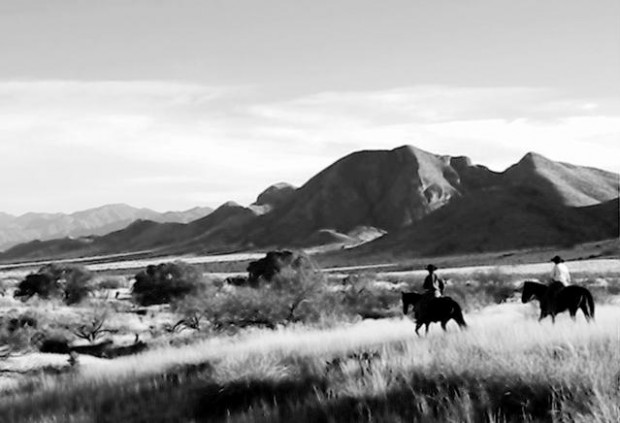
Desert grasslands that are Pima County's richest, biologically, are about to be bought and preserved.
By the end of this month, the county will close on the first installment of its purchase of the Sands Ranch, a collection of thick, lush and tall grasslands near where Pima, Santa Cruz and Cochise counties come together.
It's a 5,040-acre parcel located in Pima County's southeast corner, between the Santa Rita and Whetstone mountains, complete with landscapes that could have been taken right out of cowboy movies.
The Board of Supervisors voted unanimously last week to buy the ranch for $21 million.
The property has been owned by the same family, of ranching pioneer Louis Sands, since 1920.
This will be the 11th time that Pima County has dipped into open-space bonds to buy a ranch in the past decade. When the Sands Ranch is acquired, the county will have spent $95 million on ranches, out of about $140 million spent of $201 million in bonds that voters approved for open space in 1997 and 2004.
People are also reading…
The final payment for the Sands Ranch is due in six months.
This could be the most strategic purchase the county has made with its open-space bond money, said Diana Freshwater, director of a land trust group that helped negotiate the deal with the ranchers.
The ranch lies in a transition zone between the Sonoran and Chihuahuan deserts, at elevations between 4,800 and 5,800 feet. It's bounded on the west by Las Cienegas National Conservation Area, on the east by Coronado National Forest, on the north by state land, and on the south by the Santa Cruz County line. It's not far from the crossroads of state highways 83 and 82.
The ranch isn't broken up by any state land, whose future use and status is always in question because of state constitutional requirements that the land reap maximum value for public schools, said Freshwater, director of the Arizona Land and Water Trust.
The purchase will fill in a missing link of heretofore private land between the publicly owned Santa Rita Mountains on the west and the Whetstone Mountains on the east, she said.
Plus, the land is rated Class A grasslands by The Nature Conservancy, the only such grasslands in Pima County and one of only two in Southeastern Arizona. The other is in the Sulphur Springs Valley near Willcox.
Class A, the highest of three categories, contains virtually intact native grasslands with relatively few invasive grasses. Less than 10 percent of the Sands property is covered with shrubs.
"It is a beautiful piece of property, and it was bittersweet, I have to say," said Marilyn Harris, a granddaughter of Louis Sands. Harris is responsible for the property's overall management.
"When I walked out of the county board meeting, I felt very happy that we had done it, that the land is going to stay in the same way, probably in better condition than when my grandfather bought it," said Harris. "The part that was bittersweet is that it was part of a family legacy that we would no longer own."
Under the sale agreement, the family can keep ranching for at least another 10 years, she said. The agreement has a renewal clause to let them keep ranching for another decade after that.
"Let's face it, none of us were getting any younger," Harris said. "It was an opportunity to preserve the land and also have some remuneration."
Harris, one of four family members active as partners for the ranch, said the family said "no" to developers a couple of times in the past.
"These offers came at the height of the real estate frenzy," she said. "We'd get people calling us frequently, wanting to talk about buying part of it or all of it. We didn't want to be left with part of a ranch. Plus, it would really bother me if that property were to develop."
The partners met with planners to look at the potential for environmentally sensitive development — how to keep "the lay of the land" — but ultimately chose not to sell for development, Harris said. The family runs cattle on 64,000 acres of private, state and federal land in the three Southeastern Arizona counties.
Typically, desert grasslands such as these support a greater variety of species than any other desert ecosystem, according to the county's report on the purchase.
Of 35 vulnerable species that the county's Sonoran Desert Conservation Plan proposes to protect, one — the Rufous-winged sparrow — has been seen on this ranch. Seven others have a high probability of occurring there, said a county-financed biological report on the property.
The property is rippled with washes and canyons, which have riparian corridors that support dense stands of Emory and Arizona white oak, juniper, velvet ash, lemonade berry and mountain mahogany.
In a natural rock pond in one of the canyons, a mud turtle was seen swimming, but for such a short time that researchers couldn't tell if it was a Sonora or yellow mud turtle.
The presence of a mud turtle makes it possible that the endangered Chiricahua leopard frog or the more common but still troubled lowland leopard frog could be there, the report said. The turtle's presence also shows that the ranch has wetland-dependent creatures and suggests that other aquatic species may be surviving there.
The researchers spotted about a dozen native grass species on the ranch during a two-day visit in late October.
But they also found negative effects from nearly a century of grazing that the report said appeared to have affected water drainage, soil, vegetation and wildlife.
Directly, the grazing appears to be changing the grassland species, reducing or eliminating native, perennial bunch grasses and most other ground vegetation, the report said.
"Such areas have also been trampled, pulverizing the topsoil," it added. "These areas are prime areas for subsequent erosion, loss of topsoil and eventual head-cutting for gullies of various sizes."
In less severely affected areas, the grassland species have shifted toward less palatable varieties and in some cases have helped invasions of undesirable shrubs such as burroweed, broom snakeweed, velvet mesquite or silverleaf nightshade, the report said. But many places still contain seeds for potential restoration because the original native grasses may still exist amid cactus stands that protect them from grazing animals, it continued.
The property's livestock ponds have both desirable and undesirable effects, the report said. Water and vegetation attract birds, frogs and toads, but they also concentrate livestock — which leads to trampling and elimination of adjacent ground vegetation, the report said.
Rancher Harris was "somewhat shocked" by that part of the biological report, she said.
"For probably the last 10 years, the family has been working with people at the University of Arizona, the Forest Service and the Natural Resource Conservation District. We have monitored our grasses and our rangeland. We do that once a year," she said.
"We've collected data about the amount of moisture. We plot these different parts of the ranch for growth and how much of the grasses have been consumed. We're concerned about the rangeland health. We worked with all the experts and all the right people, and they feel we are doing the right thing," Harris said.
She said she doesn't necessarily think the county-hired biologists were inaccurate in their findings — "I think it is just their opinion."
DID YOU KNOW
Louis Sands, founder of the Sands Ranch, was born in Manistee, Mich., in 1875 and became a turn-of-the-century Arizona pioneer. He arrived in Flagstaff in 1902, where he contracted to build and enlarge sawmills. Several years later he acquired grazing privileges at the head of a nearby canyon, and he bought a farm in Glendale in the Phoenix area in 1907.
He developed extensive farming operations in Glendale and started buying Southeast Arizona land in 1919 when he acquired the Mattie Canyon ranch near Elgin. He later traded part of that property for Mescal Springs on the south slopes of the Whetstone Mountains, and eventually bought two other ranches in that area.


