

The guy in shorts on the beater bicycle with the empty child seat looks mildly out of place waiting in line with the big trucks at Gate 2 of Tucson Electric Power Co.'s generating plant on East Irvington Road.
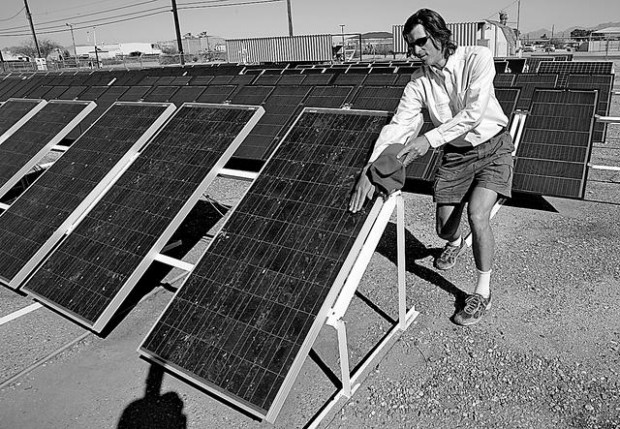
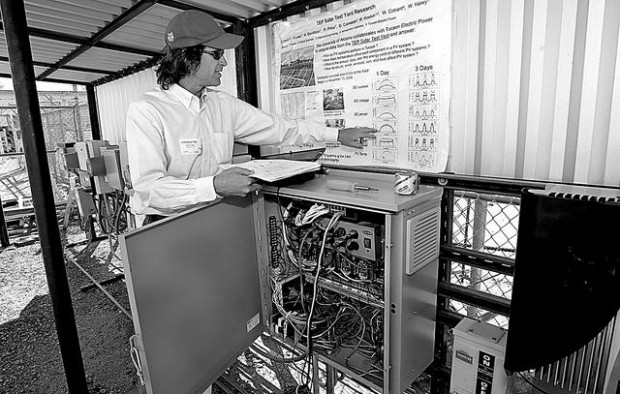
Alex Cronin is here to check on the measuring devices he and his students have placed on an array of solar panels just inside the gate.
Cronin, an atomic physicist, has built machines that measure matter waves on the subatomic level.
Measuring the temperature and the electrical output from a variety of solar devices, as you might suspect, is child's play for Cronin, but he's convinced careful measurement will lead to solving the grand challenges of solar energy generation.
He sums them up with the mnemonic CREST — cost, reliability, efficiency, storage and transmission.
People are also reading…
Currently, solar energy costs too much to compete with energy developed from fossil fuels. The reliability of recently developed systems is untested. The efficiency of solar panels, working in a system, is only 11 percent or 12 percent. Storage is needed because the resource is only available when the sun is shining. The problem of how to send power efficiently from where the sun is shining to where it is not also needs solving.
That will all take many years and many minds, says Cronin, but careful measurement is an important step.
Measurement was the reason Tucson Electric Power built this test lot of more than 600 photovoltaic panels from 20 manufacturers, beginning in 2003.
TEP took daily measurements. The system installed by Cronin and three graduate students will provide a second-by-second record of a variety of factors, including weather conditions that affect the light getting to the panels and the heat that affects their efficiency. It will be able to compare the output of a variety of panels under different conditions and eventually recommend the best products for our climate.
TEP didn't learn enough from its measurements to make those recommendations, said TEP spokesman Joe Salkowski. It did learn enough from this yard and a higher-altitude test facility in Springerville to locate its first solar-generating facility in those cooler climes.
It might seem odd that sunny Tucson would be the loser in that comparison. Conversion of the sun's energy to electricity through a photovoltaic process takes a lot of sunshine, and Springerville has less of it than Tucson.
But Tucson also has more heat and conventional solar panels, made mostly from silicon, which don't work well at high temperatures — losing up to 24 percent of their efficiency, said Salkowski.
"We determined that our customers' money would be better spent investing in a large solar array in Springerville," said Salkowski. "It's not as sunny in Springerville as it is in Tucson, but our energy output there is still greater than we would realize in town."
Salkowski said TEP also noticed an odd phenomenon at Springerville. Energy production from its panels peaks at times during cloudy days.
Cronin said he's measured the same effect in Tucson in just four months of operation. When light is hitting the panels from the edge of a cloud, he said, the combination of direct and refracted sunlight produces a power boost.
All of these effects, carefully measured, could provide clues to the efficiency puzzle, said Cronin.
If nothing else, the data will tell researchers which brands and combinations of panels and inverters work best here, said UA physics graduate student Dan Cormode, who developed the software program to measure these various arrays on a second-by-second basis.
What works best in Silicon Valley isn't necessarily the best panel for Tucson, he said.
"There are a lot of ways to define what's the best solar panel," said Cormode.
Cronin, a University of Arizona associate professor in physics and optical sciences, has plans to expand the experiment. He is collaborating with Tucson solar company Solon to install a new array of panels mounted on tracking devices that will follow the sun's path.
Other UA researchers, working under the umbrella of the Arizona Research Institute for Solar Energy (AZRISE), will use Cronin's data to predict the output of photovoltaic energy under different atmospheric conditions and to experiment with new types of materials and different approaches to collecting the sun's energy.
TEP ratepayers are funding the research under a special tariff set aside for renewable energy projects.
In addition to the panels themselves, Cronin wants to experiment with the inverters that change the direct current produced by the panels into the alternating current that feeds into a home or the electrical grid. He'd like to experiment as well on storage systems.
Cronin said he got involved in the project for its usefulness. "As a physics researcher, it is deeply satisfying to work on something that has a payback to society," Cronin said.
The payback? "I like the planet we live on. I hope we leave a thoughtful planet to our society and our children."
Cronin first got interested in intense measurement of solar panel efficiency two years ago when he had a photovoltaic system installed at his university-area home
He used cold towels to cool down his panels, for instance, and then climbed off his roof to measure the effect.
It was less than optimal. With this yard, he has the opportunity to carefully control factors in future experiments.
Nick Davidson, who had taken an honors course in optics and thermodynamics from Cronin, said his motivation for taking a job building and hooking up the measuring devices was simply "to work with one of my favorite professors."
Davidson, a senior physics major, said he also hopes that his work will lead to some gains in solar energy efficiency. "Given time and the research funds, solar can become a viable alternative to fossil fuels, not the complete solution to our problems, but it can help," Davidson said.


