

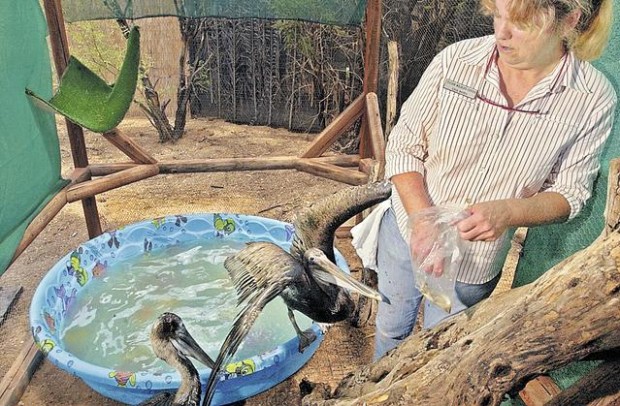
The accidental march of the penguins, er, pelicans, starts each year with monsoon winds from Mexico, and sometimes ends with a fight for life in the dry Arizona desert.
And for this year's crop of directionally-challenged birds, their Arizona misadventure is all the more arduous because the agency that normally comes to their rescue is undergoing renovations. And the agency helping them this year, instead, is being handicapped by the drought.
The pelicans accidentally get caught on a stream of monsoonal wind at the Sea of Cortez and find themselves in Tucson and Southern Arizona. Once here, they need to be rehabilitated before they are sent to Sea World in San Diego and released back to their Pacific Ocean habitat.
The Arizona-Sonora Desert Museum usually plays a big role in saving some of these young endangered brown pelicans, but this year, because of construction at the museum, it has been unable to take in the confused and distressed birds. Last summer the Desert Museum helped rehabilitate more than 26 of the birds, said museum spokeswoman Mary Powell-McConnell
People are also reading…
The Tucson Wildlife Center has helped rescue the birds the past few years, but right now they need all the help they can get. The center is tight on housing space for the birds, they need a lot of fish to feed them and, of course, a lot of water.
Lisa Bates, center president, said it's the busy season for other animals in need of help, which makes the space shortage that much worse. The center, at 13275 E. Speedway, has a variety of animals in rehab right now, ranging from coyotes to bobcats, raccoons to javelina.
The center uses a well for its water supply, but the well has gone dry in the drought, Bates said.
"It's very difficult to keep the pelican's pools cleaned and filled" with a water shortage, she said.
This isn't the first time the well has gone dry, she said, but it's more of a problem when pelicans need help.
The center is hoping for donations to help pay for the water they are trucking in, as well as flights to get the birds back to the ocean. The flights can be expensive, and several airlines won't or can't take animals when it's as hot as it is now. It is safest for the birds to travel via airplane when the outdoor temperature is 85 degrees or lower, Bates said.
The center is rehabilitating two pelicans right now and has helped three others this year, Bates said.
"When we get a big group of them, preferably we have someone drive them over (to Sea World)," said Elissa Ostergaard, an urban wildlife specialist for the Arizona Department of Game and Fish.
The Desert Museum often drives part way and meets someone from Sea World who takes the birds the rest of the trip. "We can't take them across the border so we take them to Sea World," Powell-McConnell said. "They have a pelican pen there, and they take the group out and release them."
Even with drivers, Bates is looking for people who are planning the one-hour flight to San Diego sometime soon.
If the birds could travel in the passenger compartment of an airplane, it would help avoid the heat they would be exposed to in the cargo area of an airplane, which is cooled only when the airplane is in flight, she said.
The Wildlife Center stepped in because construction of a new education center at the Desert Museum is near the area where the rehabilitating birds are kept and is too disruptive, Powell-McConnell said.
As soon as the roof construction is finished for the education center, which Powell-McConnell said is scheduled for completion at the end of the month, the museum will be able to start taking in pelicans again.
Last year was a big year for pelican breeding, which means more young ones end up in the desert. Powell-McConnell estimated about 75 to 100 pelicans made their way to the desert in 2005. During years in which fewer young pelicans hatch or survive in Baja California, fewer will end up here, she said.
The monsoon storm winds blow the younger pelicans toward Arizona, the ones who have less endurance and poorer navigation skills, Bates said.
Occasionally though, an adult will end up here during a winter storm, and El Niño years also blow the birds this way, Powell-McConnell said.
"Pelicans stay in the Baja area, Puerto Peñasco, if they don't get caught up on wind," Powell-McConnell said.
On StarNet: Find the latest wildlife-related coverage, as well as a searchable database on spending per species in the state of Arizona and videos at azstarnet.com/wildlife
● Tucson Wildlife Center, 24 hours a day, 290-WILD (290-9453)
● Arizona Department of Game and Fish, 628-5376 or the department's Tucson-area rehabilitation office, 903-1104
● Arizona-Sonora Desert Museum help line, 883-1380, ext. 313


