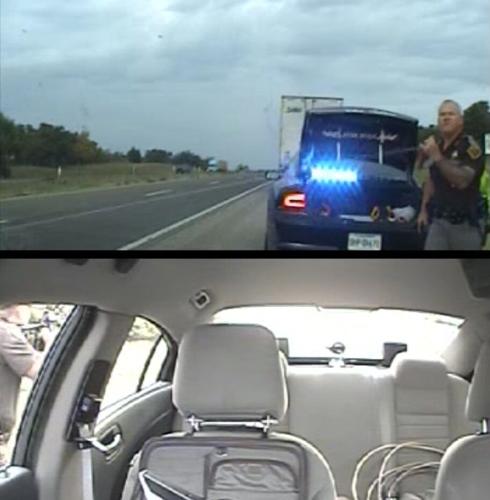
Oklahoma Highway Patrol Trooper Eric Smith fumbled with his handgun and the cord used to deploy a set of spike strips alongside Interstate 40 near McLoud as an eluding driver approached.
His partner trained his rifle on the fleeing SUV in the morning light. It was around 8:50 a.m., and the roadway was active with other motorists.
With one hand, Smith tugged the spike strips into the westbound lanes in an attempt to puncture the tires of the fleeing vehicle.
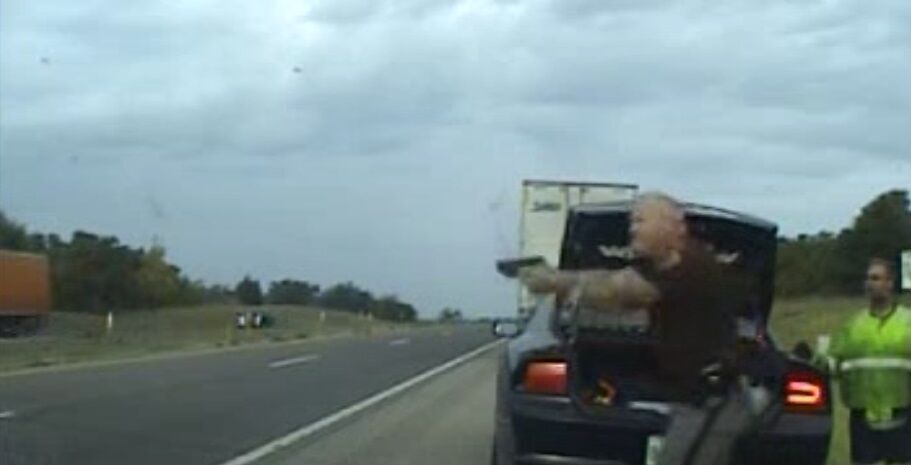
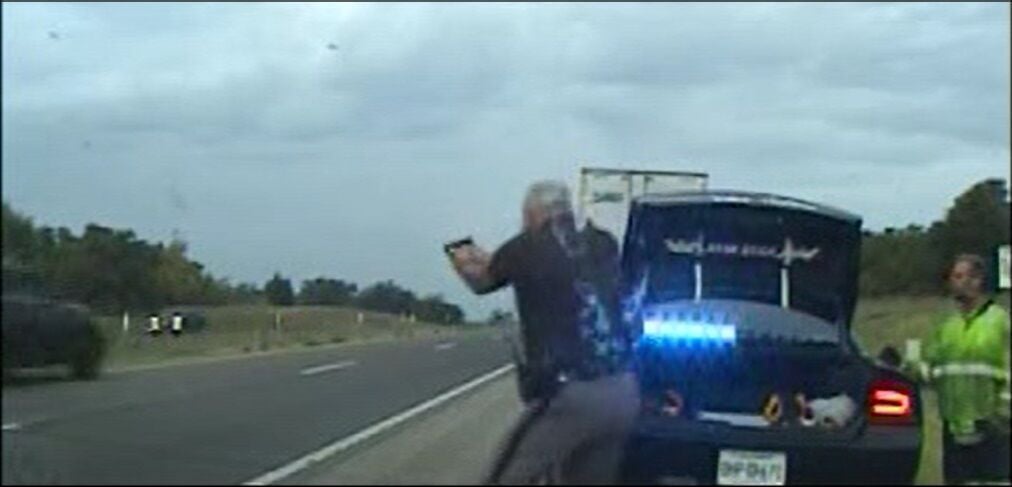
Smith then dropped the cord to bring his second hand onto his firearm and shoot four times at the Chevrolet Tahoe — innocent people driving by in the background — as the SUV swerved away from Smith to try to avoid the spikes.
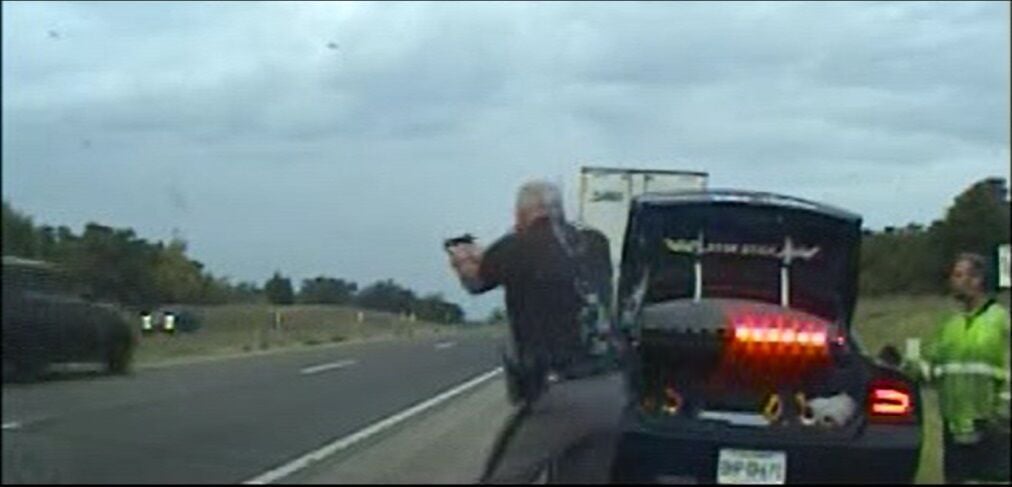
Oklahoma Highway Patrol Trooper Eric Smith fires gunshots at a fleeing SUV as innocent motorists drive by in his background on Oct. 9, 2022, on Interstate 40 in Pottawatomie County. A tow truck driver watches from behind an OHP patrol car.
Trooper Matthew Snyder, who aimed the rifle, didn't fire.
OHP suspended Smith for one workday without pay, which was the minimum presumptive discipline for his level of conduct, according to the Jan. 8, 2024, disciplinary letter.
People are also reading…
The letter broadly called his combined use of spike strips and handgun "fundamentally inconsistent" with training and guidelines but not excessive or unlawful. It stated he violated a firearms safety rule because he "failed to account for oncoming traffic" vulnerable to his gunfire.
A Tulsa World investigation has found at least five instances of troopers shooting guns at vehicles with innocent people in harm's way or cocking rifles in their laps during high-speed pursuits in which they weren't being shot at or threatened with firearms — drawing questions about institutional firearm tactics, training and safety.
Angelo Brown, an Arkansas State University criminology researcher and professor, said the cases could be indicators of a systematic problem within OHP. Perhaps troopers learn "unofficial" practices in the field, lack accountability or are "too ready to use their firearms," he said.
"Even planning to shoot from a moving vehicle — that's also not in any training I've ever heard of," Brown said. "It's dangerous for the officers themselves, and the accuracy of it is just really, really low."
Brown expressed concern that the Highway Patrol's one-day suspension of Smith — "very minimal" — doesn't reflect the seriousness of the situation or serve as a deterrent for troopers.
Brown, who is a member of the Academy of Criminal Justice Sciences, said the chances of an officer accurately shooting a tire or fleeing driver on a highway is slim to none. And succeeding with either could send the vehicle out of control in traffic.
"I don't think any agency would ever have officers trained with shooting a vehicle like that," Brown said. "So that seems (to be using) discretion in a very negative way, and that seems extremely inappropriate."
In an interview with OHP investigators more than two months after the incident, Smith said he decided to shoot at the right rear tire because he was concerned the westbound fleeing driver might make it to the Oklahoma City metro area and endanger more people.

Oklahoma Highway Patrol Trooper Eric Smith holds his pistol in one hand and the cord to a set of spike strips as he looks for a fleeing SUV on Oct. 9, 2022, on Interstate 40 in Pottawatomie County. His partner, OHP Trooper Matthew Snyder, aims his rifle in the direction of the oncoming SUV.
“I know there was eastbound traffic; I did check,” Smith said. “I don’t remember seeing any at the moment of the shooting.”
Dash-cam video shows Smith mostly looking east toward the approaching suspect’s westbound vehicle. Smith doesn’t appear to look for eastbound motorists who would be driving into his gunfire before he began pulling the trigger.
Not a police standard
The Council for Law Enforcement Education and Training (CLEET) is mandated by Oklahoma law to establish basic peace officer minimum standards and training.
CLEET doesn't have a standard or teach officers to shoot at moving or fleeing vehicles, according to Marcus Williams, deputy director of CLEET.
"The decision to shoot at a vehicle is determined by the policies set by individual law enforcement agencies, taking into consideration the specific circumstances and risks involved," Williams wrote in response to Tulsa World questions.
The Oklahoma Highway Patrol conducts its own training academies instead of using CLEET.
In the Smith case, OHP deemed his deploying of spike strips and firing of handgun to be within the level of force permitted by law or OHP policy, according to his disciplinary letter.
It was his use of each in tandem that OHP registered as "fundamentally inconsistent" with its training and guidelines in "several ways" — all of which were redacted by the agency.
OHP emphasized that Smith's gunfire with innocent people on the other side of the target vehicle was a firearm safety rule violation that created "demonstrable serious risk of harm."
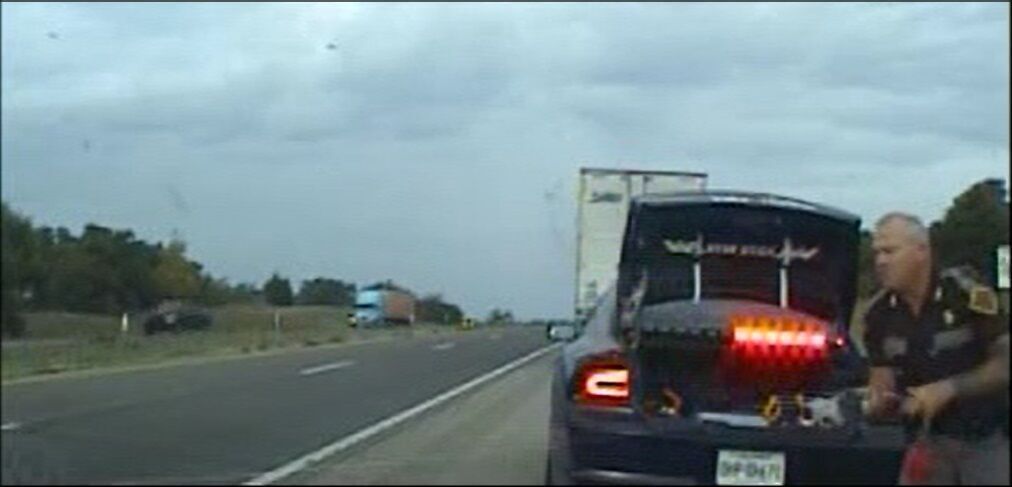
Oklahoma Highway Patrol Trooper Eric Smith fumbles with his pistol and the cord to spike strips on Oct. 9, 2022, on Interstate 40 in Pottawatomie County.
His minimum unpaid suspension of one workday could have been as high as 30 workdays and/or demotion, according to his disciplinary letter. Smith also was assessed 16 hours of remedial training.
Tulsa World attempts to speak with Department of Public Safety Commissioner Tim Tipton — who oversees OHP — or have him respond to written questions weren't responded to by OHP.
The chase and shooting
On Oct. 9, 2022, officers from the Pottawatomie County Sheriff's Office reportedly were pursuing an SUV's driver on suspicion of stealing a firearm from an RV at a campsite that morning.
The chase reached I-40 and headed toward Troopers Smith and Snyder, who were on an unrelated DUI traffic stop. Smith posted up with control of spike strips in his off hand and his sidearm in his dominant hand, according to his disciplinary letter.
Smith told OHP investigators that the driver initially moved onto the outside shoulder toward him and Snyder before then maneuvering to the inside shoulder to try to go around the spike strips.
“There was concern for him either striking us or being in a position where he can shoot out his (passenger-side) window at us,” Smith said. “Once he went to the inside, I chose — instead of using force against him — (to) use force against his vehicle because he was on the opposite side. The threat (level) went down.”
A pursuing McLoud Police officer noted the Tahoe's right rear tire did hit the spike strip. The device, called Stop Sticks, is designed to modulate release of air from tires to avoid blowouts.
The officer radioed 80 seconds later that the tire was deflating, soon shredding pieces of rubber across the interstate to end the high-speed chase. The suspect fled on foot into a wooded area and was apprehended after a brief search.
OHP's Pursuit Reporting Form requires a supplemental narrative to be filed that details events, driving behaviors and actions taken — which the agency said wasn't done in this case.
'Alarming' concerns
Smith shooting at a fleeing vehicle despite innocent people in the background of his bullets happened about 14 months after the World published a seven-part series in summer 2021 on OHP's deadly pursuits and shootings.
The series revealed reckless trooper actions, shoddy record-keeping, failure to address “alarming” concerns expressed by commanders and the agency's unwillingness to formally review several fatal chases despite red flags.
One of the World articles exposed a January 2020 OHP memo in which some commanders raised red flags about an "alarming increase" of troopers shooting people and into cars — as well as troopers "needlessly" placing themselves in harm's way to necessitate a deadly force response.
None of the concerns were addressed two months later in a Chief's Review Board report, with an agency spokesperson saying the purpose of that board wasn't to address concerns or recommendations made by the command staff.
Two cases referenced by the memo have been covered by the World.
In the first, Trooper James McKee sprayed about 10 one-handed gunshots in a neighborhood while running behind a slow-rolling SUV on July 17, 2019, in McAlester.

Oklahoma Highway Patrol Trooper James McKee, right, fires about 10 one-handed gunshots in a residential neighborhood while running behind a slow-rolling SUV whose driver already had been shot by another trooper during a brief slow down in a high-speed chase on July 17, 2019, in McAlester. McKee's errant gunfire pierced the window of an occupied home and struck a parked vehicle.
Mark Anson Schoggins, the fleeing driver who had been identified earlier by a local officer, already had been shot in the chest through the windshield by another trooper after a high-speed chase prompted by a stolen bottle of vodka.
McKee's errant gunfire pierced the window of an occupied home and struck a parked vehicle. His shooting method was described as "not a good tactic" by a Chief's Review Board that found training issues but no policy violations.
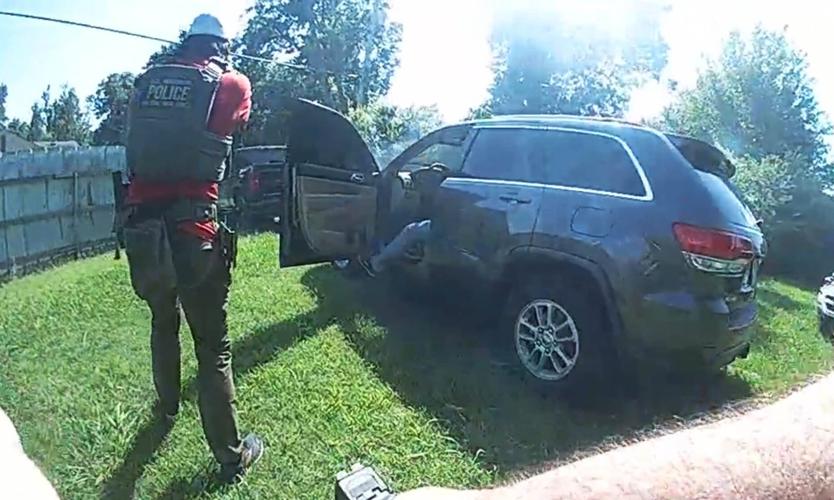
In the second case, Trooper Brian Costanza fired at least 10 gunshots toward the cab of a truck ensnared on a home's privacy fence June 27, 2019, east of downtown Tulsa after a vehicle pursuit of William Aubrey Martin III.
Only two of the rounds struck and killed Martin in the residential neighborhood. He had been wanted by U.S. Marshals on warrants related to several felony drug and gun charges for which he didn't appear in court.

Oklahoma Highway Patrol Trooper Brian Costanza is pictured after he fatally shot William Aubrey Martin III on June 27, 2019, east of downtown Tulsa when Martin's pickup truck was high-centered on a fence in a residential neighborhood amid a vehicle pursuit. Costanza, a member of the U.S. Marshals Violent Fugitive Task Force, said he fired shots because he saw the truck tires suddenly begin spinning in reverse and was fearful it might back over him.
Costanza had positioned himself on foot behind the stuck pickup truck and then fired in the same moments his partner, a Tulsa County sheriff's deputy, rammed the rear of the truck with their Jeep.
Both say they saw the truck shift into reverse, according to law enforcement documents. The pair were on a U.S. Marshals Service task force and had spotted Martin at a pawnshop.
Cocked rifles in laps during chases
The World's investigation later found two separate instances in which dash-cam video recorded troopers putting their rifles in their laps and cocking them during vehicle chases prompted by traffic infractions.
"Neither of these situations had any police being shot at or even threatened with firearms or anything like that," said Brown, the Arkansas State University criminologist. "So I don't see why they think it's so necessary to have their rifles out while driving."
Trooper Tanner Eads cocked his rifle in his lap during a lull in the chase and kept it there while driving in a pursuit that began with a reportedly stolen license plate on Jan. 13, 2021, in Cleveland County, according to dash-camera video.

Oklahoma Highway Patrol Trooper Tanner Eads, a rookie, is seen on his in-car video cocking his rifle in his lap during a brief lull in a high-speed chase on Jan. 13, 2021, in Cleveland County. Eads kept it in his lap as he drove across a middle school’s soccer field, then the field’s track, a downed fence and a curb to re-enter a neighborhood street.
Eads' in-car recording system reportedly malfunctioned about halfway through the pursuit and before he spun out the SUV into a violent rollover at more than 100 mph.
Vinnie Hamlet, the 17-year-old driver who had been "joyriding" in his grandmother's vehicle, was killed. Two survivors were seriously injured.
In an interview 69 days after the chase, Eads told OHP investigators that he had his rifle "next to me." Neither investigator pursued questions about the rifle despite having watched Eads' video.
On Aug. 15, 2022, on Interstate 35 in Norman, Trooper Austin May held a cocked rifle in his lap as a passenger in a high-speed chase that had been prompted by a minor traffic infraction and equipment failure, according to dash-camera video.

Oklahoma Highway Patrol Trooper Austin May, a passenger, is pictured on dashcam footage pulling out a rifle and cocking it in his lap during a high-speed pursuit Aug. 22, 2022, in Norman.
The chase ended when a different trooper spun out the truck into a barrel roll, ultimately killing two passengers in the fleeing vehicle — Ethan Mestas, 22, and Mercedes Martinez, 26.
Oklahoma Highway Patrol Trooper Eric Smith fires gunshots at a fleeing SUV as innocent motorists drive by in his background on Oct. 9, 2022, on Interstate 40 in Pottawatomie County. A tow truck driver watches from behind an OHP patrol car.
Oklahoma Highway Patrol Trooper Eric Smith fires gunshots at a fleeing SUV as innocent motorists drive by in his background on Oct. 9, 2022, on Interstate 40 in Pottawatomie County. A tow truck driver watches from behind an OHP patrol car.
Corey Jones of Tulsa is a member of Lee Enterprises’ Public Service Journalism Team. corey.jones@lee.net