

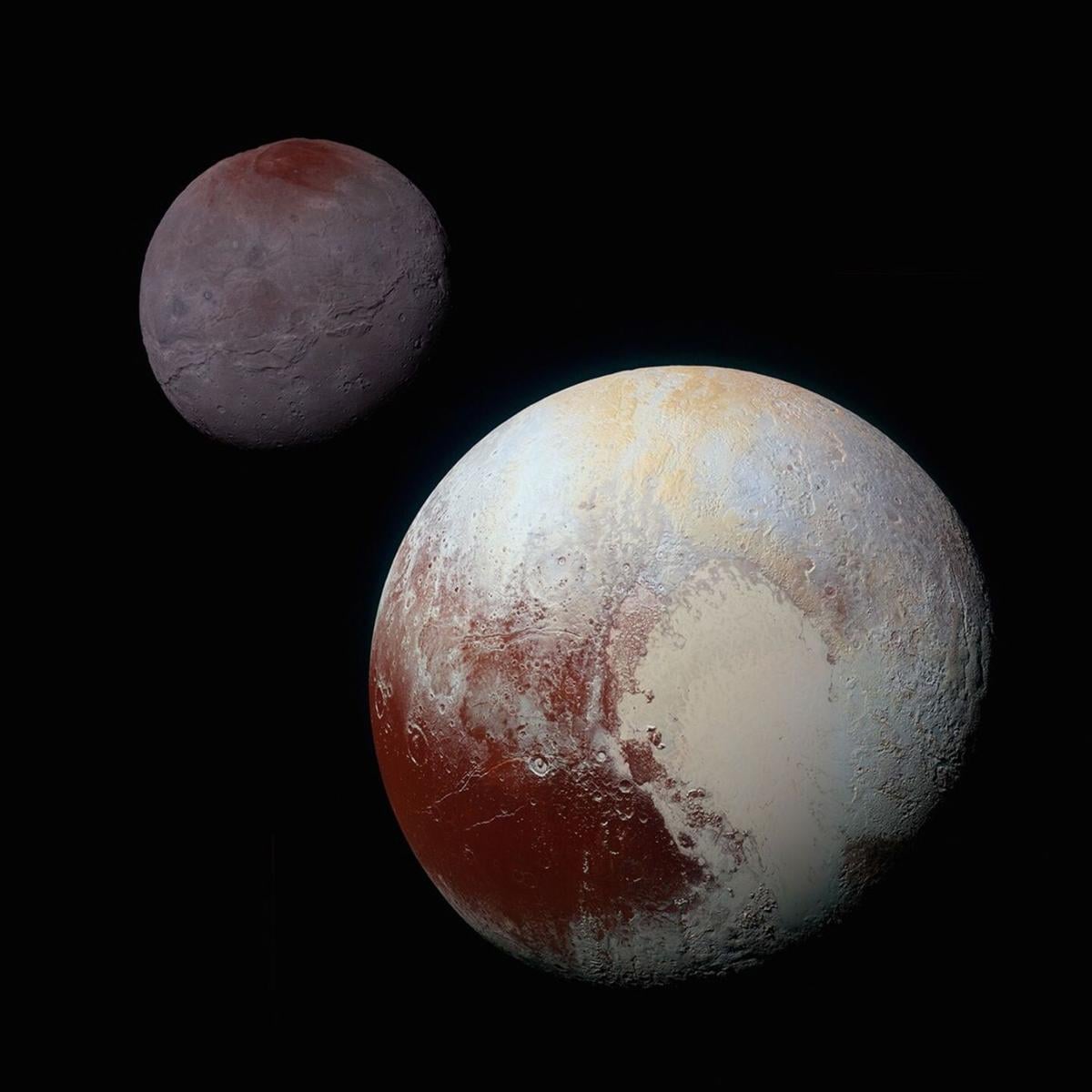
NASA chief Jared Isaacman has doubled down on his stance that Pluto is without a doubt a planet.
For two decades, controversy has surrounded the distant icy world after it was infamously stripped of its planethood and reclassified as a dwarf planet instead. Since that 2006 decision, Pluto's legion of supporters has insisted that the demotion was unjustified and has demanded that the astronomical organization responsible for the ruling reconsider.
And among Pluto's more vocal and influential defenders is Isaacman, a private astronaut and the administrator of the largest space agency in the world.
Here's everything to know about Pluto and Isaacman's role in the ongoing campaign to make it a planet again.
Why is Pluto not a planet anymore?
Pluto was long considered the ninth and furthest planet in our solar system from the sun until it was controversially downgraded in 2006 in a vote by members of the International Astronomical Union.
People are also reading…
Pluto may orbit its own star and be large enough to be mostly round – two key IAU criteria to be considered a planet. But because Pluto – only about 1,400 miles wide – lacks the gravitational forces necessary to "clear its orbit of debris," the celestial body was instead classified as a smaller dwarf planet, the IAU stated in its resolution, according to NASA.
Pluto, a frigid mountainous world with craters and glaciers, is located among icy bodies in the Kuiper Belt, located at the outskirts of our solar system beyond Neptune's orbit – now the farthest planet from the sun.
The only spacecraft to explore Pluto up close was NASA's New Horizons, which in 2015 flew by the world and its five known moons.
Isaacman: 'Make Pluto a planet again'
Isaacman, who was confirmed in December 2025 as NASA's administrator, recently reiterated his belief that Pluto rightfully deserves to have its planetary status restored.
Isaacman's latest remarks about Pluto came as the NASA head was speaking Tuesday, April 28, before a U.S. Senate committee on President Donald Trump's proposed budget for NASA, which outlines significant cuts to the agency.
After more than an hour of testimony, Isaacman was asked about Pluto by Sen. Jerry Moran, a Republican from Kansas who chairs the Senate Committee on Appropriations.
Replied Isaacman: "Senator, I am very much in the camp of 'make Pluto a planet again.'" Isaacman then teased a number of research papers in the works at NASA that "we would love to escalate through the scientific community to revisit this discussion."
This isn't the first time Isaacman has been asked about his stance on Pluto. In an interview published in March with the Daily Mail, Isaacman said he endorses the idea of Trump taking action to reclassify Pluto as a planet.
Pluto discovered in 1930 in Arizona
Pluto was discovered in 1930 by Clyde Tombaugh, an American astronomer from Kansas at the Lowell Observatory in Flagstaff.
But nearly 30 years earlier, astronomer Percival Lowell first theorized the existence of the planet, partially based on irregularities in the orbit of Uranus. Lowell – who founded the Lowell Observatory in 1894 – died in 1916, having never officially discovering the elusive planet, which came to be called Planet X.
That left Tombaugh, hired in 1929 to carry on his predecessor's work, to finally pinpoint the mysterious body after months of tedious work with an instrument known as a blink comparator.
Who was Pluto in Roman mythology?
The idea for Pluto's name came from 11-year-old Venetia Burney of Oxford, England, who suggested to her grandfather that the new discovery be named for the Roman god of the underworld. In Greek mythology, Hades is the equivalent of Pluto.
Burney's grandfather shared the name with the Lowell Observatory, which ultimately agreed with the suggestion, according to NASA.
Who else supports classifying Pluto as a planet?
Of course, it takes more than one person's declaration to reclassify Pluto as a planet – even if he is the leader of NASA.
Fortunately for Pluto, the world has had plenty of big names in its corner over the years. That includes Alan Stern, the principal investigator of the New Horizons mission, who has long used a different definition of planethood focused on factors including geology and atmosphere that don't exclude Pluto, Space.com has reported.
"Star Trek" actor William Shatner also recently spoke out, decrying IAU's members as "just a bunch of corrupt nerds on a power trip" and calling for "an end to the union’s tyranny of the cosmos." Shatner then turned to none other than billionaire SpaceX CEO Elon Musk for an assist.
"We should ask Elon to get the President to sign one of those Executive thingies to make Pluto a planet again," Shatner posted in May 2025 on social media site X, which Musk also owns.
Musk, who at the time had the ear of Trump as one of the president's closest advisers, responded: "I'd support that.
But even if Trump were to sign an executive order, it would not be binding on the members of the IAU, who have the ultimate say in defining just what sort of body Pluto is.


