

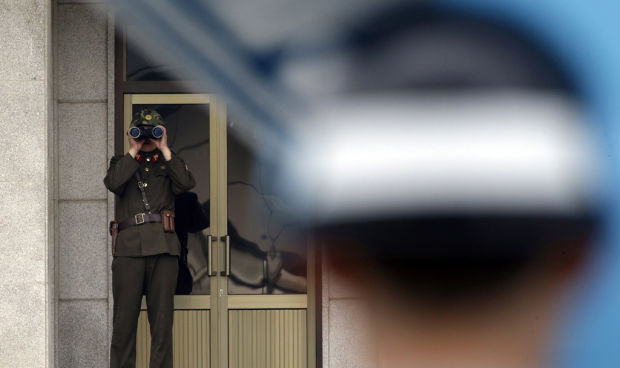
PANMUNJOM, North Korea - Some Americans call it the "Forgotten War," a 1950s conflict fought in a far-off country and so painful that even survivors have tried to erase their memories of it.
The North Koreans, however, have not forgotten. Sixty years after the signing of the armistice, the country is marking the milestone anniversary with a massive celebration today, a holiday it calls "Victory Day" - even though the two sides only signed a truce and have yet to negotiate a peace treaty.
Signs and banners reading "Victory" line the streets of Pyongyang, the North Korean capital.
Here at the border in Panmunjom, the war never ended. Both sides of the Demilitarized Zone are heavily guarded, making it the world's most fortified border, and dividing countless families. The North Koreans consider the presence of 28,500 U.S. troops in South Korea a continued occupation.
People are also reading…
In some ways, war today is being waged outside the confines of the now-outdated armistice.
The disputed maritime border off the west coast of the Koreas is a hot spot for clashes. In 2010, a South Korean warship exploded, killing 46 sailors; Seoul blamed a North Korean torpedo. Later that year, a North Korean artillery attack on a front-line South Korean island killed four people, two of them civilians.
Earlier this year, Kim Jong Un enshrined the pursuit of nuclear weapons as a national goal, calling it a defensive measure against the U.S. military threat. In recent months, the warfare has extended into cyberspace, with both Koreas accusing the other of mounting crippling hacking attacks that have taken down government websites in the North and paralyzed online commerce in the South.
Sixty years on, as both Koreas and the United States mark the anniversary today, there is still no peace on the Korean Peninsula.
•••
The two sides don't even agree on who started the war.
Outside the North, historians say it was North Korean troops who charged across the border at the 38th parallel and launched an assault at 4 a.m. on June 25, 1950.
North Korea agrees that war broke out at 4 a.m. - but says U.S. troops attacked first. A photo offered as proof at a Pyongyang war museum shows U.S. soldiers advancing, rifles cocked, as they run past the 38th parallel.
Ri Su Jong, a 21-year-old guide at a flower show in Pyongyang, said Tuesday that she was taught the North Koreans marched into Seoul three days later, "liberating" South Korea from U.S. forces.
As North Korean troops advanced south, the U.S. retaliated with bombing campaigns that left both Seoul and Pyongyang in rubble.
Then came the counterattack.
Dick Bonelli was a 19-year-old from the Bronx, a self-professed troublemaker, who was shipped off with the U.S. Marines to fight in a country he never knew existed. He arrived in September 1950 with the amphibious assault known as the Inchon Landing, the surprise attack that helped the U.S.-led U.N. forces push the North Koreans back.
Bonelli later took part in one of the costliest fights of the Korean War: the 17-day winter campaign in the mountainous region of the North then known by its Japanese name, the Chosin Reservoir. Several thousand were killed in combat, and thousands more died of frostbite.
"I tried for 30 to 40 years to forget it all," Bonelli said in Pyongyang on Thursday, an American flag pinned to his blazer. "Who wants to remember that? It's war. It was terrible."
In all, the fighting took more than 1.2 million lives. More than 500,000 North Korean troops died, along with 183,000 Chinese who fought alongside them.
On the other side, 138,000 South Koreans were killed, and 40,670 more from the U.N.-led force, including 36,900 Americans.
Civilian deaths totaled almost 374,000 in South Korea and are unknown in the North.
Bonelli is back in North Korea for the first time since 1950. His hope is to revisit Fox Hill, the remote spot that he guarded that first cold winter of the war.
•••
How the main players in the war will mark today's anniversary is a telling indication of how each country considers the conflict.
North Korea is treating it as a celebration, an occasion to rally support for the country's leader and draw attention to the division of the Korean Peninsula.
In South Korea, it's a day of remembrance. For the government, it's a day of thanks to the 16 U.N. nations that came to South Korea's defense during the 1950-53 war. For many, it's also a day of sorrow as they remember family members left behind in the North, forever divided from their loved ones.


