

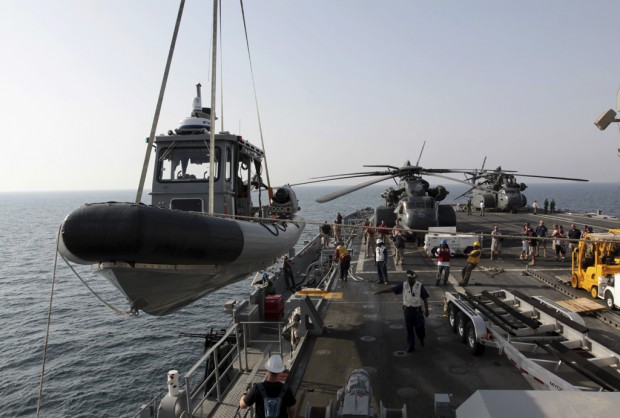
ABOARD THE USS PONCE - A new, key addition to American-led naval efforts to ensure Mideast oil keeps flowing has emerged as an unusual mix of a ship combining decades' worth of wear and tear with state-of-the-art technology and a largely civilian crew.
After winning a reprieve from the scrapyard, the USS Ponce was reborn through a rush retrofit earlier this year and turned into a floating base prowling the waters of the Persian Gulf. It is now getting its biggest workout since refurbishment as the centerpiece for sweeping naval exercises under way that serve as a very public warning to Iran. The Islamic Republic has threatened to shut the Gulf's entrance at the Strait of Hormuz, the route for a fifth of the world's oil supplies, and would likely use mines to do so.
Anti-mine divers on practice drills deployed in small boats off the Ponce's stern gate early Saturday, and MH-53 minesweeping helicopters launched from the ship kicked up sea spray as they hauled mine-detecting equipment through the water. Later in the day, a U.S. destroyer pulled alongside, fighter jets roared past and gunners fired thunderous rounds from .50 caliber machine guns during a simulated encounter with a hostile vessel.
People are also reading…
Senior Navy officials in the Gulf are quick to downplay talk of conflict with Iran, which is locked in a dispute with the U.S. and its allies over Tehran's disputed nuclear program.
U.S. military officials in the region insist the exercises, which include forces from more than 30 countries, are defensive and not directed at any country. They prefer to focus instead on the Ponce's role as an innovative new tool to help ensure security in the region, and on the need to train with allies to keep sea lanes open.
Still, the message is clear.
"Any extremist group, any country that puts mines in the water would be cautioned" by the exercises, said Marine Gen. James R. Mattis, the U.S. Central Command chief, during his first visit onboard the Ponce since it deployed June 1. "We do have the means to take mines out of the water if they go in. We will open the waterways to freedom of navigation."
Military leaders believe the Norfolk, Va.-based Ponce is central to that mission.
More than half the length of most U.S. aircraft carriers, the Ponce can accommodate multiple helicopters on deck and small boats in a well deck below.
The ship is known as the Navy's first "afloat forward staging base-interim," a name given because the Ponce is meant to be a stopgap until a similar base built from scratch is delivered. That won't happen until at least 2015.
"This will more or less act as a test for using floating platforms in the sea for military operations," Riad Kahwaji, chief executive of the Dubai-based Institute for Near East and Gulf Military Analysis, said of the reconfigured Ponce. "There'll be a lot of defense industry officials observing the performance of this."
Much of the original ship remains, including the tight Marine-style bunks stacked four high from floor to ceiling in some parts of the ship. But there are plenty of 21st-century additions, too.
Berths for about 100 people were removed and replaced with a high-tech joint operations center, where streaming video and data feeds can be shown on flat-screen displays.
Powerful MK-38 guns installed during conversion include remotely controlled digital cameras that let operators zoom in on far-off targets of interest. And a ScanEagle surveillance drone launched from and recovered by the ship keeps an eye on the sea for miles around all day long.
In its new role, the Ponce is initially intended to be a close-to-the-action support hub for mine-clearing ships, coastal patrol vessels and helicopters. Ships can take on fuel and supplies without having to return to port, and a wide range of repairs can be handled by machinists onboard. That means far less down time for minesweepers and other vessels using the Ponce as a stopping-off point, according to analysts and Navy officials.
The Ponce's Spartan accommodations can also handle hundreds of additional personnel, such as the French anti-mine divers in distinctive camouflage shorts currently onboard. In theory, special-operations forces could also fill bunks aboard the Ponce, which is able to launch the small boats and helicopters they often use.
Although it is under the command of a Navy captain, most of the Ponce's crew are civilians. It has more than 155 civilian crew members from the Military Sealift Command and 55 Navy sailors, according to the ship's commanding officer, Capt. Jon Rodgers. The number of civilian crew can fluctuate depending on who is on board.
The Military Sealift Command is normally responsible for running about 110 supply ships and other non-combat vessels for the Navy, but the Ponce's hybrid crew is unusual. Visitors arriving by helicopter are met on the flight deck by some crew in uniform and others in civilian coveralls. Civilian employees keep the floors and toilets clean, and dish out corned beef hash and French toast on the mess deck.
The Ponce is among the Navy's oldest ships. Construction began in 1966, and it was commissioned in 1971.
"Yeah, it's old," says Kevin Chavis, 45, a retired Navy electronics specialist from Brooklyn who is now part of the Ponce's civilian crew. "But just like a car, if you change the filters and the oil, it'll keep running."


