

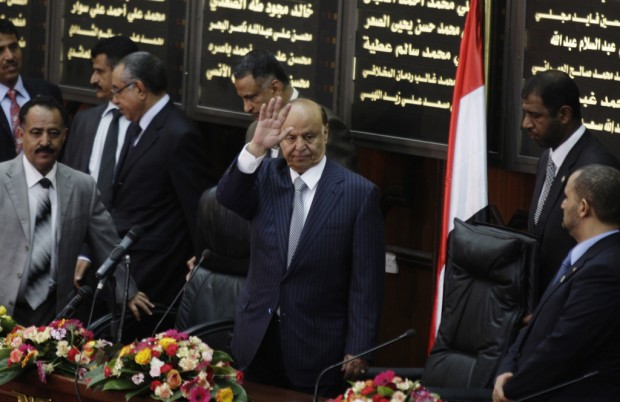
SANAA, Yemen - A car bomb outside the gate of a presidential compound in southern Yemen killed at least 25 people Saturday, hours after the country's new president was inaugurated and vowed to fight al-Qaida.
A security official said the attack in the city of Mukalla was carried out by a suicide bomber, and that it bore the hallmarks of an al-Qaida operation. Al-Qaida and southern separatists are active in the region.
The blast came hours after Abed Rabo Mansour Hadi was sworn in as president to replace longtime leader Ali Abdullah Saleh, following an election aimed at ending more than a year of political turmoil in Yemen.
Hadi was the only candidate in the election.
In his televised speech before Parliament, Hadi vowed to keep up Yemen's fight against al-Qaida-linked militants, who have taken advantage of the country's political turmoil to seize control of towns and swaths of territory in the restive south.
People are also reading…
"One of the most prominent tasks is the continuation of war against al-Qaida as a religious and national duty, and to bring back displaced people to their villages and towns," Hadi said.
Hours after Hadi spoke, the blast rocked Mukalla in the province of Hadramout, part of formerly independent south Yemen, which united with the north in 1990.
Ahmed al-Rammah, who witnessed the blast, said by phone from Mukalla that he saw a pickup moving to the gate slowly as soldiers were coming out. Then it exploded, he said. The blast was followed by heavy gunfire from the surviving guards.
Hadramout's governor, Khaled Said el-Deeny, told The Associated Press that police have launched an investigation.
The province is one of many in southern Yemen that has been wracked by violence in the wake of anti-Saleh protests over the past year. Many accuse the longtime ruler of allowing security to collapse as a way of pressuring Western governments and neighboring Gulf countries into keeping him in power.
Under international pressure late last year, Saleh signed a Gulf-brokered and U.S. backed agreement that gave him immunity from prosecution for the deaths of hundreds of people in last year's turmoil in exchange for handing over powers to Hadi, his deputy at the time.
Now in office, Hadi faces a slew of challenges as he tries to bring stability to Yemen. He must restructure powerful security forces packed with Saleh loyalists, launch a national dialogue that would include southern secessionists, and appease a restless religious minority in the north as well as disparate opposition groups in the heartland.
He takes power with a popular mandate bolstered by the unexpectedly large turnout - 65 percent - for the Tuesday vote.
Washington has played an active role in the transition, in hopes that Hadi can head off chaos and ensure cooperation against the country's al-Qaida branch.
Government operations have failed to oust the group, which is blamed for trying to blow up a U.S.-bound airliner in 2009 and cargo planes bound for the U.S. a year later.
Saleh, meanwhile, returned to Yemen early Saturday after spending about three weeks in the U.S. receiving treatment for injuries he suffered during a June explosion at his compound that helped hasten his departure.
Saleh is the fourth Arab leader swept from power by the Arab Spring. But thanks to his continued presence in the country and his negotiated exit, the political changes brought by his ouster may be much less dramatic than the results of uprisings in Tunisia, Egypt and Libya.
Many fear that the ex-president, who has cast a large web of tribal and family relations during his more than three decades of rule, may still try to pull the strings during the transitional period until a new constitution is written.
"One of the most prominent tasks is the continuation of war against al-Qaida as a religious and national duty, and to bring back displaced people to their villages and towns."
President Abed Rabo Mansour Hadi,
newly inaugurated Yemeni leader


