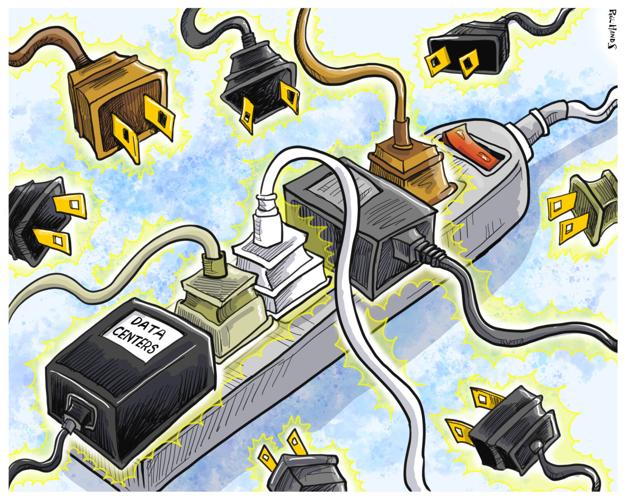
As the use of artificial intelligence accelerates, several state legislatures and U.S. Sen. Bernie Sanders are calling for a pause on the development of AI data centers. They worry about lost jobs for working people and the potential dangers of superintelligence.
People are also reading…

Donald Kimball
Their concerns aren’t baseless. But a data center moratorium is not the solution. It won't slow the development of AI, as Sanders hopes. Nor will it help the U.S. win the AI race against China.
AI is the marriage of many components: applications, models, chipsets, casing, networking cables, cooling systems and external infrastructure.
As it stands, these components develop and grow in a symbiotic relationship. With better chipsets, the models and applications can be fine-tuned and work faster. Faster applications drive demand for infrastructure investment, which in turn funds research into more powerful housing, cooling and networking mechanisms. That, in turn, make chipsets more efficient.
When this cycle continues, it attracts the best developers to train models and applications to use U.S.-developed platforms, whether through Nvidia, AMD, Google or others.
What Sanders and others are taking aim at is only one limited component of AI. Even with a moratorium on data centers, the continued build-out of AI would occur globally and domestically. But it would proceed at a slower, more expensive rate in the United States.
Such a self-inflicted wound would give China a further advantage in this already competitive race. We would fail to expand our own capacity to invest in AI and sabotage one of the steps in the self-growth cycle.
Even if we stopped all data center growth, it wouldn’t stop hardware development for AI. Winning the AI race requires more than data centers alone. The U.S. now uses data centers as one large system to power AI. But eventually, we will need to adapt to a model closer to China’s rollout, with many medium paths.
This will mean integrating AI to be deployed from other infrastructure, such as broadband and cellular towers. The generational jump from 5G to 6G will not be primarily through different signal bands, as prior transitions were, but rather by deploying AI to cell towers for smart management. This will make signal communication more efficient and enable AI capabilities to reach new heights in areas such asself-driving cars and automated manufacturing.
A moratorium on data centers wouldn’t stop AI growth. It would merely shift to these new paths. But it would make our offerings much less competitive globally.

By ceding our data center growth, we hamper our ability to expand into this deployment, allowing China to keep its stranglehold on the cellular infrastructure. China’s 5G tower expansion globally has left the U.S. behind. Even large parts of Europe use Huawei technology. This is partly due to the slow pace of Federal Communications Commission band approvals and government hesitation to accommodate demand from commercial industries.
In contrast, the Chinese government allowed its commercial industries to set the course. This has led to Huawei’s lead in the 5G market and allowed China to extract concessions globally from countries eager to gain the growth enabled by access to wireless internet infrastructure. It is clearly in the United States' interest to prevent a repeat of this.
AI growth gives the U.S. the chance to reclaim that, but only if we keep up with commercial AI development. If we can demonstrate superiority on AI hardware domestically, it will be easier to export this technology to Europe, Africa and other countries. A data center moratorium strikes at the heart of the development necessary for the U.S. to keep up.
For every concern about job loss and superintelligence, there are miracles for health care and entrepreneurship. By limiting our domestic capabilities, we forfeit the gains of AI and fail to avoid potential pitfalls, handing China a free win without even competing.