Gasoline prices have increased more than $1 a gallon during the last month, as President Donald Trump’s war with Iran continues. As a result, many consumer staples that rely on diesel-fueled trucks to reach store shelves are more costly. Food prices are climbing, in part due to a logjam of global fertilizer supply -- nearly a third of which depends on the Strait of Hormuz for transit to farmers worldwide.

Mitch Jones
The situation is remarkable, given the president’s many years of bold claims and arrogant pledges of dirt-cheap fossil fuels, lower energy prices and shrinking inflation. He was supposed to be a populist “America first” leader.
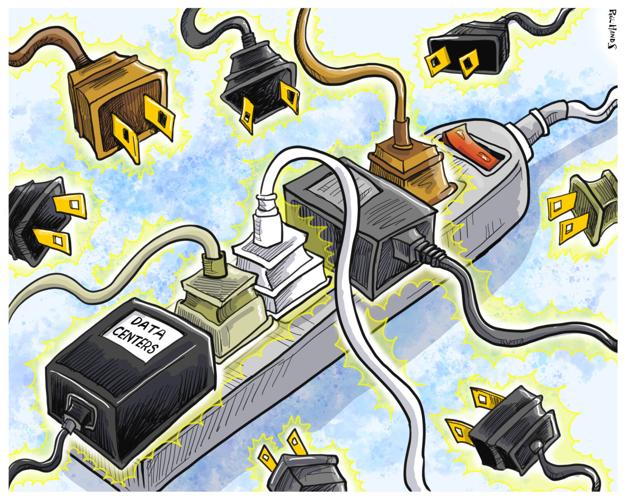
Yet energy prices in many areas of the country were already skyrocketing before the conflict with Iran. The driver of these inflated electric bills has been data centers to power artificial intelligence for big technology companies.
People are also reading…
Indeed, the nation’s boom in constructing data centers is dramatically reshaping communities around the country and starkly hurting Americans’ budgets.

Energy demand from AI data centers in the United States is expected to soar in the coming years, according to research by my organization, Food and Water Watch. Our analysis suggests these facilities could consume up to 12% of total national demand and the equivalent of the energy used by more than 55 million households.
The largest of these massive projects may house 5,000 or more computer servers over millions of square feet and consume as much power as 2 million households.
This extreme surge in energy demand across the American grid is unsustainable, and it is already having grave effects on the environment, climate and people's finances. Much of the energy needed for AI data centers is produced by fossil fuels — the coal and gas that are driving the climate crisis, producing stronger and more violent storms, raising our sea levels and slowly cooking our planet.

As the use of artificial intelligence accelerates, several state legislatures and U.S. Sen. Bernie Sanders are calling for a pause on the development of AI data centers. They worry about lost jobs for working people and the potential dangers of superintelligence.
Additionally, giant data centers require vast amounts of water to operate. U.S. data centers will need billion of gallons of water each year just to cool AI servers. That's as much as could fill 1 million Olympic-size swimming pools, or enough water to meet the indoor needs of about 18 million American households. All of this is happening as many communities are struggling to provide clean, affordable water for everyday use.
Americans will pay for the AI boom with their wallets. Driven largely by new data centers, surging power demand compelled U.S. electric and gas utilities to request $31 billion in consumer rate increases in 2025 — double the total request in 2024, according to a PowerLines report. Average residential electricity rates in the U.S. soared from 2020 to 2025. This cost crisis is only deepening.

Sanders
But people and communities are fighting back. In October, Food and Water Watch called for a nationwide moratorium on the construction of AI data centers, citing the massive and growing burden on electricity and water resources. Many local, state and national groups have joined in this demand. Responding to the growing public outcry, U.S. Sen. Bernie Sanders, I-Vt., recently introduced a bill to enact just such a pause.
Meanwhile, community leaders nationwide are taking matters into their own hands, rejecting scores of AI data center proposals in recent months and pursuing multi-year local and statewide halts to the industry’s expansion.
We need a nationwide pause on the explosive growth of AI data centers now because the industry has failed to show it can protect people and our society from harm.
Jones is the managing director of policy and litigation at Food and Water Watch, a national environmental organization. He wrote this for InsideSources.com.