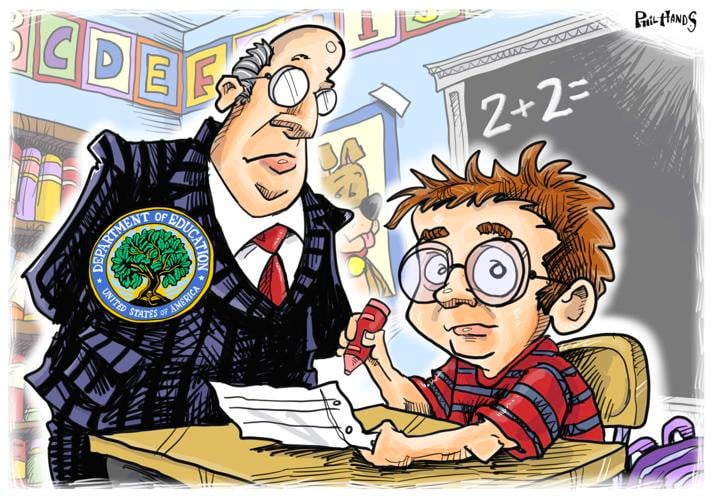
The presidential election has brought back the debate over ending the U.S. Department of Education. Republican candidate Donald Trump says he wants to eliminate it.

Neal McCluskey
Critics of the idea have reacted with claims of doom, as if the federal agency were the nation’s primary educator.
It's not.
American public schooling draws its origins to at least 1837 and the start of Horace Mann’s "common schooling” crusade." That was long before the federal Department of Education was created in 1979.
People are also reading…
Federal intervention in education also predates the birth of this federal agency. The “Great Society” laws and programs of the 1960s, for example, created Head Start, the Elementary and Secondary Education Act, and the Higher Education Act.
Why did it take the federal government so long to get involved? Because it was widely recognized that the U.S. Constitution gave Washington no authority to govern education. It was an area reserved for the states and the people.
Education has not needed the department, as even former American Federation of Teachers president Albert Shanker argued when it was being debated.

As long as it has been involved in K-12 education, the federal government has been by far the smallest of three major public-schooling funders. On average, since the 1969-70 school year, it has provided only 8.5% of all public-school revenue. Local governments and states primarily pay for education.
That said, Washington has taken over a lot of control of education. The No Child Left Behind Act from 2002 to 2015 forced states to have uniform standards and tests in math and reading and punished schools who failed to make “adequate yearly progress” toward proficiency in those subjects.
The Department of Education also drove a national curriculum. In 2009, it coerced states to adopt the Common Core standards and align tests and evaluate teachers on them. By 2015, people on the left and right declared they had enough micromanagement of education. No Child Left Behind was replaced by the Every Student Succeeds Act.
Federal funding tends to go to lower-income districts. But this frees states and districts from spending as much of their own money. Federal control and the push to equalize funding also threaten ham-fisted policy and exacerbate the national debt.

Since President Jimmy Carter created the modern Department of Education in 1979, it has faced continuous calls for its abolition. This threat has persisted through Republican administrations, from Ronald Reagan to Donald Trump.
The Education Department's effect on higher education has arguably been even worse. The department has failed in running student loan programs. This including poor record-keeping of repayments and bungling the simplification of the Free Application for Federal Student Aid.
Last school year, the FAFSA overhaul left students in the dark about their financing far into the time when aid and enrollment decisions should have been made. Delays are on the horizon this school year, too.
Far from being a disaster, ending the Education Department and moving student lending to, for example, the Treasury Department would almost certainly be an improvement.
More effectively run student-aid programs could save some taxpayer money and make life easier for students and colleges.
I don't want to overstate the benefits of eliminating the federal agency. We would still have a vast student-aid problem: It fuels tuition inflation. Fixing that will require downsizing federal lending.
Similarly, little evidence suggests federal K-12 funding markedly improves K-12 education. This is especially true absent rules that connect funding to testing outcomes and learning.
The Department of Education is ineffective and unconstitutional. Ending it would be a modest improvement for schools.
McCluskey directs the Cato Institute’s Center for Educational Freedom. He wrote this for InsideSources.com.