President Donald Trump’s disastrous war on Iran is weakening the United States and providing America's principal adversaries, China and Russia, with a strategic opportunity to expand their global influence.

Andrew Miller
The war in Iran is already diverting U.S. attention and resources from Ukraine and East Asia. This gives China and Russia a freer hand to pursue their anti-America agendas.
According to the Center for Strategic and International Studies, the Trump administration spent $16.5 billion on the war in its first 12 days. The Center for American Progress estimates the ongoing cost of the war at more than $1 billion a day.
As part of the massive buildup of U.S. military in the Middle East, Trump deployed the USS Abraham Lincoln to the Arabian Sea. It is one of five aircraft carrier strike groups that's operational. It is no longer in the South China Sea, where it was deterring Chinese threats. Our largest aircraft carrier, the USS Gerald Ford, is undergoing maintenance in Greece after it was ordered to the Middle East despite having exceeded its service hours.
People are also reading…
More alarming, the deployment of additional U.S. missile-defense assets and the transfer of scarce Patriot batteries and interceptors to the Middle East risk exposing U.S. forces and allies to more advanced threats from China and Russia.

The United States and Israel are devastating the parasitic Islamic regime that squandered the wealth of Iran for decades and exported terror across the Middle East. Understanding the biggest losers in this war is just as important as any assessment of the battle damage to government buildings in Tehran.
At least one of our most advanced anti-ballistic missile defense system may be destroyed by Iranian attacks. U.S. Gulf partners are now requesting more interceptors, the missiles used to destroy incoming projectiles, in response to the Iranian onslaught. Israel is reportedly conserving its own interceptor stocks.
With slow production timelines, the United States will have fewer systems to protect troops and civilians from aerial attacks, while Ukraine and Taiwan will find it even harder to maintain adequate stocks to defend against Russia and China, respectively. The longer the war in Iran continues, the more vulnerable it will leave the U.S. and our allies.
Given the substantial toll on the U.S. military, this war could only be justified if the defeat of Iran would constitute an enormous loss for Russia and China. But Iran is ultimately expendable to Beijing and Moscow. China's and Russia’s relationships with Iran are nice to have, but not a necessity. For Russian President Vladimir Putin, he already has what he wanted from Iran: advanced drone technology that Russia is now producing and selling back to Tehran.

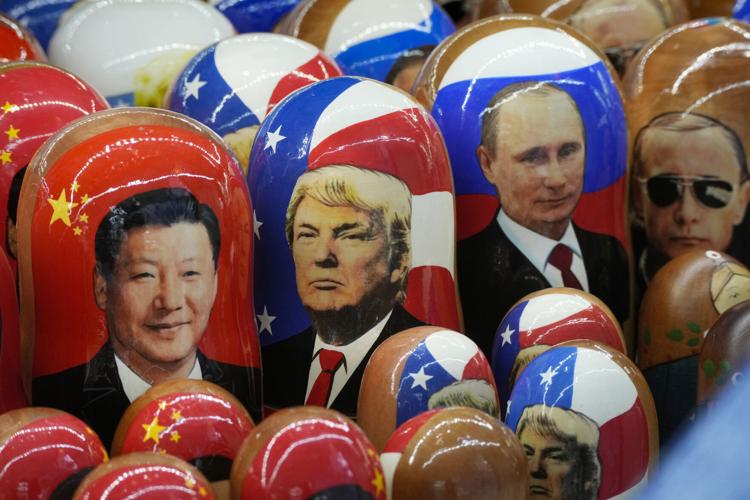
Traditional Russian wooden dolls for sale at a souvenir shop in St. Petersburg, Russa, depict the leaders of the world's three superpowers (from left): China's President Xi Jinping, U.S. President-elect Donald Trump and Russian President Vladimir Putin.
China’s ability to purchase discounted oil from Iran is beneficial to the Chinese economy. But Beijing is better positioned than most countries to absorb energy shocks due to its stockpile of 1.4 billion barrels of oil. China also has invested in renewable energy.
Russia and China are among the beneficiaries of the sharp increase in oil and gas prices caused by the closure of the Strait of Hormuz. President Trump’s decision to lift sanctions on Russian and Iranian oil to combat rising energy prices for the American consumer generated a windfall for oil-producing Russia and mitigated risk for China in procuring Iranian oil.
Even under a best-case scenario in which the U.S. ousts the Iranian regime in favor of a more cooperative government, this would not be catastrophic to China or Russia. In the far more likely scenario that the Islamic Republic survives, the regime could claim victory not just for the Islamic Republic but also for China and Russia.
So the war in Iran is a lose-lose proposition for the U.S. and the Trump administration.
Russia and China are watching with satisfaction as the U.S. pursues another foolhardy war in the Middle East. Every time the U.S. gets bogged down militarily in the Middle East by anything less than an imminent threat, that is an opportunity for our adversaries to remake their regions of the wolrd in their own image. The U.S. can ultimately prevail, but only if our government stops shooting itself in the foot.
Miller is a senior fellow focused on the Middle East in the National Security and International Policy Department at the Center for American Progress. He wrote this for InsideSources.com.