The United States and Israel are devastating the parasitic Islamic regime that squandered the wealth of Iran for decades and exported terror across the Middle East. Understanding the biggest losers in this war is just as important as any assessment of the battle damage to government buildings in Tehran.

Peter Doran
The third Gulf War is very bad news for America’s enemies, including Russia and China.
The biggest loser by far is the Islamic Revolutionary Guard Corps, America’s arch-enemy in the Middle East and the primary military and ideological guardian of the Iranian regime. The Revolutionary Guard brutalizes the Iranian people while exporting violence around the region, including attacks on American troops and civilians in Iraq.
In just weeks, the United States and Israel have achieved what decades of diplomacy and sanctions could not: the systematic “housecleaning” of a terrorist group with the largest missile arsenal in the region and a global arms proliferator.
People are also reading…
The Revolutionary Guard is lobotomized and without a command structure. It is reduced to a set of rogue, discombobulated members. Preventing its reconstitution should be a priority for the United States.
Second on the list of losers is the network of terrorist subsidiaries Iran funded and armed for decades. This includes entrenched brutes such as Hezbollah and Hamas. While Israel systematically dismantles what remains of Hezbollah in Lebanon, a defunded Hamas has become surprisingly open to negotiating the most important part of a peace plan: surrendering its heavy weapons.
Disorganized and cut off from their patron, these groups are effectively orphaned.
The next loser is Russia’s Vladimir Putin and his grand vision of creating a globe-spanning, multipolar world order, including North Korea, to challenge the United States. That vision is disintegrating. When the U.S. toppled Kremlin allies such as Venezuelan President Nicolás Maduro and dispatched Iran’s terrorist leadership to the afterlife, Moscow offered condolences but little more.
Talk is cheap, and Putin’s bold rhetoric about resisting American hegemony now looks astonishingly weak. When the chips were down, Russia was entirely unable to assist its friends, keep them alive or keep them out of U.S. custody.
This staggering failure will significantly harm Putin’s credibility the next time he calls for nations to rally around his anti-American “axis of resistance.” Other world leaders will ask: Why join a losing side?

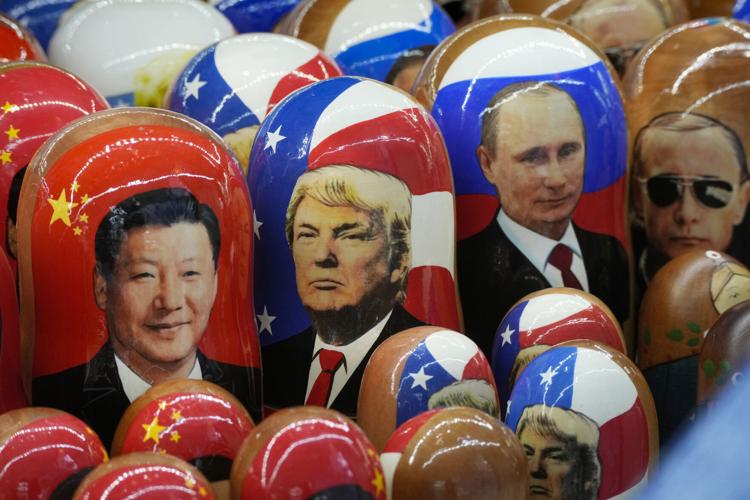
Traditional Russian wooden dolls for sale at a souvenir shop in St. Petersburg, Russa, depict the leaders of the world's three superpowers (from left): China's President Xi Jinping, U.S. President-elect Donald Trump and Russian President Vladimir Putin.
Finally, China is a loser. While the United States historically insisted that Beijing is a competitor rather than an enemy, the war for Iran has imposed new costs on Xi Jinping’s economic machine. Close to half of China’s crude oil imports cross the Strait of Hormuz. With that vital maritime checkpoint severely disrupted, China has been forced to burn through portions of its vast oil stockpiles to ride out the storm. That is a short-term fix rather than a long-term solution.
In a future crisis over Taiwan, Beijing’s bluster and aggressive military posture should be viewed in a context of potential vulnerabilities. Washington and Beijing are increasingly aware that the fight over Hormuz may have profound implications for a future fight over the Taiwan Strait.
Naysayers long claimed that an armed confrontation with Iran would trigger World War III and spiral into a global catastrophe. As the dust settles on the first few weeks of this war, a very different set of outcomes is emerging.
By striking at the heart of the “axis of resistance,” the United States has begun to dismantle a regional menace and the largest factory of terror in the Middle East. And more than humiliating Putin’s ambitions, Beijing’s vulnerability is on full display.
Perhaps the biggest lesson for America’s enemies? Never wake the American giant unless you wish to pay the consequences.
Doran is a senior adjunct fellow at the Foundation for Defense of Democracies. He wrote this for InsideSources.com.