A collared wolf shot near Yellowstone out of season. Four bucks decapitated in Carbon County. A pair of elk left to waste at Georgetown Lake, and two more left unclaimed near Toston.
Poaching cases – including these from just the past few months – keep popping up across all corners of Montana, and the state’s Fish, Wildlife and Parks department devotes millions to prevent wildlife crimes each year.
People are also reading…
But is poaching a growing problem in the state? How often does poaching occur in Montana each year? And how many of those cases lead to criminal prosecutions and convictions?
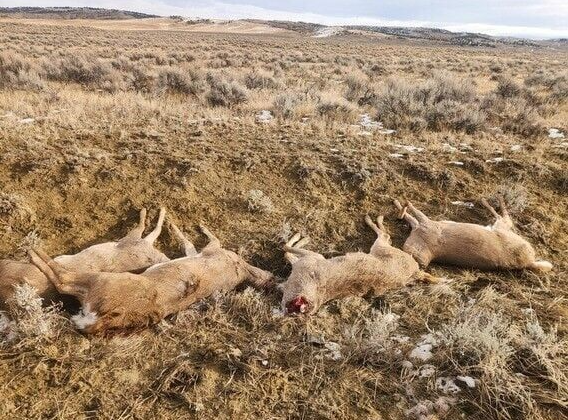
Montana Fish, Wildlife & Parks wardens provided this photo of four decapitated whitetail bucks in Carbon County.
A Lee Enterprises Public Service Journalism Team investigation found that FWP doesn’t have answers to those questions, raising concerns about how the agency’s Enforcement Division allocates resources aimed at cracking down on those who illegally kill one of the state’s most valuable resources: its wildlife.
In a pair of public records requests, Lee Enterprises sought FWP poaching data as well as information about the number and nature of unsolved poaching cases in the state over the past decade. In response, FWP indicated that it does not keep such data or keeps incomplete data.
But the data FWP did provide showed a 62% drop in poaching-related violations between 2015, when wardens issued 217 poaching-related citations, and 2024, when that number dropped to 82.
FWP provided these violation figures in response to a public records request that sought FWP poaching data, including information about the region, animal type, enforcement action and enforcement outcome, from Jan. 1, 2015 through April 18, 2025.
The data included counts of violations for crimes like hunting game animals during the closed season, hunting game animals in closed areas, hunting or taking game animals without a license and killing or possessing overlimit game animals.
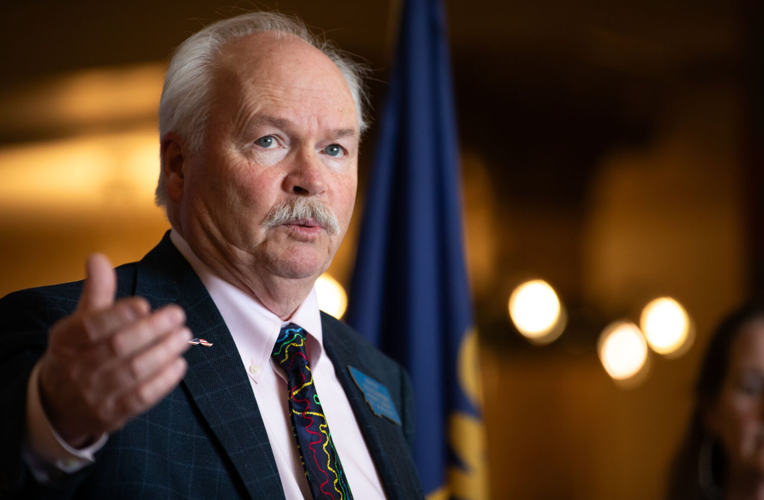
John Sullivan, who serves on the board of the Montana chapter of Backcountry Hunters and Anglers, said those violations are “significant, for sure,” and that a 60% drop in citations is “surprising” and concerning.
“I don't think that that's going to make the Montana hunting community very thrilled,” Sullivan said, adding, “And then the question would be like, ‘Well, why? Why that drop?’”
In an interview, Ron Howell, FWP’s chief of law enforcement, attributed the decline in violations to “a lot of factors,” including changes in game populations, new hunting regulations and the specific circumstances that wardens encounter in the field.
Howell also indicated that the numbers provided by his agency were not a complete and accurate reflection of how often the Enforcement Division catches serious and purposeful poaching, as FWP does not keep data on felony charges for poaching-related crimes.
Howell said those felony cases are difficult to track because they are handed over to county attorneys or, in some cases, the state attorney general’s office for prosecution.
So while the Enforcement Division keeps “track of how many of those citations we write in a given year,” Howell said that felony cases can take years to investigate and get “in front of a judge.”
“And so the data would show that maybe we see less, but maybe wardens are working on this one particular (felony) case for a very long time, taking them away or taking their time away from the field,” Howell said. “So the tickets for (a misdemeanor like) hunting without landowner permission for that warden might show down. But there's a reason for that. We call it ‘the rest of the story.’ So they've been working on a case for a very long time. That's ate up a bunch of their hours, if you will. And the fruits of that are going to come down the road, but they don't show right now, so you'll see a dip in numbers.”
But Sullivan pushed back on the idea that decline in citations could be explained away entirely by looking at the data with more nuance.
“There's something that's changed if there's a 62% drop in citations,” Sullivan said. “And their excuse is, 'Well, you just gotta read the numbers differently.’ Well, that doesn't really make a lot of sense. What do you mean? ... Are you reporting them differently? How are the numbers you're putting out now different than the ones they were putting out before?”
In a second public records request, Lee Enterprises sought information about the number and nature of unsolved poaching cases.
In response, a representative of the Montana Office of Public Information Requests wrote that "FWP Enforcement does not keep track of this information regarding ‘poaching’ incident (sic) in which there is no suspect or charge made by a warden."
Rep. Eric Albus, a Republican from Glasgow, said FWP’s incomplete poaching data is a problem.
“They need to keep track of that,” Albus said.
Doing so, Albus said, would help FWP’s understaffed and overworked wardens more effectively combat what he believes to be a serious and growing problem.
“It would certainly help inform legislators as to how big of a problem it is and that it needs addressed,” Albus said. “If we have those numbers, (FWP) can come and say, 'Hey, we had X number of unsolved elk poaching cases and deer poaching cases this last year, and it's up or down from the year before.’ That would be great data for the Representatives and Senators to have to know if it is a serious enough problem that maybe we better do” more to combat poaching.
‘Unaware of the data trends’
The FWP Enforcement Division’s handling and use of data has been criticized before.
In 2023, a legislative audit found that FWP’s Enforcement Division was failing to effectively collect and analyze data – and that the division’s lack of a “data management strategy” was hampering their ability to allocate resources efficiently.
“Generally, Enforcement management was unaware of the data trends and spoke anecdotally about potential causes,” that audit stated. The audit’s authors also stated that the Enforcement Division’s “annual report should be considered unreliable” and that the "inaccuracy and inconsistency of the data … make it unclear if the data reported by Enforcement should be considered for resource distribution decisions.”
Such gaps in data and understanding, the audit’s author wrote, made it difficult “to determine if warden duties are being prioritized appropriately across the state.”
“They have not determined what data is important to gather, standardized its collection, or determined how the data will be used to distribute Enforcement resources,” the audit read. “Wardens indicated that they were unsure of what data was being used for outside of a disciplinary tool against wardens when they made errors entering it into the system.”
But the audit’s authors argued that problems with FWP’s available data led to some confusing trends. For example, while the number of license sales jumped by more than 15% between 2019 and 2021, the number of overall citations – not just those related to poaching – declined slightly during that period.
That was counter to the expectation that more licenses would lead to a “corresponding increase in citations and licensee contacts,” the audit said.
But in looking at the amount of time wardens spent on different activities, the authors of the audit found that the second-biggest decrease “in actual hours” spent by wardens on various activities from 2019 to 2021 was in criminal investigation, which is a central element of pursuing poaching cases and which was down 2,590 hours or 11%.
‘Our role is to provide facts’
In an interview with Lee Enterprises, Howell called the audit’s critique of the division’s data handling “unfair.”
“We most certainly have the data and the correct data,” Howell said. “Where I agree with the audit is that I think we needed to – and we have, since the audit – clearly articulated what our duties are and what our priorities are. And I have done that.”
He said the data has helped ensure that his division is focused on its statutory duties, which are related to “catching violators in the fish-and-game world,” including poachers, and not on more general law-enforcement duties, like catching drunk drivers. As the Enforcement Division has refocused on those core duties, Howell said wardens have increased the amount of time they spend on criminal investigations.
Howell also said data can play a crucial role in how FWP informs the lawmakers who ultimately decide the agency’s funding and who set up the laws that punish poachers and others who harm Montana’s wildlife.
“I think our role is to provide facts to our legislators, to our lawmakers, so that they can make informed decisions, if you will,” Howell said, adding: “What (lawmakers) ask us for is, things like, ‘How many of this happens?’”
“And that's where I think our role is, is to give them those facts, give them that data so that they can make that decision, because that's really their role,” Howell said.
While he wasn’t able to provide accurate data about felony poaching prosecutions or unsolved cases, Howell argued that the press releases FWP issues about poaching “help give (lawmakers) those facts, give them an idea of how many of these things are happening.”

Senate Minority Leader Pat Flowers, D-Belgrade, talks to reporters at a press conference following the adjournment of the 2025 legislative session on in 2025.
Pat Flowers, who spent decades in FWP leadership and now serves as the Senate Minority Leader, said he found it “hard to believe that, if they wanted to, they couldn't compile” data on “large-scale poaching cases” that were filed over the past decade.
“Because I don't think it's that many a year,” said Flowers, a Democrat. “When I was working, you’d have one of those cases or a couple of those cases break a year statewide. … And so they may not track it, per se, but it seems like an easy thing for the department to go back and kind of manually compile, over the last 10 years, how many cases they had.”
As for the drop in citations that is reflected in the data, Flowers said the decline could have to do with weather or other factors that have led to “fewer hunters in the field, fewer people taking animals,” which makes it “less likely that you're going to have violations.”
But Flowers also floated another explanation: that the department “made some kind of a policy shift where they are issuing more warnings rather than citations.”
‘Cleaning up their image’
Howell objected to the idea that the decline in citations reflects a cultural shift in the Enforcement Division.
But he also said that just because the data shows a drop in citations, that doesn’t mean “there's less of that thing going on. It’s just, we might handle that particular case differently.”
While Howell said his division emphasizes “consistency” because “it leads to credibility,” he also said that “when things happen on the ground, we don't want to get so black-and-white that a warden doesn't have discretion based on the totality of the circumstances.”
And because “education is a huge part of our job,” Howell said, wardens “write far more warnings than we do citations and charges in front of the county attorney.”
That emphasis on warnings and education above citations appears to be reflected in the data – and Albus is among those who appreciate this change of approach.
“I think it's probably a positive thing, because most of the people they're catching in the field are unwitting,” Albus said. “They'll be doing something that is illegal, and they didn't even know it.”
He said the FWP Enforcement Division’s more forgiving approach “has gone a long ways to clean up their image,” which was “terrible” 15 or 20 years ago
“I think the wardens have done a remarkable job of cleaning up their image, rebranding themselves and being a lot more user-friendly to the public,” he said.
But Sullivan, of Backcountry Hunters and Anglers, said he is troubled by the “idea that maybe now the state is kind of directing its law enforcement agency to be more lenient on folks who violate certain game laws. Like, where does that line get crossed?”
While he emphasized that “Montana's game wardens, by and large, are fantastic individuals” and that he appreciates their willingness to work with hunters who make honest mistakes, Sullivan said, “There shouldn't be a directive from the top down saying, ‘Well, hey, just look away for these certain kinds of crimes. But these ones are okay. These ones are bad.’ My fear is it would create a gray area where then people on the ground don't know how to apply the law appropriately, either.”

John Sullivan is pictured in this provided photo. Sullivan serves on the board of the Montana chapter of Backcountry Hunters and Anglers.
‘Resentment killing’
Howell said people often ask, “Is poaching worse than it used to be?”
“And the answer is, it's cyclic,” he said. “It goes up and down. You can watch deer trend populations. When deer numbers are the highest they've ever been, we see more violations than we've ever seen before. And as deer numbers drop back down, we see less violations.”
But some claim that certain forms of poaching, at least, are on the rise.
Ben Krakowka, who has worked as a county attorney in Anaconda-Deer Lodge and Musselshell counties and who is currently a deputy prosecutor in Butte-Silver Bow, said he has seen an “emerging” trend that involves wealthy hunters who hire guides.
“And then those guides are under pressure, because somebody's coming out spending $10,000 or $15,000 to come out here and hunt elk, and he wants to put his client on elk,” Krakowka said. “And so what we're seeing an emergence of — and it's driven by the money — is guides engaging in fairly significant illegal behavior in order to satisfy their clients.”

Prosecutor Ben Krakowka walks back to his seat during the second day of trial at Butte-Silver Bow Courthouse in Butte on Feb. 03.
Krakowka said Musselshell County sits in “a special draw district for bull elk,” which means “there's massive bulls running around out there everywhere. And if somebody wants to shoot one of those bulls, it's almost all private land out there, so they're going to have to hire a guide to be able to access that and you know that guy might be willing to bend or break those rules because his client's paying him a lot of money to get on the elk.”
Albus said he believes poaching is a growing problem in Montana, due in part to what he referred to as “resentment killing.” That resentment, he said, is directed against FWP and private landowners.
“Unfortunately, our big game, our deer and elk and general season areas, have been, I would personally call it, mismanaged,” Albus said. “Fish and Game would disagree with me. But there's no quality (game) left to the public on public land.”
Albus argued that “our resources being loved to death” as FWP has allowed “too much hunting pressure” on deer, elk and other species from both resident and non-resident hunters.

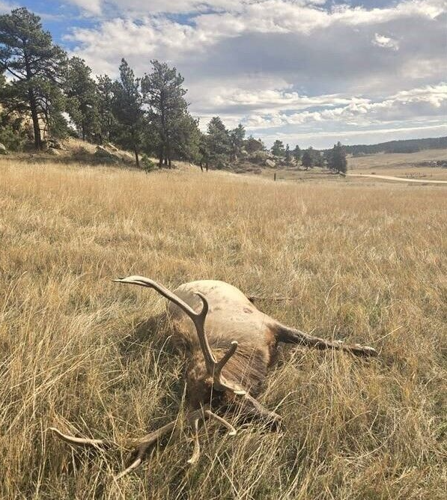
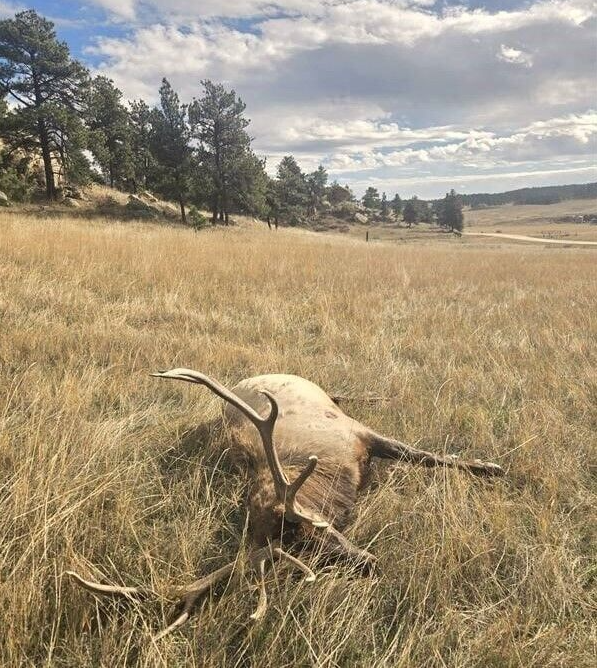
A 6x6 bull elk was poached in October 2025 near Musselshell.
The result, he said, has been “an access-to-quality issue” that has bred anger among sportsmen in the state and that has led to a rise in poaching.
“It's an age-old jealousy thing,” Albus said. “The attitude is, ‘If I can't have them, you can't have them. Now we're seeing these trophy class animals shot and just left. And it doesn't have to be trophy-quality. People are shooting whatever and leaving it lay on private land, just as a, 'Oh, if I can't have him, you can't have him either type deal.' And it's sad. It's sad and sickening. But I look at it as a cry from the Montana sportsmen to Fish and Game, begging them to manage so they have something that looks like the private land.”
He said that non-resident hunters have “overrun” local hunters to that point that they “outnumber” local sportsmen in some areas.
And as resentment grows and game quality declines, Albus said hunters increasingly kill illegally – and FWP lacks the resources to stop them.
“The problem is, Montana is too big of a state, and the wardens are spread too thin,” Albus said. “That was the reason that I agreed to help FWP with some funding, legislatively, to hire an extra warden in each Fish and Game region. Each of the seven regions has the money available now to hire another warden, if they can find qualified people, which is getting increasingly difficult.”
The new funding that Albus and other lawmakers approved last legislative session for more wardens and other costs brought the Enforcement Division’s budget up to $16.7 million, according to the post-session budget report.
Howell said FWP now has 126 full-time positions, but 15 of them are vacant.
Howell also said that FWP is “doing everything we can, thinking outside the box even, to improve our relationships with landowners” and noted that the Montana Fish and Wildlife Commission recently voted to cut the number of nonresident deer hunter licenses by 2,500 for the 2026-2027 hunting seasons.

Montana Fish, Wildlife & Parks logo.
‘Poachers are stealing’
Flowers said he’s not bothered by the gaps in FWP’s poaching data. His first-hand experience at FWP left him with “a lot of respect for the people that are doing that job” and for an approach to allocating resources that’s “more based on anecdotal experience in the field” than on data, he said.
“I don't think that kind of seat-of-the-pants or experiential assessment of personnel needs is necessarily a bad thing,” Flowers said. “I don't think that's a complete, perfect approach to doing that, but I think it's a reasonable approach.”
But Albus said he wants more concrete information from FWP so they can more effectively combat a kind of crime that should be at or near the top of the FWP Enforcement’s priority list.
“Because these poachers are stealing from every resident of the state of Montana,” Albus said. “They're taking opportunity that should go to a law-abiding citizen.”
Albus said there are likely “thousands” of unsolved poaching cases in the state.
But that, he acknowledged, is just an estimate.
Dylan Charles Boyer changed his plea to guilty Jan. 14, 2026 before Lewis and Clark County District Court Judge Michael McMahon.