
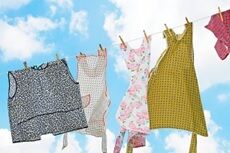
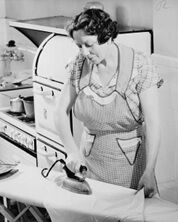
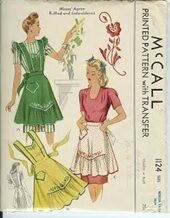
A friend suggested that I write an article on the topic of the apron; I am glad that she did, for this little “article of clothing” holds a multitude of memories for many people.
The word apron is from the French word “naperon,” meaning a small tablecloth. The Merriam-Webster dictionary gives several definitions for the word. But the definition most known to the general population is: A garment usually of cloth, plastic, or leather usually tied around the waist and used to protect clothing or adorn a costume.
The history of the apron is ancient. The word dates to Biblical times; in fact, to Genesis 3:7: And the eyes of them both (Re: Adam and Eve) were opened, and they knew that they were naked; and they sewed fig leaves together, and made themselves aprons.
Admittedly, the aprons sewn by Adam and Eve were not of the kind we know of today. Still, the apron has had a long and illustrious career, beginning with adornment, mostly by men, in many ancient cultures. The apron later evolved for use with men who were butchers, cobblers or men who worked with cement, and, eventually European men wore them in their dangerous occupations–in mostly fire-related jobs, such as welding and smelting.
But when, exactly, did women start wearing the garment? Perhaps during the Revolutionary War, when the living conditions were dusty and dirty, and they wore the aprons to protect their long garments.
In time, the apron became a part of prairie attire for women, as a necessity, because they had so few garments the women protected their clothing with an apron to keep them as clean as possible.
When countries became industrialized the all-over apron for women came into its own, starting with those worn by nurses, nannies and housekeepers. And in the Victorian Era, English women wore a “conceal everything” apron, ostensibly to cover every part of the major body parts. In the 19th century, domestic staff started wearing aprons, displaying their position within a household. The habit of wearing an apron continued during the early part of the 20th century, when aprons were used as a part of doing the usual house-hold chores–to pick and collect vegetables from the garden, to keeping items at-hand while in the kitchen or to pick up items from around the house.
But, then, in the 1950’s the apron became stylish. With its fancy accoutrements–sashes, rickrack, lace and cute pockets–the apron became in-vogue but had, with it, many connotations. Its reputation, if you will, was enhanced by the myriad of television shows, depicting the ideal wife and mother donning a stylish apron to show her place within the household. June Cleaver comes to mind here.
As the Women’s Liberation Movement of the 1960’s took hold, many women left the apron-wearing tradition behind, for the apron represented a woman who was inherently relegated to be a stay-at-home wife, who “served” at the behest of her husband.
Presently, however, the apron pendulum has swung into the far-reaching corners of kitchens world-wide. Now, both men and women – as well as children–have started wearing aprons. So, the next time you are in the kitchen–or your work room, for that matter–don your beautiful and historical apron!
The Lavender Manor held a grand opening Nov. 12 at 347 E. Fourth St., on the northern end of Tucson's Fourth Avenue. The shop sells homemade products and lavender from owner Carolyn Blair's family farm, Life Under the Oaks, in Oracle. Video by Andrea Morabito for the Arizona Daily Star.
 Vacant Tucson stores could transform into new housing


