


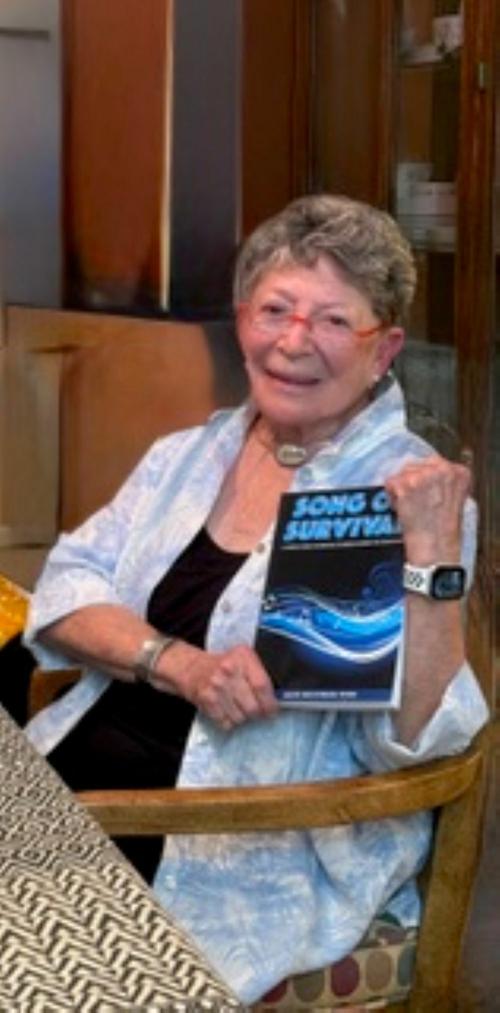
SaddleBrooke Writers Group is proud to feature a new book published by one of its members, “Song of Survival” by Alice Milchman Frier.
In my conversation with Alice, I asked what first inspired her to turn her family’s stories into a memoir. As she explained, “In Song of Survival, I set out to preserve the story of my family’s endurance during the Holocaust and the difficult years that followed. Their transformative journey began when they escaped from Nazi-occupied Poland, then were exiled to Siberia, where they barely survived the brutal conditions. After leaving Siberia at war’s end, we traveled hundreds of miles—mostly on foot—to reach a Displaced Persons Camp in Germany. From there, we eventually immigrated to America. The memoir illuminates the challenging, life-changing experiences of those years. I hope it speaks to readers.”
My Story (as told by Alice)
For many years, I felt a strong urge to document my family’s history, but I had postponed the task, knowing it would require a deep emotional excavation. Everything changed when my sister—my last remaining sibling—passed away. A t that moment, I realized I was now the only surviving member of my immediate family, and that my own “departure gate” was not too far off in the future. If I didn’t write our story, it would be lost. I wanted my nieces and nephews to know the lineage of resilience, courage and strength from which they came, and to understand what a tower of bravery and wisdom their grandmother was.
I knew from the beginning that I was writing from inherited memory—stories told in fragments, in letters, at family gatherings, in moments of both pain and pride. That distance only strengthened my determination to approach the memoir with accuracy, humility, and honesty. I gathered all available materials: family conversations, letters, photos, documents and historical accounts. I immersed myself in the global events unfolding at that time, recognizing that they were not merely a backdrop but directly shaped the course of my family’s life.
What surprised me most was not any single revelation, but rather the profound interconnectedness of the world—then and now. As I researched the rise of Nazism, the start of WWII with the invasion of Poland—and the ensuing suffering, deaths, and displacement of millions of people worldwide—I saw unsettling parallels to current events. The resurgence of authoritarianism in countries such as Hungary, Italy and France—and, alarmingly, within the United States—echoes the conditions that led to the tragedies of the 1930s. These realizations were among the most emotionally challenging aspects of writing the book.
Throughout the writing process, I was intent on neither sensationalizing trauma nor softening it. The Holocaust is a deep wound that must be acknowledged with clarity, honesty and respect. I wrote as faithfully as possible, guided by research, memory and the emotional truth in the stories passed down through my family.
Did I struggle with deciding how much to include? Yes—constantly. I wanted to honor the truth without overwhelming readers. Ultimately, I chose to include only what felt essential to understanding who my family was—and who they became.
From the moment I told my nieces and nephews about the project, they were enthusiastic and supportive. They followed my progress during the three years it took to complete the manuscript, and when “Song of Survival” was finally published, sending each of them an inscribed copy was one of the happiest moments of the entire process. Their positive reactions—and those from readers outside my family—affirmed for me that this story resonates far beyond my own family’s history.
Writing the memoir also deepened my understanding of my own identity. Exploring the past has strengthened my appreciation for the resilience that has been woven through generations of my family. It reinforced my belief that we are all interconnected; nothing happens in isolation. The suffering and displacement my family endured are part of a larger human story of war, migration and the struggle for survival that continues to unfold today. Sadly, it is happening daily in Africa, the Middle East, Europe, and in places too numerous to list here.
I hope readers come away with a clearer understanding not only of what happened to my family, but of how vital it is to remain vigilant about the world around us. Freedom can erode quietly and quickly. Ignoring the suffering of others is dangerous because it dismisses our shared humanity. And when we categorize any group of people as less than ourselves— Jews, Blacks, Asians, immigrants, gay people—we can justify any hateful action against that group.
Writing Song of Survival allowed me to honor my family’s courage and to preserve a history that might otherwise have faded with time. I hope readers not only learn from the past but also reflect on the world we live in today and on the responsibilities we all share. Following this article is my poem, “They and We and She,” which expands on these themes.
Song of Survival is available on Amazon for anyone interested in exploring the whole memorable story.
For SaddleBrooke residents interested in joining the Writers Group, call Mary Richling at (520) 437-8329 or send an email to jmrichling@yahoo.com. Meetings are held on the first and third Saturdays of each month from 10 a.m. to 12:30 p.m. in the Catalina Room, which is located at 38735 S. Mountain View Boulevard.
They and We and She
They suffer grinding poverty and violent gangs,
they survive pitiless famine and ruinous floods,
they endure persecution, brutal violence and rape.
Finally, they see no hope.
When hope withers and dies … they say… we must flee.
They battle savage jungles, scorching deserts, turbulent oceans,
they endure disease, hunger, pain … and sometimes bullets,
they face endless miles of towering, razor-wired WALLS.
She says: "Give me your tired, your poor,
your huddled masses yearning to breathe free,
the wretched refuse of your teeming shore.”
We say: Go home! You’re not welcome! You steal our jobs, you rape our daughters. You spread disease and violence and crime. You are vermin
tainting our white America
with your brown, your yellow, your black.
She sighs: But who will pick your cotton, your berries, your greens?
Who will mow your lawns, fix your fiery roofs, dig your ditches?
Who will care for your babies, clean your toilets?
She says: “Send these, the homeless, tempest-tossed to me,
I lift my lamp beside the golden door!”
G e n e r a t i o n s p a s s.
Storied memories fade … slowly… willingly
Erasing … that once… WE, too, were THEY.
—Alice Frier, 2024


