


If the bald eagle is America’s national symbol of majesty, the wild turkey might be America’s symbol of perseverance, provided perseverance includes running through the woods, flying into trees, and occasionally looking as though it has forgotten why it entered the room. Yet, this ungainly bird has survived millions of years of evolution, habitat destruction and the appetite of a nation that celebrates its existence by eating it every November.
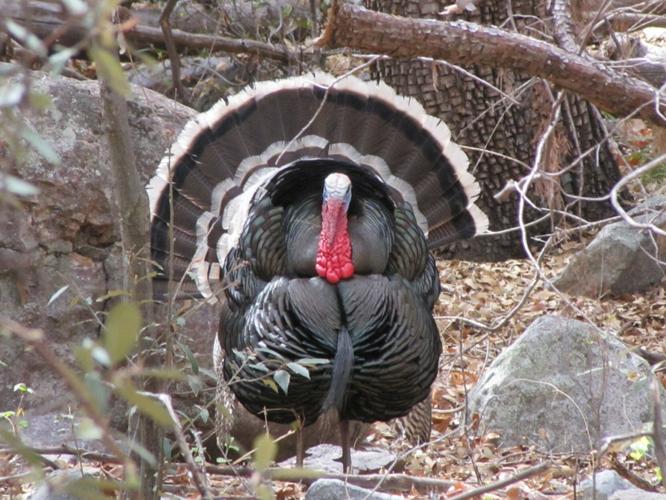
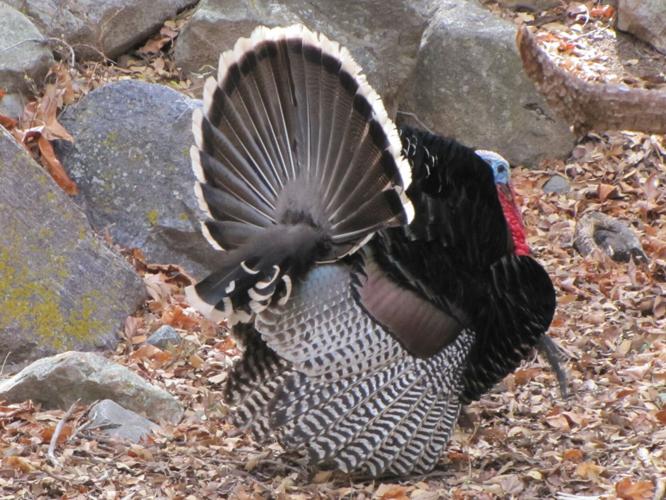
The Wild Turkey (Meleagris gallopavo) is native to North America, inhabiting much of the United States and extending into Mexico. It is a substantial bird, with adult males, called toms or gobblers, weighing roughly 15 to 30 pounds and females or hens, generally weighing 8 to 12 pounds. Males sport iridescent bronze, copper and greenish plumage, a fan-shaped tail, a beard of coarse bristles projecting from the chest and spurs on their legs. Their heads are bare and colorful, often displaying red, white and blue skin. A fleshy appendage called a snood hangs over the bill. During courtship, the tom puffs himself into a feathered hot-air balloon, drags his wings, fans his tail and gobbles loudly. Apparently, subtlety has never been a requirement for turkey romance.
Hens are generally less flamboyant, which is probably sensible in a species where conspicuousness can attract both romantic attention and predators.
Wild turkeys are traditionally divided into five or six recognized subspecies in the United States and northern Mexico. Each has its own geographic range, with the Eastern Wild Turkey being the most widespread. The bird of the mountain West, Merriam’s, is one of Arizona’s principal native turkeys, and is also native to New Mexico and Colorado. They inhabit the ponderosa pine forests of northern Arizona, especially around the Mogollon Rim and White Mountains, generally between 5,000 and 9,000 feet. In winter, they may descend into pinyon-juniper and oak woodlands; in spring, they follow melting snow uphill toward their breeding grounds. Gould’s is the giant of the family, found mainly in the mountains of northern Mexico, with populations extending into southern Arizona and New Mexico. Its remote mountain habitat and wary nature make it especially elusive. Both Merriam’s and Gould’s are found on Mt. Lemmon, although Merriam’s is far more common. Arizona also has a third subspecies, the introduced Rio Grande, located in the Arizona Strip in the state's far northwest.
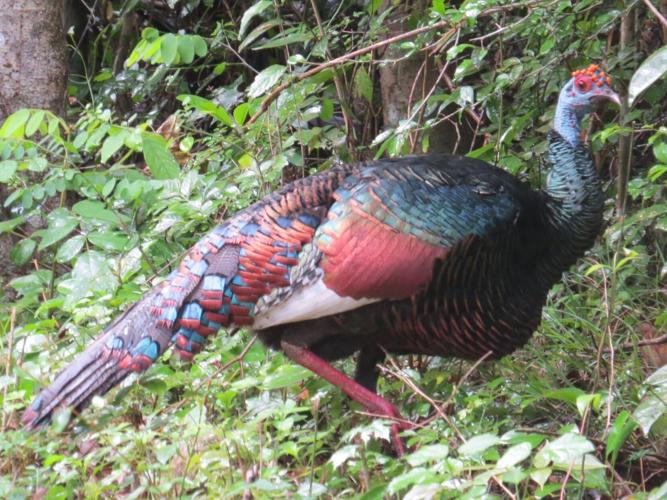
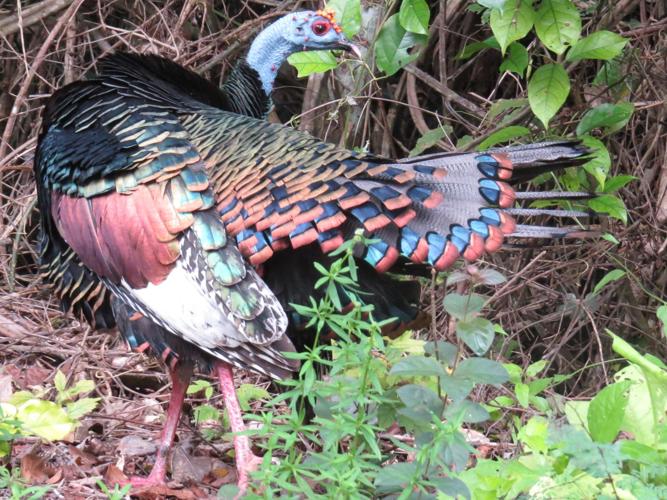
The turkey’s history is a conservation success story with a few chapters of near-disaster. Before European settlement, wild turkeys numbered in the millions across North America. By the early twentieth century, unregulated hunting, widespread forest clearing and agricultural expansion had devastated many populations. In some regions, turkeys virtually disappeared. Protection from excessive hunting, restoration of suitable habitat and carefully managed trapping and relocation programs helped reverse the decline. The National Wild Turkey Federation and state wildlife agencies played important roles in this recovery. Today, Wild Turkeys occupy much of the continental United States, although their abundance varies considerably. Some eastern communities have so many that turkeys wander into traffic, while finding a wild turkey in Arizona can require considerably more effort. Worldwide, there is a second turkey species, the Oscillated Turkey (Melagris ocellata), a rare cousin found in very limited areas of Mexico’s Yucatan, Belize and Guatemala.
The principal threats to turkeys are habitat loss, drought, predation on eggs and young and severe wildfires. Turkeys need food, water, nesting cover and safe roosting trees. In Arizona, prolonged drought can leave hens with fewer resources to raise their poults, the charmingly named youngsters that emerge from eggs after about 28 days of incubation. The state’s turkey populations are considered stable following several relatively mild winters, but drought remains a concern. Wildlife managers monitor birds with GPS transmitters and continue relocating turkeys to selected areas with low populations. In 2025, reported Arizona harvests included 1,160 Merriam’s turkeys and 69 Gould’s. Obviously, Gould’s turkeys are the most exotic prize for Arizona bird enthusiasts as well as hunters.
Arizona permits regulated spring and fall turkey hunting, subject to season dates, hunt areas, permits and other restrictions. The annual bag limit is a single turkey, either Merriam’s or Gould’s, not one of each. Current rules should always be checked with the Arizona Game and Fish Department before hunting. A resident hunting license costs $37, and a standard turkey permit-tag is listed at $25 under the state's published fee schedule. The tag is the inexpensive part of the adventure. Equipment can quickly change the arithmetic. A suitable shotgun could cost $700, camouflage clothing $150 to $300, boots $100 to $250, and calls, binoculars, a pack and other essentials another $300 or more. Experienced hunters may already own much of the equipment, but beginners may discover that the turkey is merely the first item on a surprisingly long shopping list.
Then there is the guide. Published 2026 Arizona outfitters' rates list a three-day guided Merriam’s hunt at approximately $2,250 to $2,750 per person, depending on whether one or two hunters share a guide. A guided Gould’s hunt runs about $2,500 to $3,250. Travel, lodging arrangements and additional expenses may increase the total. At those prices, a hunter could buy a considerable quantity of turkey at a supermarket. But supermarket poultry rarely requires a predawn departure, mountain hiking, camouflage and several hours of listening to a bird gobble from somewhere it refuses to disclose.
The wild turkey is more than a sporting trophy or a centerpiece surrounded by mashed potatoes. I t is a resilient native bird whose recovery demonstrates what thoughtful wildlife management can accomplish. In Arizona, its future depends on protecting the mountain forests, water sources and the woodland corridors that sustain it.
And perhaps that is the turkey’s finest achievement. After nearly vanishing from much of its homeland, it has returned to strut through the American landscape, tail fanned, head blazing, utterly convinced that it is the most impressive creature in the forest.
For once, the turkey may have a point.
If you have questions or comments about SaddleBrooke’s birds, or to receive emailed information about bird walks led by Bob and Prudy, call (520) 330-0366 or email bobandpru@gmail.com. Previously published articles can be found at birdingthebrookeandbeyond.com.


