
Ten weeks after Arizona lost to Wichita State in the NCAA Tournament, the offseason has finally begun for the Wildcats.
Ten, long, anxious weeks that really had nothing to do with that first-round loss and everything to do with a revamped 2016-17 roster.
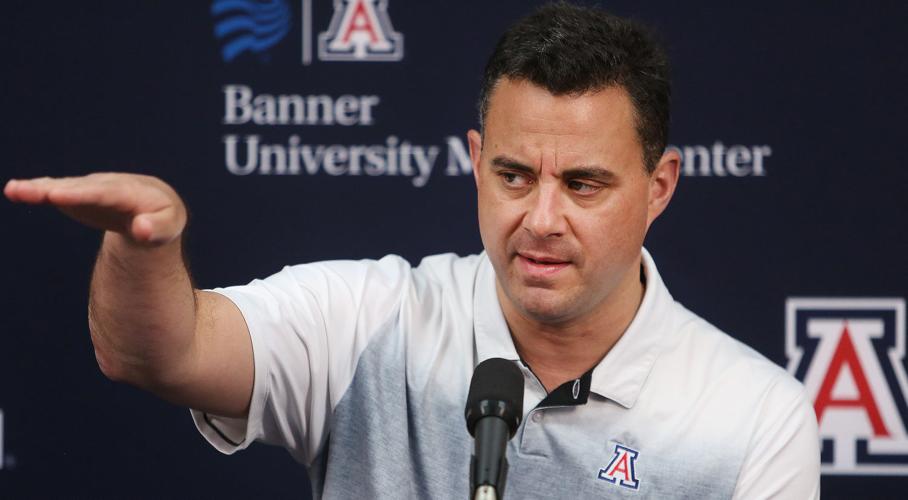
“When you guys say, ‘What have you been doing this spring?’” UA coach Sean Miller said, “I mean, I’ll do the math here: Six and five, eleven, and seven.... that’s 18 players we’re moving in or out or welcoming back.”
Another calculation: Six, six and seven. Six returnees. Six departures (four seniors and two transfers out). Seven newcomers (four freshmen and two transfers in), six of whom were signed in the past two months.
Plus a ton of phone calls and texts. A lot of travel. A lot of nervous waiting.
A lot of stress.
People are also reading…
Like those weeks in early April, when five-star wing Terrance Ferguson teased everyone with an “April Fools” announcement that never was, when the Wildcats lost top target Josh Jackson to Kansas, when signed letters from Ferguson and Alkins took longer than expected to arrive, and when names like Keanu Pinder and Dylan Smith, UA’s final two signees, were just beginning to pop on the radar.
Back then, Miller’s confident early October statement that the “hay doesn’t enter the barn until April” didn’t always look like it would be easy to back up. Miller secured only Finnish forward Lauri Markkanen during the fall recruiting period and admitted last week that there were some anxious moments earlier this spring.
“Yes,” Miller said. “Yes. Every day. This year was different for us because in the past we’ve signed more in the early period.”
Not only were there four seniors to replace, but Arizona also didn’t know immediately if Allonzo Trier (NBA draft potential), Elliott Pitts (who left the team in February for an off-court issue) and Justin Simon (who sat the bench for much of his freshman season) would return.
But Miller said his staff “anticipated right” over those question marks, keeping Trier but losing Pitts and Simon to transfers, and the Wildcats recruited to fill those two extra spots.
Miller also had several reasons to keep confidently plugging away.
For one thing, as he noted, more and more top recruits are choosing to decide in the spring, when it is clear who is leaving a particular program and what the playing time and coaching situation will really be.
UA did enter April with commitments from three five-star talents: Markkanen, Georgia guard Kobi Simmons and New York guard Rawle Alkins.
It also had reason to be optimistic about Ferguson because of Miller’s strong relationship with the elite wing, who played for Miller on USA Basketball’s U19 team last summer. He appeared to be leaning toward the Wildcats after decommitting from Alabama in March.
There was also little doubt that Miller would succeed with one of his increasingly favorite recruiting strategies: Getting transfers of any sort, be it of the graduate, four-year or junior college variety.
By the middle of this month, it all came together: Ferguson committed, Alkins and Simmons sent in their LOIs and Miller landed all three types of transfers.
Tucson native Talbott Denny was the graduate transfer, an engineering student from Lipscomb who was happy to return home and play a role off the bench next season.
The junior college transfer was Keanu Pinder, an Australian rebounder/shot-blocker who stood out at the same junior college where UA senior Kadeem Allen played. Then there was four-year transfer Dylan Smith, a late-bloomer who proved as a freshman at UNC Asheville that he has high-major potential.
The roster, finally, was full. But it was a roster that neither Miller – nor anyone, really – could have precisely named in early April, especially considering how fluid the college basketball transfer market has become.
“It happens late,” Miller said. “There are players who decide to transfer today. It’s just hard to believe. I’ll make the prediction that players will transfer as late as August now. It’s just a different world. It’s not one that everybody loves, but it’s the way it is.”
In a way, though, the transfers are exactly what Miller needs to flush out his recruiting classes: Experienced players who often must redshirt and learn the UA system for a season before hitting the floor as ready-to-go veterans.
That kind of timetable doesn’t happen often with today’s top freshmen, many of whom are often anxious to star immediately and then jump to pro ball.
Simon, a top-50 prospect in high school who played a limited role in only 24 of UA’s 34 games as a freshman last season, might have been the latest evidence of that trend.
“I definitely think Miller is adjusting to a new time in college basketball,” Scout.com analyst Josh Gershon said.
“He clearly wants (his roster) to get older, and it’s tougher to take high school kids and keep them happy, have them be patient. When you take transfers, they have nowhere to go. They have to buy in and work.”
The result is that crazy math Miller referred to.
Next season, Arizona will have five players who are juniors or older and only four true freshmen, but more than half of its roster will be new: The true freshmen plus Denny, Pinder and Dylan Smith. Smith, a sophomore, must redshirt per NCAA transfer rules.
“This year does mark almost wholesale change when you consider who has left, not just this year but over the last three years,” Miller said. “So there’s an excitement and with that excitement, there’s some anxiousness to get these guys here and start to let them know what it’s like to be part of Arizona.
“That’s why (returning players) like Allonzo and Dusan (Ristic) are so important. How they embrace these new players, and the chemistry, will set the tone for sure. But rest assured, we’re not the only program facing this challenge.
“Some of these teams that will end up in Phoenix at the (2017) Final Four are at that same stage when you consider who they lost and who’s coming into their programs as well.”