

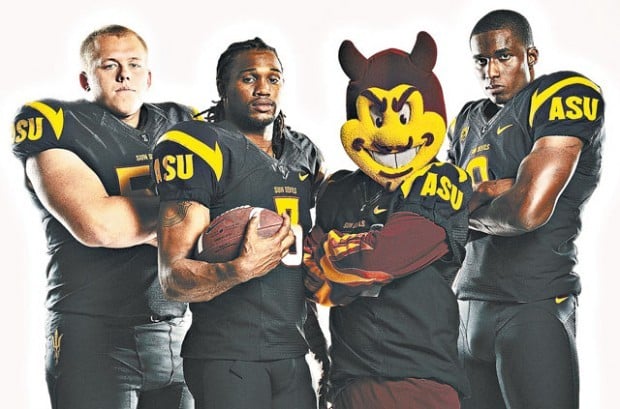
There is Black Magic, Black Friday, the Black Market, Black Sabbath and "Paint It Black," as sung by the Rolling Stones.
"I wanna see it painted, painted, painted, painted black."
But that was 1966. Today's anthem for college football should be "Men In Black."
ASU director of athletics Lisa Love last week announced that her school will incorporate black into the apparel of Sun Devil teams.
She said: "That is the color right now that actually really speaks to the generation of student-athletes that are competing now and will be recruited in the future. They love it."
Washington's football team had a "Blackout" last November at Husky Stadium - black football uniforms for the players and black shirts for the students - and whipped UCLA 24-7.
People are also reading…
USC's basketball team wore black uniforms in January and clobbered UCLA 63-52.
Even stodgy and traditional Stanford wore all-black football gear last season. The not-so-cardinal Cardinal thumped Wake Forest 68-24.
UCLA wore black basketball uniforms as far back as 1998. Not to suggest that the students loved it, but the Daily Bruin reacted to the Bruins-in-black announcement by lavishing praise on young coach Steve Lavin in an editorial that said, "Lavin is young, stylish, hard-working, debonair, energetic and one hell of a coach."
Lavin was fired a few years later. His true color was blue.
Oregon State has worn black longer than Johnny Cash, and the current fashionista of college sports, the Oregon Ducks, accessorize just about everything with black. The Ducks boast of 384 uniform/color combinations. Everything but black and blue.
When the lighting is just right, the Cal Golden Bears wear a dark shade of blue that looks as black as the Batmobile. They are accessorized by black socks and black shoes.
In "Men in Black," Will Smith sang "the good guys dress in black, remember that."
Remember this: Arizona wears all-red, all-blue, all-white and combinations thereof. UA director of athletics Greg Byrne said Monday that he has no plans to add black to the UA's wardrobe. "We are very proud of our school colors," he said.
It was two months ago today that Arizona staged a "Whiteout," which became the most extraordinary (and sexy) basketball game played at McKale Center in years.
Isn't this fun?
For 100 years, college athletics was a slow-to-change, inside-the-box industry that encouraged sameness. This could be called the Joe Paterno era.
Now the game is changing so fast that you can't keep up.
Washington State changed its uniform colors last week. Unfortunately, word of 21st century style did not reach the Palouse in time. The Cougars added more grey (and no black) to their new outfits.
Oregon State changed its logo in 2007, incorporating an interlocking O and S. Oregon followed by painting a forest of trees on its new basketball court, thereby obscuring the midcourt line. Arizona State downsized Sparky but is going to feature his pitchfork, and Cal has recently worn all-gold football uniforms.
Why the change? "This will set us apart from other schools," said Oregon State director of athletics Bob De Carolis.
The competition to be cool never ends.
Wazzu athletic director Bill Moos presented his team's color scheme last week and added that the Cougar logo "is the best logo in college athletics."
ASU's Love denied that the Sun Devils will be eliminating Sparky. "That is the best mascot in the United States," she said.
Funny how things change. Until 1946, ASU's mascot was a Bulldog named Pete. When the name was changed to Sun Devils, ASU had a singular identity that has always escaped the Arizona Wildcats (there are 27 Wildcat mascots in the NCAA).
Yet Sun Devil fans weren't quite sure what they had. In 1972, the student body voted on abolishing "Sun Devils." Fortunately, good sense prevailed by a vote of 11,122 to 3,142, and ASU continues to own one of the inimitable nicknames in college athletics.
Gone are the days that a mere coach can dictate color schemes for competitive reasons. Today, it must fit with the university's branding/marketing.
In the early 1950s, UCLA football coach Red Sanders declared that Bruins football jerseys should be a much lighter shade of blue.
No dummy, Sanders knew that the light blue jerseys and white numbers were virtually invisible on 1950s-era film. Opposing scouts often didn't know which of the Bruins actually were on the field.
In the Desert Swarm years of the 1990s, Arizona football coach Dick Tomey had his team wear tacky black shoes. Most others wore white at the time.
Why the change? "You look slower on film wearing black shoes," Tomey said. "Really."
But today, in college sports, black rides in the fast lane.
Contact Greg Hansen at 573-4362 or ghansen@azstarnet.com


