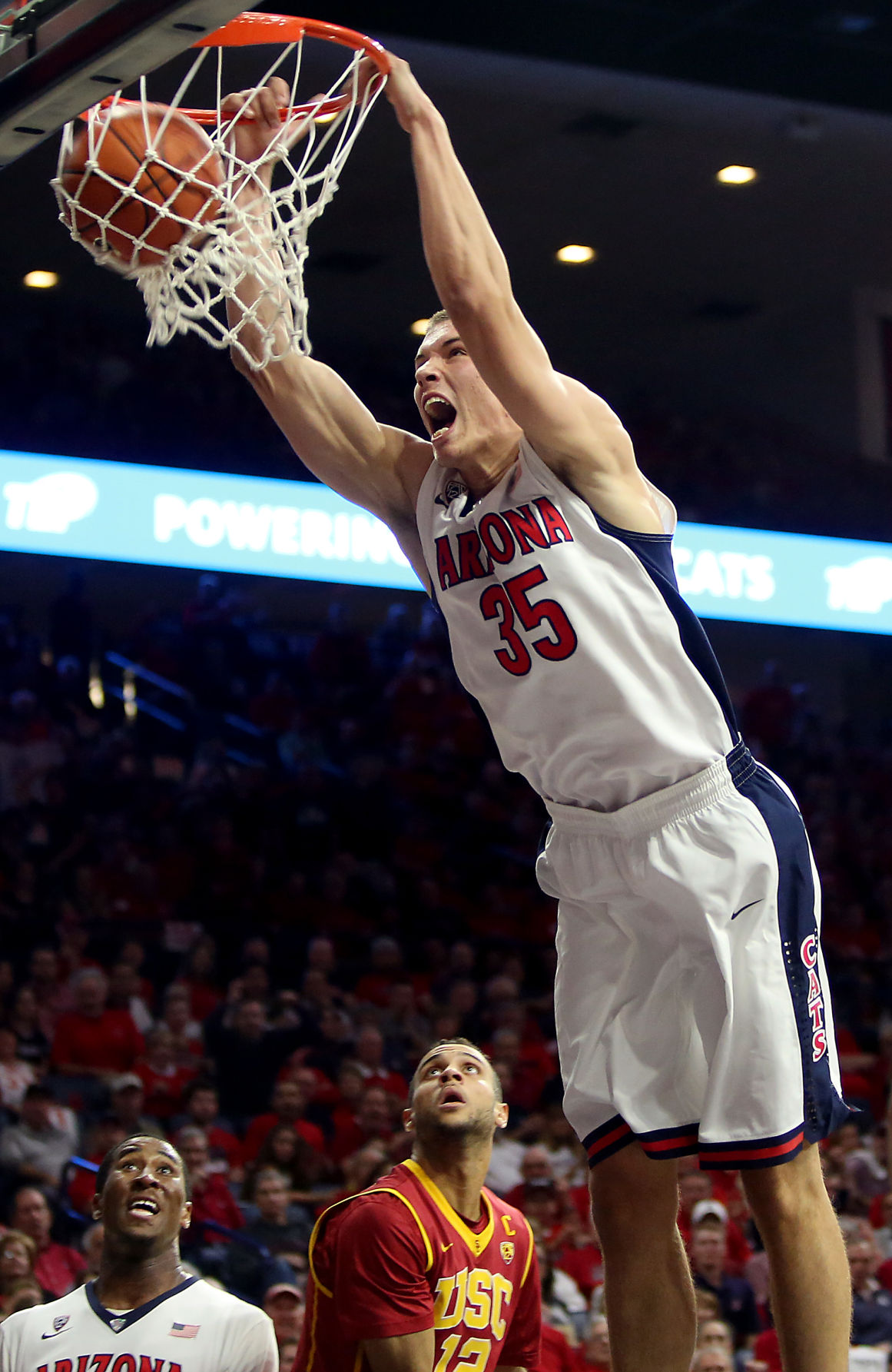
One reason Arizona blew out USC 87-57 on Thursday: The Wildcats outrebounded the Trojans 50-34, and scored 20 second-chance points off 22 offensive boards.
Last Sunday at Washington State, the Wildcats were even more dominant. UA outrebounded WSU 44-23 overall and held the Cougars to just four offensive rebounds while getting 12 of their own.
The way Sean Miller looks at it, that kind of momentum on the glass is exactly what UA needs Saturday against UCLA.
The Bruins are No. 2 in Pac-12 games behind only Arizona in offensive rebounding percentage and are No. 3 behind UA and ASU in defensive rebounding percentage, although UCLA was outrebounded 39-27 on Wednesday in its 68-66 loss at ASU.
In overall rebounding margin, the Bruins are right there, too: UA leads in Pac-12 games with a margin of 9.2 while UCLA is second at 4.2.
People are also reading…
“Rebounding is one of our great strengths and it will be tested like it never has on Saturday,” Miller said. “UCLA, in my opinion, is the best rebounding team that we’ve played other than Gonzaga.”
UCLA also mixes up defenses more than most teams, including a 1-2-2 zone with Kevon Looney at the top, and zones haven’t always been UA’s favorite thing to deal with. But the Wildcats did see some zone Thursday against USC, which could help prepare them for Saturday.
“USC played a few defenses and anytime a team plays different defenses, that prepares us for a team that might switch it up,” T.J. McConnell said. “UCLA is the same way. They’re going to throw a lot of defenses at us.”
This will be the Wildcats’ only regular-season game against UCLA, since the unbalanced Pac-12 schedule kept the Bruins away from McKale Center last season and kept UA out of Pauley Pavilion this season.
Each Pac-12 team faces four teams only once per season, and those teams flip home/away sites during a two-year period, after which four more teams are rotated in.
“I support the Pac-12 when it comes to the scheduling model,” Miller said. “We’re like a lot of conferences where you wish things were the way they used to be – well, there’s very few things right now in college basketball that were the way they used to be. So it’s all part of the round robin that we’ve come up with.”
After Kaleb Tarczewski scored 2 points on 1-for-6 shooting at ASU on Feb. 7, Miller talked it out with him.
“He felt terrible,” Miller said. “Kaleb is very self-critical. He cares a lot. Sometimes when you’re hard-working, diligent, and you care about your performance, you can also once in a while lose your confidence and I think that happened to him. It happened to him prior to that (ASU) game but it all seemed to fester on that Saturday afternoon.
“But his response is what you would want. He’s gotten back to work. He’s watched some extra film. To me, he has a renewed sense of confidence. One of the points I made to Kaleb is don’t judge yourself by the points you score. There’s so many things that he does that are valuable for winning that you don’t see in the box score. You can sometimes get away from that when you’re not scoring. But I think he’s in a good place right now.”
Tarczewski had 15 points on 6-for-11 shooting and nine rebounds against USC. He had 17 points on 6-for-6 shooting at WSU on Sunday.
Our full coverage of Thursday’s game and Jason Terry events: A game story, Greg Hansen’s column on Terry, analysis on Tarczewski, a Terry sidebar, seen-and-heard notes and a photo gallery.
Utah managed to keep pace with the Wildcats atop the Pac-12 standings by handing Oregon State its first loss at home this season. Predictably, it was not a high-scoring affair.
Matt Muehlebach and Spero Dedes broke down the game on Pac-12 Networks video.
A reminder that ESPN GameDay will be filming on Saturday morning at McKale between 8-10 a.m. if you want to attend.