Willie Mays, the electrifying “Say Hey Kid” whose singular combination of talent, drive and exuberance made him one of baseball’s greatest and most beloved players, has died. He was 93.
Mays' family and the San Francisco Giants jointly announced Tuesday night he had died earlier in the afternoon in the Bay Area.
“My father has passed away peacefully and among loved ones,” son Michael Mays said in a statement released by the club. “I want to thank you all from the bottom of my broken heart for the unwavering love you have shown him over the years. You have been his life’s blood.”

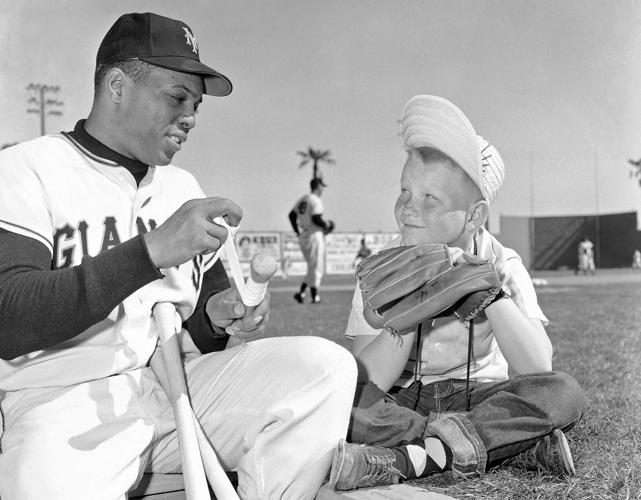
Freckle-faced nine-year-old Terry Klindt of Lusk, Wyo., admiringly watches New York Giants' Willie Mays tape a bat during a baseball spring training session in Phoenix, Ariz., in this Feb. 27, 1956, file photo.
The center fielder, who began his professional career in the Negro Leagues in 1948, was baseball’s oldest living Hall of Famer. His signature basket catch and his dashes around the bases with his cap flying off personified the joy of the game. His over-the shoulder catch of a long drive in the 1954 World Series is baseball’s most celebrated defensive feat.
People are also reading…
Mays died two days before a game between the Giants and St. Louis Cardinals to honor the Negro Leagues at Rickwood Field in Birmingham, Alabama.

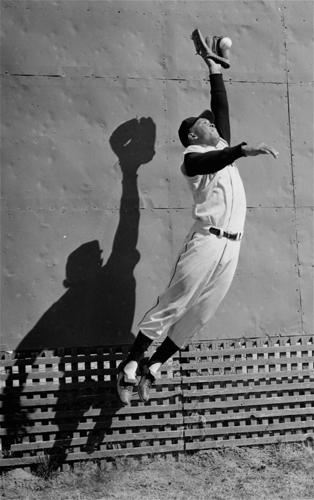
New York Giants center fielder Willie Mays leaps high to snare a ball near the outfield fence at the Giants' Phoenix spring training base, Feb. 29, 1956.
“All of Major League Baseball is in mourning today as we are gathered at the very ballpark where a career and a legacy like no other began,” Commissioner Rob Manfred said. “Willie Mays took his all-around brilliance from the Birmingham Black Barons of the Negro American League to the historic Giants franchise. From coast to coast in New York and San Francisco, Willie inspired generations of players and fans as the game grew and truly earned its place as our National Pastime. ... We will never forget this true Giant on and off the field.”
Few were so blessed with each of the five essential qualities for a superstar — hitting for average, hitting for power, speed, fielding and throwing. Fewer so joyously exerted those qualities — whether launching home runs; dashing around the bases, loose-fitting cap flying off his head; or chasing down fly balls in center field and finishing the job with his trademark basket catch.
“When I played ball, I tried to make sure everybody enjoyed what I was doing,” Mays told NPR in 2010. “I made the clubhouse guy fit me a cap that when I ran, the wind gets up in the bottom and it flies right off. People love that kind of stuff.”

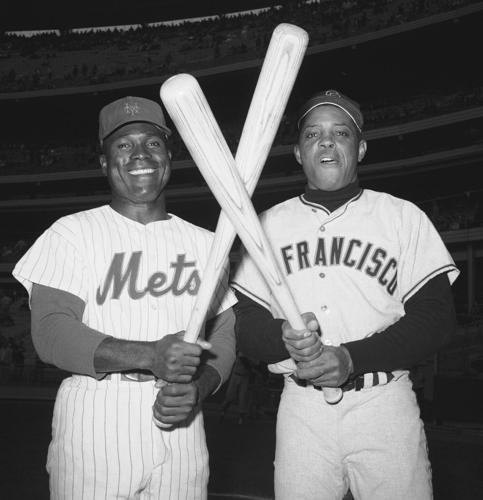
New York Mets right fielder Joe Christopher, left, crosses bats with San Francisco Giants center fielder Willie Mays at Shea Stadium on May 29, 1964, in New York.
Over 23 major league seasons, virtually all with the New York/San Francisco Giants but also including one in the Negro Leagues, Mays batted .301, hit 660 home runs, totaled 3,293 hits, scored more than 2,000 runs and won 12 Gold Glove. He was Rookie of the Year in 1951, twice was named the Most Valuable Player and finished in the top 10 for the MVP 10 other times. His lightning sprint and over-the-shoulder grab of an apparent extra base hit in the 1954 World Series remains the most celebrated defensive play in baseball history.
He was voted into the Hall in 1979, his first year of eligibility, and in 1999 followed only Babe Ruth on The Sporting News’ list of the game’s top stars. (Statistician Bill James ranked him third, behind Ruth and Honus Wagner). The Giants retired his uniform number, 24, and set their AT&T Park in San Francisco on Willie Mays Plaza.
For millions in the 1950s and ’60s and after, the smiling ball player with the friendly, high-pitched voice was a signature athlete and showman during an era when baseball was still the signature pastime. Awarded the Medal of Freedom by President Barack Obama in 2015, Mays left his fans with countless memories. But a single feat served to capture his magic — one so untoppable it was simply called “The Catch.”

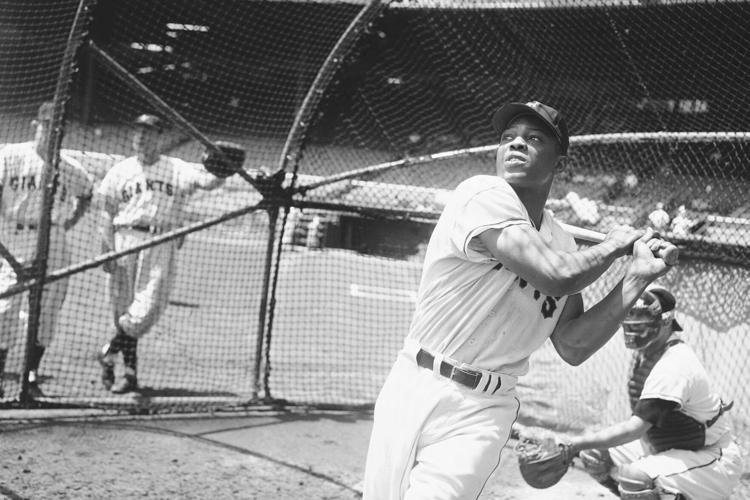
New York Giants' Willie Mays, takes a batting practice swing on June 24, 1954, in New York. The Giants center fielder, one of the game’s greatest and most beloved players, died Tuesday.
In Game 1 of the 1954 World Series, the then-New York Giants hosted the Cleveland Indians, who had won 111 games in the regular season and were strong favorites in the postseason. The score was 2-2 in the top of the eighth inning. Cleveland’s Vic Wertz faced reliever Don Liddle with none out, Larry Doby on second and Al Rosen on first.
With the count 1-2, Wertz smashed a fastball to deep center field. In an average park, with an average center fielder, Wertz would have homered, or at least had an easy triple. But the center field wall in the eccentrically shaped Polo Grounds was more than 450 feet away. And there was nothing close to average about the skills of Willie Mays.
Decades of taped replays have not diminished the astonishment of watching Mays race toward the wall, his back to home plate; reach out his glove and haul in the drive. What followed was also extraordinary: Mays managed to turn around while still moving forward, heave the ball to the infield and prevent Doby from scoring even as Mays spun to the ground. Mays himself would proudly point out that “the throw” was as important as “the catch.”

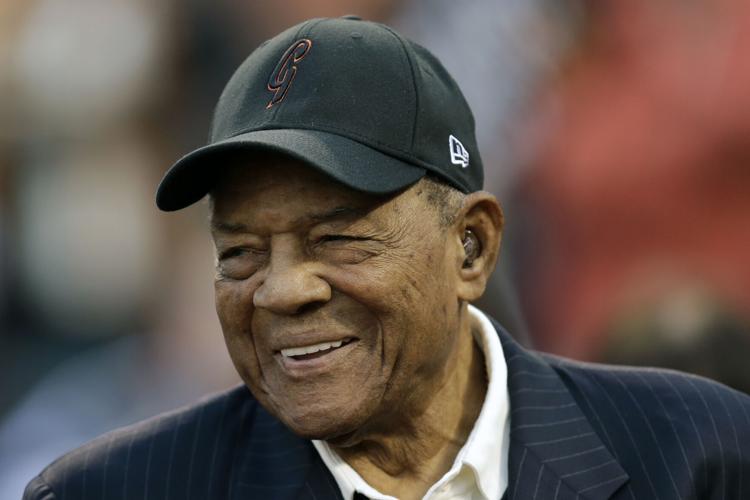
Baseball great Willie Mays smiles prior to a game between the New York Mets and the San Francisco Giants in San Francisco, Aug. 19, 2016.
Decades of taped replays have not diminished the astonishment of watching Mays race toward the wall, his back to home plate; reach out his glove and haul in the drive. What followed was also extraordinary: Mays managed to turn around while still moving forward, heave the ball to the infield and prevent Doby from scoring even as Mays spun to the ground. Mays himself would proudly point out that “the throw” was as important as “the catch.”
“Soon as it got hit, I knew I’d catch the ball,” Mays told biographer James S. Hirsch, whose book came out in 2010.
“All the time I’m running back, I’m thinking, ‘Willie, you’ve got to get this ball back to the infield.’”
“The Catch” was seen and heard by millions through radio and the then-emerging medium of television, and Mays became one of the first Black athletes with mass media appeal. He was a guest star on “The Donna Reed Show,” “Bewitched” and other sitcoms. He inspired a handful of songs and was named first in Terry Cashman’s 1980s novelty hit, “Talkin’ Baseball (Willie, Mickey & The Duke),” a tribute in part to the brief era when New York had three future Hall of Famers in center: Mays, Mantle of the Yankees and Snider of the Brooklyn Dodgers.
The Giants went on to sweep the Indians, with many citing Mays’ play as the turning point. The impact was so powerful that 63 years later, in 2017, baseball named the World Series Most Valuable Player after him even though it was his only moment of postseason greatness. He appeared in three other World Series, in 1951 and 1962 for the Giants and 1973 for the Mets, batting just .239 with no home runs in the four series. (His one postseason homer was in the 1971 National League playoffs, when the Giants lost to the Pittsburgh Pirates).
But “The Catch” and his achievements during the regular season were greatness enough. Yankees and Dodgers fans may have fiercely challenged Mays’ eminence, but Mantle and Snider did not. At a 1995 baseball writers dinner in Manhattan, with all three at the dais, Mantle raised the eternal question: Which of the three was better?
“We don’t mind being second, do we, Duke?” he added.
Between 1954 and 1966, Mays drove in 100 or more runs 10 times, scored 100 or more 12 times, hit 40 or more homers six times, more than 50 homers twice and led the league in stolen bases four times. His numbers might have been bigger. He missed most of 1952 and all of 1953 because of military service, quite possibly costing him the chance to overtake Ruth’s career home run record of 714, an honor that first went to Henry Aaron; then Mays’ godson, Barry Bonds.

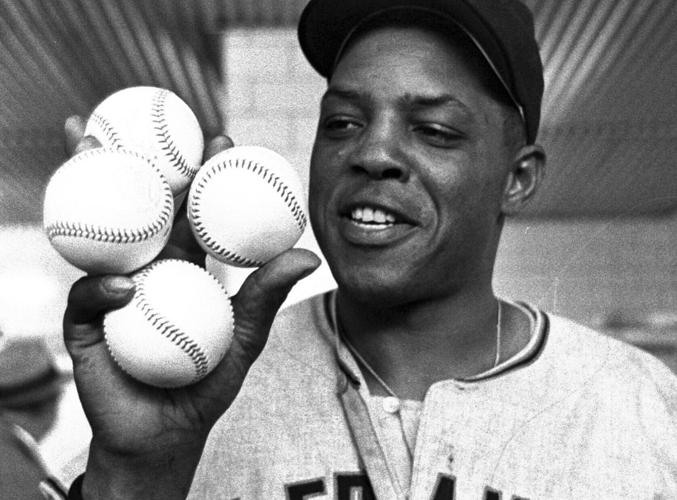
San Francisco Giants outfielder Willie Mays displays the four baseballs in the clubhouse representing the four homers which he hit against the Milwaukee Braves, April 30, 1961, in Milwaukee.
He likely would have won more Gold Gloves if the award had been established before 1956. He insisted he would have led the league in steals more often had he tried.
“I am beyond devastated and overcome with emotion. I have no words to describe what you mean to me,” Bonds wrote on Instagram.
Mays was fortunate in escaping serious injury and avoiding major scandal, but he endured personal and professional troubles. His first marriage, to Marghuerite Wendell, ended in divorce. He was often short of money in the pre-free agent era, and he received less for endorsements than did Mantle and other white athletes. He was subject to racist insults and his insistence that he was an entertainer, not a spokesman, led to his being chastised by Jackie Robinson and others for not contributing more to the civil rights movement. He didn’t care for some of his managers and didn’t always appreciate a fellow idol, notably Aaron, his greatest contemporary.

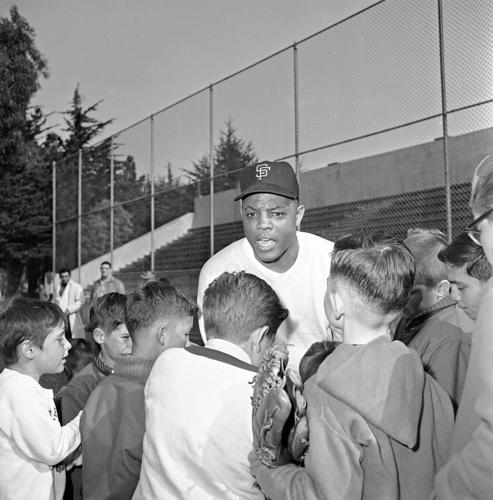
Willie Mays, star outfielder for the San Francisco Giants, found himself surrounded by youngsters when he turned up on Feb. 5, 1962, at a San Francisco public playground to have a little workout on his own.
“When Henry began to soar up the home-run chart, Willie was loathe to give even a partial nod to Henry’s ability, choosing instead to blame his own performance on his home turf, (San Francisco’s) Candlestick Park, saying it was a lousy park in which to hit homers and this was the reason for Henry’s onrush,” Aaron biographer Howard Bryant wrote in 2010.
Admirers of Aaron, who died in 2021, would contend that only his quiet demeanor and geographical distance from major media centers — Aaron played in Atlanta and Milwaukee — kept him from being ranked the same as, or even better than Mays. But much of the baseball world placed Mays above all. He was the game’s highest-paid player for 11 seasons (according to the Society for American Baseball Research) and often batted first in All-Star games, because he was Willie Mays. From center field, he called pitches and positioned other fielders. He boasted that he relied on his own instincts, not those of any coach, when deciding whether to try for an extra base.
Sports writer Barney Kremenko has often been credited with nicknaming him “The Say Hey Kid,” referring to Mays’ spirited way of greeting his teammates. Moments on and off the field sealed the public’s affection. In 1965, Mays defused a horrifying brawl after teammate Juan Marichal clubbed Los Angeles Dodgers catcher John Roseboro with a bat. Mays led a bloodied Roseboro away and sat with him on the clubhouse bench of the Dodgers, the Giants’ hated rivals.
Years earlier, when living in Manhattan, he endeared himself to young fans by playing in neighborhood stickball games.
“I used to have maybe 10 kids come to my window,” he said in 2011 while visiting the area of the old Polo Grounds. “Every morning, they’d come at 9 o’clock. They’d knock on my window, get me up. And I had to be out at 9:30. So they’d give me a chance to go shower. They’d give me a chance to eat breakfast. But I had to be out there at 9:30, because that’s when they wanted to play. So I played with them for about maybe an hour.”
He was born in Westfield, Alabama, in 1931, the son of a Negro League player who wanted Willie to do the same, playing catch with him and letting him sit in the dugout. Young Mays was so gifted an athlete that childhood friends swore that basketball, not baseball, was his best sport.
By high school he was playing for the Birmingham Black Barons, and late in life would receive an additional 10 hits to his career total, 3,293, when Negro League statistics were recognized in 2024 by Major League Baseball. With Robinson breaking the major league’s color barrier in 1947, Mays’ ascension became inevitable. The Giants signed him after he graduated from high school (he had to skip his senior prom) and sent him to its minor league affiliate in Trenton, New Jersey. He began the 1951 season with Minneapolis, a Triple-A club. After 35 games, he was batting a head-turning .477 and was labeled by one scout as “the best prospect in America.” Giants Manager Leo Durocher saw no reason to wait and demanded that Mays, barely 20 at the time, join his team’s starting lineup.
Durocher managed Mays from 1951-55 and became a father figure — the surly but astute leader who nurtured and sometimes pampered the young phenom. As Durocher liked to tell it, and Mays never disputed, Mays struggled in his first few games and was ready to go back to the minors.

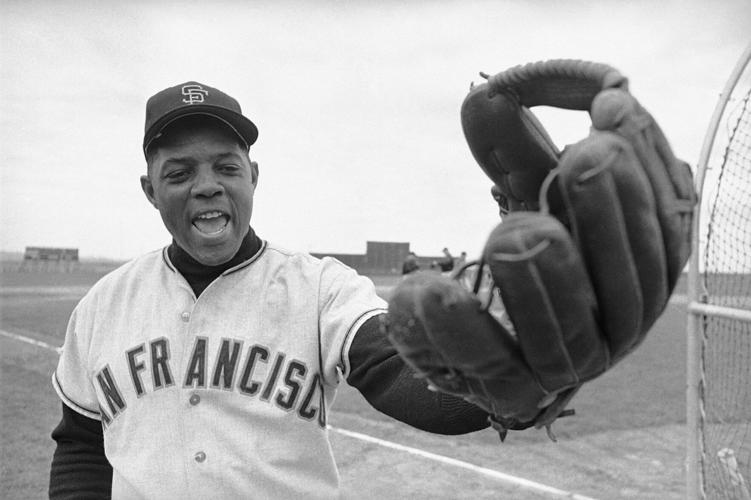
San Francisco Giants' Willie Mays is all set for workout at the baseball club's training camp at Casa Grande, Ariz., in March 2, 1964.
“In the minors I’m hitting .477, killing everybody. And I came to the majors, I couldn’t hit. I was playing the outfield very, very well, throwing out everybody, but I just couldn’t get a hit,” Mays told the Academy of Achievement, a Washington-based leadership center, in 1996. “And I started crying, and Leo came to me and he says, ‘You’re my center fielder; it doesn’t make any difference what you do. You just go home, come back and play tomorrow.’ I think that really, really turned me around.”
Mays finished 1951 batting .272 with 20 home runs, good enough to be named the league’s top rookie. He might have been a legend that first season. The Giants were 13 games behind Brooklyn on Aug. 11, but rallied and tied the Dodgers, then won a best-of-3 playoff series with one of baseball’s most storied homers: Bobby Thomson’s shot in the bottom of the ninth off Ralph Branca.
Mays was the on-deck batter.
“I was concentrating on Branca, what he was throwing, what he might throw me,” Mays told The New York Times in 2010. “When he hit the home run, I didn’t even move.
“I remember all the guys running by me, running to home plate, and I’m saying, ‘What’s going on here?’ I was thinking, ‘I got to hit!‘”
His military service the next two years stalled his career, but not his development. Mays was assigned as a batting instructor for his unit’s baseball team and, at the suggestion of one pupil, began catching fly balls by holding out his glove face up, around his belly, like a basket. Mays adopted the new approach in part because it enabled him to throw more quickly.
He returned full time in 1954, hit 41 homers and a league-leading .345. He was only 34 when he hit his 500th career homer, in 1965, but managed just 160 over the next eight years. Early in the 1972 season, with Mays struggling and the Giants looking to cut costs, the team stunned Mays and others by trading its marquee player to the New York Mets, returning him to the city where he had started out in the majors.
Mays’ debut with his new team could not have been better scripted: He hit a go-ahead home run in the fifth inning against the visiting Giants, and helped the Mets win 5-4. But he deteriorated badly over the next two seasons, even falling down on occasion in the field. Many cited him as example of a star who stayed too long.
Read more:
In retirement, he mentored Bonds and defended him against allegations of using steroids. Mays himself was in trouble when Commissioner Bowie Kuhn banned him from the game, in 1979, for doing promotional work at the Bally’s Park Place Hotel and Casino in Atlantic City, New Jersey. (Kuhn’s successor, Peter Ueberroth, reinstated Mays and fellow casino promoter Mantle in 1985).
But tributes were more common and they came from everywhere — show business, sports, the White House. In the 1979 movie “Manhattan,” Woody Allen’s character cites Mays as among his reasons for living. When Obama learned he was a distant cousin of political rival and former Vice President Dick Cheney, he lamented that he wasn’t related to someone “cool,” like Mays.
Asked about career highlights, Mays inevitably mentioned “The Catch,” but also cherished hitting four home runs in a game against the Braves; falling over a canvas fence to make a catch in the minors; and running into a fence in Brooklyn’s Ebbets Field while chasing a bases-loaded drive, knocking himself out, but still holding on to the ball.
Most of the time, he was happy just being on the field, especially when the sun went down.
“I mean, you had the lights out there and all you do is go out there, and you’re out there by yourself in center field,” he told the achievement academy. “And, I just felt that it was such a beautiful game that I just wanted to play it forever, you know.”
A look back at Baseball legend Willie Mays' life, in photos.
1951: Willie Mays

Willie Mays, slugging outfielder for the Minneapolis American Association Baseball Club, gets his ticket in Omaha, Nebraska on May 24, 1951 before leaving by plane for New York to join the New York Giants. The Giants called up May who is hitting. 477 and announced he would play against Philadelphia at night. At the left is United Air Lines clerk Lloyd Miller.
1951: Willie Mays debuts with New York Giants

Willie Mays (center), 20-year-old centerfielder, meets New York Giant manager Leo Durocher (left) and President Horace Stoneham in the club's downtown office in New York on May 25, 1951. Mays, brought up from Minneapolis in the American Association, is slated to make his debut with the Giants against the Philadelphia Phillies in a night game on May 25 at Shibe Park, Philadelphia. Mays has a .477 batting average in the American Association.
1951: Willie Mays

New York Giants outfielder Willie Mays poses at the Polo Grounds in New York City on June 9, 1951.
1952: Willie Mays

Willie Mays, New York Giant centerfielder, signs autographs at an exhibition game in Oakland, California, March 21, 1952.
1952: Willie Mays inducted into U.S. Army

Pvt. Willie Mays, of the New York Giants' outfield, hands over a pair of spikes and holds a pair of Army boots after being sent to Camp Kilmer, N.J. for processing following his induction into the U.S. Army on May 28, 1952. (AP Photo)
1952: Willie Mays

Willie Mays, centerfielder for the New York Giants, is sworn in as a private at the U.S. Army induction center at 39 Whitehall Street in New York City on May 29, 1952.
1954: Willie Mays

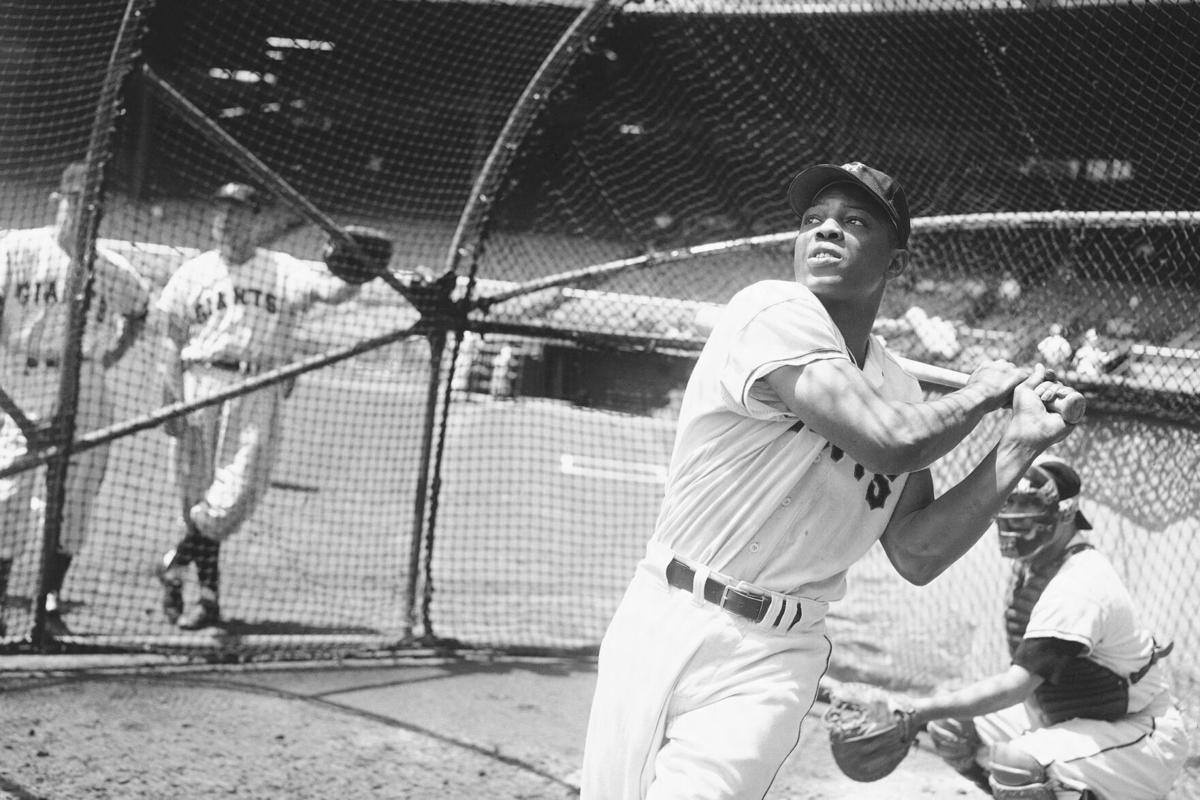
New York Giants Willie Mays, outfielder in action batting practice-swing on June 24, 1954. (AP Photo/John Lent)
1954: Willie Mays, Duke Snider

Duke Snider, left, Brooklyn center fielder, congratulates Willie Mays, Giant center fielder, in the Giants dressing room in Ebbets Field in Brooklyn, New York, Sept. 20, 1954. Snider's congratulations were twofold; The Giants had just won the National League pennant with a 7 to 1 victory over Brooklyn and Mays had replaced Snider as the leading batter in the loop. Averages: Mays .344, .Snider 340. (AP Photo)
1954: Willie Mays makes miraculous World Series catch

Running at top speed with his back to the plate, New York Giants center fielder Willie Mays gets under a 450-foot blast off the bat of Cleveland first baseman Vic Wertz to pull the ball down in front of the bleachers wall in the eighth inning of the World Series opener at the Polo Grounds in New York on September 29, 1954. In making the miraculous catch with two runners on base, Willie came within a step of crashing into the wall. The Giants won 5-2. (AP Photo)
1954: Willie Mays

Willie Mays (24) playing winter baseball in Puerto Rico is besieged by young fans after a game, Nov. 23, 1954, Puerto Rico.
1955: Willie Mays

This is a 1955 file photo showing New York Giants baseball player Willie Mays. (AP Photo/File)
1955: Willie Mays

Substituting a cowboy hat for his baseball cap and winding up a lariat, New York Giants centerfielder Willie Mays looks at if he's aiming to rope in another good season as he takes a breather from practice at team's Phoenix, Arizona, training camp, March 10, 1955. (AP Photo/Harold Filan)
1955: Willie Mays

New York Giants' hustling centerfielder, Willie Mays, bears down as usual as he blows out a candle on a cake to celebrate his 24th birthday in the Polo Grounds club house after night game with the Pittsburgh Pirates in New York, May 6, 1955. Giants had little to celebrate, however, as Pittsburgh walked off with a 3-2 victory. Willie snapped out of a short batting slump by getting two hits, one a run-scoring double. (AP Photo/Matty Zimmerman)
1956: Willie Mays marries Marguerite Wendelle

Willie Mays, fleet-footed New York Giants' centerfielder, poses with his bride of a few hours at her home in East Elmhurst, New York, Feb. 14, 1956. The Bride, 27, is the former Marguerite Wendelle. They were wed in Elkton, Md., by the Rev. Rufus L. Bond, a Giant Fan. (AP Photo/JR)
1956: Willie Mays

Freckle-faced nine-year-old Terry Klindt of Lusk, Wyo., admiringly watches New York Giants' Willie Mays tape a bat during a baseball spring training session in Phoenix, Ariz., in this Feb. 27, 1956, file photo. (AP Photo/Harold Filan, File)
1956: Willie Mays

Willie Mays, New York Giants centerfielder, takes up the task of autographing baseballs in the Giants dressing room after their game with Milwaukee was called because of rain in New York, Sept. 16, 1956. The game has been re-scheduled as a twi-night doubleheader on September 17. (AP Photo/John Lindsay)
1957: Willie Mays

Willie Mays of the Giants shows some gifts he received before the game from fans in Trenton, N.J., , where he used to play before they lost their franchise, Aug. 11, 1957. (AP Photo)
1959: Willie Mays

Willie Mays, outfielder for the San Francisco Giants, rests at home after he had 35 stitches taken in his leg, March 19, 1959. Mays split his leg open when he slid into home plate during an exhibition game between the Giants and Boston Red Son. (AP Photo/Harold Filan)
1963: Willie Mays, Casey Stengel

Willie Mays of the San Francisco Giants, sitting on a bicycle and Casey Stengel, manager of the New York Mets, are seen in New York's Polo Grounds during a tribute to Mays on May 3, 1963. Mays, a long-time favorite of New York fans, played with the Giants when they were a New York team. (AP Photo)
1965: Willie Mays hits 500th home run

San Francisco, centerfielder, Willie Mays, as he hits his 500th homer of his Major League career crosses home plate and is congratulated by teammate Willie McCovey in Houston, Texas, Sept. 13, 1965. (AP Photo)
1966: Willie Mays hits NL-record 512th home run

San Francisco Giants centerfielder Willie Mays connects for his 512th home run off Los Angeles Dodgers pitcher Claude Osteen, hereby setting a new National League record, in the fifth inning of their game on May 4, 1966, in San Francisco, California. (AP Photo)
1957: Willie Mays

Willie Mays, San Francisco Giants center fielder whose bid for the purchase of a $37,500 home was turned down by the house owner, plays catch with 14-months-old Herbert Henderson at home of the tot's parents on Nov. 14, 1957 in San Francisco. (AP Photo/Ernest Bennett)
1961: Willie Mays

In this April 30, 1961, file photo, San Francisco Giants star outfielder, Willie Mays, proudly displays the four baseballs in the clubhouse representing the four homers which he hit against the Milwaukee Braves in Milwaukee. The four homers tied the record of four homers in a single game held by nine other major league players at the time. The Giants won 14-4. Willie's homers accounted for eight runs batted in.
1968: Willie Mays

Willie Mays, the San Francisco center fielder, licks his fingers after cutting his happy birthday cake given to him by Judge Roy Hofheinz just before the game with his Houston Astros, May 6, 1968, Houston, Tex. Mays celebrated his 37th birthday with a little work in centerfield. The 569-pound cake, one pound for each of Mays home runs, contains 3,800 eggs, 150 lbs butter, 150lbs sugar, 300 lbs flour, and 100 lbs of almonds. The cake is in the figure of 24, Mays uniform under. (AP Photo/Ed Kolenovsky)
1969: Willie Mays hits 600th home run

Willie Mays (24) of the San Francisco Giants connects for his 600th lifetime home run, Sept. 23, 1969, San Diego, Calif. (AP Photo)
1970: Willie Mays connects on 3,000th career hit

In this July 18, 1970, file photo, San Francisco Giants' Willie Mays connects with the 3,000th hit of his career, a single to left, in the second inning against the Montreal Expos at Candlestick Park in San Francisco. Expos catcher John Bateman waits for pitch from teammate Mike Wegener. The umpire is Mel Steiner. (AP Photo/Robert H. Houston, File)
1972: Willie Mays

Willie Mays (in Giants uniform) at Spring Training in 1972, location unknown. (AP Photo)
1972: Willie Mays, Hank Aaron

Hank Aaron, right, exchanges a few words with New York Mets’ Willie Mays on June 2, 1972 before the Mets-Braves game at New York’s Shea Stadium. It was the first meeting of the two since Aaron tied Willie Mays’ record of 648 career home runs last week. Neither homered during the game, and both have a way to go before they match the 714 record set by George Herman “Babe” Ruth. (AP Photo/Dave Pickoff)
1972: Willie Mays, Roberto Clemente

Pirates right fielder Roberto Clemente, left, gets a hand from Mets' Willie Mays after he belted his 3,000th hit in Pittsburgh, Sept. 30, 1972. Clemente, by doing so, became one of 11 players in the history of the majors to hit that number or better. Mays is also a member of the 3,000 or better club. Pirates won the game, 5-0. (AP Photo/MB)
1973: Willie Mays

Willie Mays of the New York Mets on March 2, 1973. (AP Photo/Harry Harris)
1975: Willie Mays

Two living legends from New York sports history make their entrance from Shea Stadium’s centerfield area in New York, June 29, 1975 during the Mets Old Timers’ Day ceremonies. The numbers, of course, belong to Willie Mays (24), of the Giants and Mets, and Hall of Famer Joe DiMaggio (5) of the Yankees. (AP Photo/Harris Harris)
1979: Willie Mays elected into baseball's Hall of Fame

Former star center fielder with the Giants in New York and San Francisco, Willie Mays, gestures before microphones in New York on Tuesday, Jan. 23, 1979, after being elected to baseball’s Hall of Fame. Mays received 409 of a possible 132 votes by 10-year members of the Baseball Writers Association of American, who participate in the annual balloting. (AP Photo/ Marty Lederhandler)
1979: Willie Mays

Baseball great Willie Mays and his wife, Mae sit together on bench of the “A” train in the IND subway of New York City on Thursday, August 2, 1979. The two, accompanied by newsmen and officials of the Colgate Women’s Games, took the subway to the site of the old Polo Grounds. (AP Photo/Marty Lederhandler)
1979: Willie Mays inducted into baseball's Hall of Fame

Willie Mays holds his plaque as he waves to the crowd at induction ceremonies on Sunday, August 5, 1979 in Cooperstown, N.Y. where he became a member of the Hall of Fame. Mays played for the Giants and the Mets before retiring in 1973. (AP Photo/Rusty Kennedy)
1983: Willie Mays's number retired by San Francisco Giants

Baseball great Willie Mays waves to a crowd as the San Francisco Giants officially retire uniform No. 24 during Willie Mays Day before the Giants game against the New York Mets at Candlestick Park in afternoon on Saturday, August 20, 1983 in San Francisco. (AP Photo/Paul Sakuma)
1983: Willie Mays

Willie Mays, the "Say Hey Kid," gets a worried look from Tony Torrance, 3, during a visit at Philadelphia's Children's Hospital on Monday, Nov. 28, 1983. On behalf of his Atlantic City casino employer, Mays presented four city hospitals with $2,500 cash and gave autographed baseballs to patients and staff. (AP Photo/George Widman)
1986: Willie Mays

Baseball Hall of Fame slugger Willie Mays pulls out his retired jersey at a press conference in San Francisco on Wednesday, Feb. 13, 1986, announcing his return to the San Francisco Giants as special assistant to the club's president. (AP Photo/Jeff Reinking)
1991: Willie Mays

Former Major League Baseball great Willie Mays, wearing a Denver Zephyr’s minor league baseball team uniform, is surrounded autograph seekers and photographers at Mile High Stadium where Mays and other former major league stars played an old timers game, Saturday, June 15, 1991, Denver, Colo. (AP Photo/Joe Mahoney)
1993: Willie Mays, James Earl Jones

Baseball Hall of Famer Willie Mays accepts a tributary award from actor James Earl Jones during taping of the “Baseball Relief: An All-Star Comedy Salute” on Saturday, Oct. 3, 1993 in Pasadena, California. (AP Photo/Mark J Terill)
2005: Willie Mays, Barry Bonds

Former San Francisco Giants player Willie Mays, front, laughs at a comment by slugger Barry Bonds, rear, following a team workout Thursday, March 3, 2005, at the Giants' spring training facility in Scottsdale, Ariz. Mays is Bonds' godfather. (AP Photo/Paul Connors)
2006: Willie Mays, President George W. Bush, Laura Bush

President Bush, middle row right to left, National Baseball Hall of Fame member Willie Mays, and first lady Laura Bush, cheer during the White House Tee Ball Game on the South Lawn at the White House, Sunday, July 30, 2006, in Washington. (AP Photo/Manuel Balce Ceneta)
2006: Willie Mays

Willie Mays, right, uses his hand to chop through a large birthday cake presented in honor of his 75th birthday before the start of the San Francisco Giants baseball game against the Los Angeles Dodgers in San Francisco, in this Friday, May 12, 2006, file photo. Giants' Jose Vizcaino, left, laughs and former Giant and current broadcaster Tito Fuentes, center, applauds.(AP Photo/Eric Risberg, File)
2007: Willie Mays

Baseball legend Willlie Mays is surrounded by children from the Boys and Girls Club of San Francisco as he celebrates his upcoming birthday before the start of a baseball game between the San Francisco Giants and the Philadelphia Phillies in San Francisco, Friday, May 4, 2007. (AP Photo/Marcio Jose Sanchez)
2007: Willie Mays

San Francisco Giants Hall of Famer Willie Mays, second from right, Major League Baseball Commissioner Bud Selig, left, Giants President Peter Magowan, right, and Giants Executive Vice President Larry Baer, second from left, smile during a dedication of the Willie Mays Boys & Girls Club in San Francisco's Hunters Point area, Tuesday, July 10, 2007. Selig is in San Francisco for the All-Star Baseball Game. (AP Photo/Paul Sakuma)
2007: Willie Mays

San Francisco Giants' Barry Bonds, left, cries while making an emotional tribute to his late father Bobby Bonds, while standing with his godfather and Giants' Hall of Famer Willie Mays, right, after hitting his 756th career home run against the Washington Nationals during the fifth inning of their baseball game at AT&T Park in San Francisco, Tuesday August 7, 2007. (AP Photo/Eric Risberg)
2008: Willie Mays

San Francisco Giants Hall of Famer Willie Mays waves to fans during a pre-game ceremony honoring the 1958 San Francisco Giants before a baseball game against the San Diego Padres in San Francisco, Monday, April 7, 2008. (AP Photo/Jeff Chiu)
2009: Willie Mays, President Barack Obama

President Barack Obama, left, walks off Air Force One with Baseball Hall of Famer Willie Mays, Tuesday, July 14, 2009, after arriving at Lambert-St. Louis International Airport in St. Louis. (AP Photo/Haraz N. Ghanbari)
2011: Willie Mays

President Barack Obama and Major League Baseball hall of famer Willie Mays, hold up an autographed San Francisco Giants jersey presented to the president by San Francisco Giants manager Bruce Bochy, left, as he honored the 2010 World Series baseball champions during a ceremony in the East Room of the White House in Washington, Monday, July 25, 2011. Others are General Manager Brian Sabean, right, and pitcher Brian Wilson, center, rear. (AP Photo/Manuel Balce Ceneta)
2011: Willie Mays

FILE - In this Jan. 21, 2011, file photo, former Major League baseball player Willie Mays listens during his appearance at the San Francisco Giants' 2010 World Series trophy display tour event at the Arthur Tappan School P.S. 46 in Harlem, New York. Baseball announced on Friday, Sept. 29, 2017, they have named its World Series Most Valuable Player award after Mays. (AP Photo/Bebeto Matthews, File)
2014: Willie Mays

President Barack Obama welcomes the World Series champion San Francisco Giants baseball team, including Giants great Willie May, left, Thursday, June 4, 2015, during a ceremony in the East Room of the White House in Washington, where the president honored the 2014 World Series baseball champions. (AP Photo/Evan Vucci)
2015: Willie Mays receives Presidential Medal of Freedom

Baseball Hall of Famer Willie Mays, left, receives the Presidential Medal of Freedom from President Barack Obama during a ceremony in the East Room of the White House, on Tuesday, Nov. 24, 2015, in Washington. (AP Photo/Evan Vucci)
2016: Willie Mays

Willie Mays smiles prior to a baseball game between the New York Mets and the San Francisco Giants in San Francisco, in this Friday, Aug. 19, 2016, file photo. Willie Mays has won the inaugural Lifetime Achievement Award presented by Baseball Digest. The Hall of Fame center fielder was honored Thursday, April 22, 2021, with a new accolade to be given annually recognizing a living individual who has made “significant contributions to the national game.” (AP Photo/Ben Margot, File)
2018: Willie Mays

Former San Francisco Giants players Willie Mays, Will Clark, Kirk Rueter, Juan Marichal and Willie McCovey, clockwise from left, acknowledge fans during a ceremony to retire Barry Bonds' jersey number before a baseball game between the Giants and the Pittsburgh Pirates in San Francisco, Saturday, Aug. 11, 2018. (John G. Mabanglo/Pool Photo via AP)
2019: Willie Mays

Former San Francisco Giants player Willie Mays waves during a ceremony honoring Giants manager Bruce Bochy after a baseball game between the Giants and the Los Angeles Dodgers in San Francisco, Sunday, Sept. 29, 2019. (AP Photo/Jeff Chiu, Pool)
2020: Willie Mays

Wildfire smoke darkens the sky over a statue of former baseball player Willie Mays outside Oracle Park before a baseball game between the San Francisco Giants and the Seattle Mariners on Wednesday, Sept. 9, 2020, in San Francisco. (AP Photo/Tony Avelar)