Henri Jokiharju was a teenage rookie with the Chicago Blackhawks in 2018 when one of his assistant coaches, Don Granato, noticed a trait that’s common among young players breaking into the league.
“I think the difference with him is he’s moved from being happy to be in the NHL to determined to become a top NHL defenseman, in the top tier,” said Granato, now Jokiharju’s head coach with the Buffalo Sabres.

The next steps for Mittelstadt are uncertain. Buffalo Sabres coach Don Granato expressed hope that Mittelstadt can be considered day to day, but it was too soon to lay out a timeline to return.
Like every young defenseman, the development path hasn’t been linear for Jokiharju. He’s endured some difficult nights, particularly around the Sabres’ net, and the offensive side of his game is still progressing. But Jokiharju has made significant improvement, ascending to a top-pairing role that has him facing the opponent’s best players every night.
Only 22 years old, Jokiharju is averaging a career-high 21:18 of ice time over 30 games. He’s trusted to skate alongside Rasmus Dahlin at 5-on-5 and recently earned a spot on the second power-play unit.
People are also reading…
While people across hockey are captivated by Dahlin’s wizardry with the puck, Jokiharju has an understated approach to the position. He’s rarely the one to carry the puck across the opponent’s blue line and doesn’t take significant risks. Jokiharju relieves pressure on the breakout with a smart first pass and his preference to play conservatively complements the way Dahlin fearlessly attacks on offense.

"Granato wants to see more fire out of this team. I'm all for it. Skate. Attack. Forecheck. Make some plays. Overcome adversity for once," writes Mike Harrington.
Jokiharju doesn’t make jaw-dropping plays, aside from pinpoint breakout passes that can be overlooked by the casual observer, but he’s a stable presence on the blue line and unquestionably one of the Sabres’ top trade acquisitions in recent years.
“I love to be here,” said Jokiharju, a first-round pick of Chicago in 2017. “It’s a great opportunity, especially a young group over here. It’s going to be a good future here. We just have to work hard and hopefully we get there.”
It’s unlikely that Jokiharju will ever be much of a point producer. He’s on the power play as a placeholder until the arrival of recent first overall draft choice Owen Power and hasn’t shown the aggressive approach at 5-on-5 that typically leads to a 40- or 50-point season for a defenseman. But Jokiharju is the Sabres’ best option at right-shot defense and his ability with the puck fits perfectly with Granato’s system.
Jokiharju’s risk-averse approach led to a diminished role in Chicago upon the firing of Joel Quenneville in November 2018, leading to the July 2019 trade that sent Jokiharju to the Sabres and former first-round pick Alex Nylander to the Blackhawks. It’s become clear since Granato's promotion last March that Jokiharju is capable of more offensively.
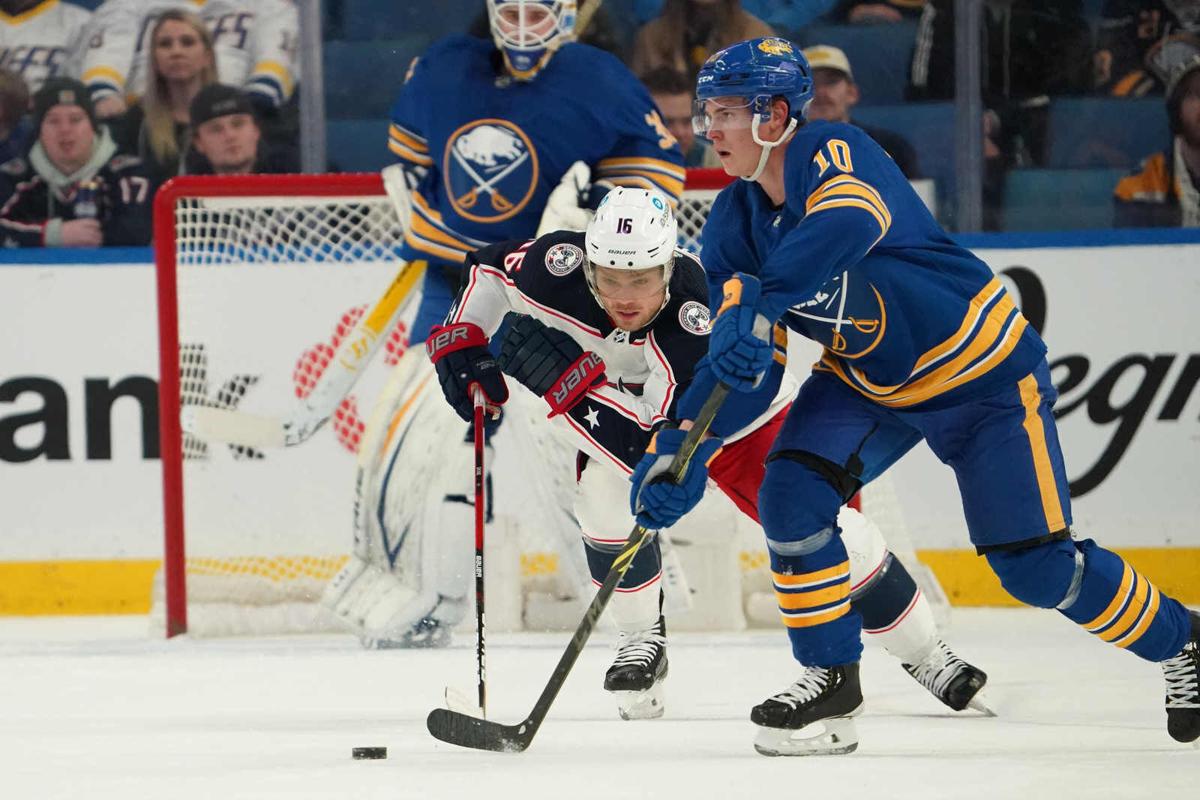
The most recent example occurred Thursday in the 4-3 overtime loss to Columbus, as Jokiharju pinched in the offensive zone to find space in the slot, collected a pass from Peyton Krebs and challenged goalie Elvis Merzlikins with a backhand shot late in the first period.

Luukkonen hasn’t played since suffering a knee injury Jan. 11, and although his talent tantalized in nine NHL appearances this season, coach Don Granato didn’t feel comfortable turning the starting job over to a prospect who has missed so much time.
“Joki has taken a big step in knowing when to take risks and when to hang back and when to support Dahls,” winger Kyle Okposo said. “When you have somebody as skilled as Ras back there, you really have to read the game very well, and I think his maturity level has grown a lot this year.”
Jokiharju and Dahlin have played more at 5-on-5 than any Sabres defense pair this season, producing a plus-1 goal differential in 336:10 of ice time. This is a case in which the analytics don’t necessarily paint an accurate picture of performance. Among the 73 NHL defense pairs to play at least 250 minutes together at 5-on-5, Dahlin and Jokiharju rank 72nd in on-ice shot quality share, according to Evolving-Hockey.com. However, the duo receives a heavy dose of defensive zone starts against the top line for a Sabres team that ranks 32nd in faceoff winning percentage.
Simply put, Dahlin and Jokiharju are on the ice in difficult situations with a variety of different linemates against the opponents’ best players. Faceoff losses lead to shots on goal and chances against, skewing the underlying numbers for the defense pair, even if they had nothing to do with how the scoring chance was created. Any difficult nights are to prepare them for the future, when, theoretically, the supporting cast will also be further along in its development.
The pair hasn’t been perfect, but Dahlin and Jokiharju have significantly improved in killing plays in the defensive zone. They routinely knock the opponent off the puck to regain possession and know how to absorb hits while starting the breakout.
“Joki’s a guy that works for his team and teammates and adjusts to Dahls,” Granato said. “Dahls is going to set the pace and create the attack. Joki’s going to be one layer off of it, ready to defend if there’s a hiccup and ready to support if there needs to be a kick-out play. He’s quick to jump to defending. … That’s been a good pair and that could be a good pair for a long time here. They’re trending that way, so we’ve got to keep them moving in that direction. They’ve been the least of our concerns, that’s for sure.”
Anderson is 5-3 in eight games this year with a 2.62 goals-against average and .917 save percentage. That has him at 296 career wins and he's racing with Dallas' Braden Holtby (298) to become the 40th goalie in NHL history to reach 300.
Dahlin was selected an NHL All-Star Game in his fourth season, piling up eight goals and 29 points while averaging a career-high 23:48 of ice time in 45 games. Jokiharju has just 34 points in 145 games with the Sabres, but points don’t illustrate his impact. He’s provided much-needed stability for Dahlin and excels in areas of the game that aren’t shown in the box score.
“We both know we don’t want anything bad for each other,” Jokiharju said of his partnership with Dahlin. “We want to see the best version of ourselves. That’s the key and knowing that better days are coming. … I feel we’re both still so young. We have to work hard. Looking around at the best d-men in the league, they’re 30 when they’re actually in their prime, so I think there’s still a long way to go.”