Editor’s note: This is part of the Star’s ongoing “Big 12 Blitz” series, where we introduce U of A fans to the on- and off-field need-to-know details surrounding each member of the new 16-team Big 12. Today: The West Virginia University, located in Morgantown, West Viginia.
The Star's Big 12 Blitz is presented by Tucson Appliance Company.


Tucson Appliance Company has something for everyone! We specialize in new, reconditioned, scratch-and-dent, and high-end appliances. Known for…
For reasons long forgotten, West Virginia began a coast-to-coast football schedule more than 60 years ago, playing at USC in 1959, Oregon in 1960, Oregon State in 1962, Cal in 1971 and Stanford in 1972
What could the Mountaineers have been thinking?

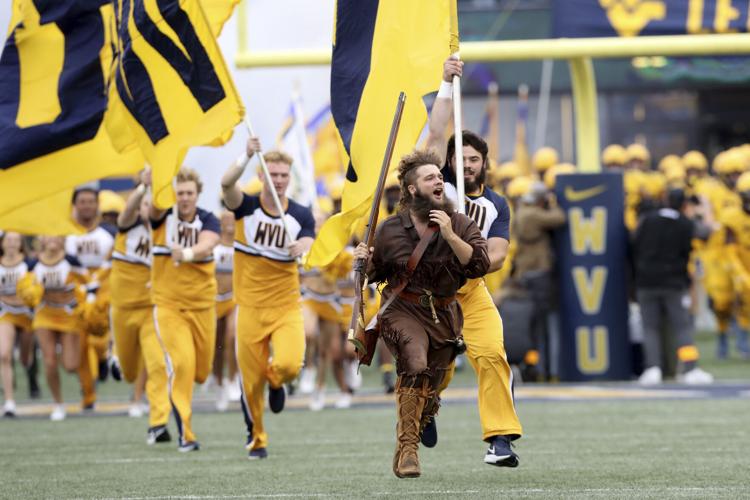
West Virginia’s Mountaineer mascot leads the team onto the field before the Mountaineers 20-13 football victory over visiting Texas Tech on Sept. 23, 2023, at Mountaineer Field at Milan Puskar Stadium in Morgantown, West Virginia.
There were no lucrative road guarantees in the ‘60s as there are today. No made-for-TV games. None of the Pac-8 teams agreed to a home-and-home arrangement, never playing in Morgantown, West Virginia.
People are also reading…

is the longtime sports columnist for the
Arizona Daily Starand
Tucson.com.
Worse, the Mountaineers lost all five games by a combined score of 158-67.
Since that failed coast-to-coast experiment, West Virginia entered 2024 having only played one regular season football game at a Pac-10/12 school, losing at Arizona State 42-7 in 1979.
The Mountaineers have never played Arizona in football; on Saturday, Oct. 26, West Virginia debuts its Big 12 rivalry against Arizona in Tucson.
One word of advice for the WVU business department: get out a map and study geography of the Four Corners, as well as your budget.
Life in a conference with Arizona, ASU, Utah and BYU is going to be a new world.
The same goes for Arizona. While Arizona has hosted WVU in men’s basketball (early 1990s) and baseball (the Mountaineers took two of three from Chip Hale’s club in early 2023, then returned in May-June of this year to win the NCAA Tournament’s Tucson Regional at Hi Corbett Field), the UA will play its first game of any kind in Morgantown in November (volleyball).
Then, Tommy Lloyd’s Wildcat men’s basketball team at some point in 2024-25 will also head to Morgantown for the first time since, strangely, Arizona played basketball in West Virginia in 1948-49 and 1950-51, a long-ago period in which the Mountaineers had a series of football coaches named Trusty, Sleepy, Pappy and Greasy.
Really.
In football, Arizona’s first season in the Big 12 will find the Wildcats traveling 10,790 miles, which is the second longest travel log in the league’s 2024 football season. You guessed it: West Virginia is traveling 11,137 football miles this year, and it’s not even visiting ASU, Utah or BYU.
The Big 12 is a conference of big borders, although nothing compared to the newly-designed Big Ten. UCLA is to travel 22,148 miles for football games this season, including those at Rutgers, Penn State and Hawaii. What a year to schedule Hawaii, huh?

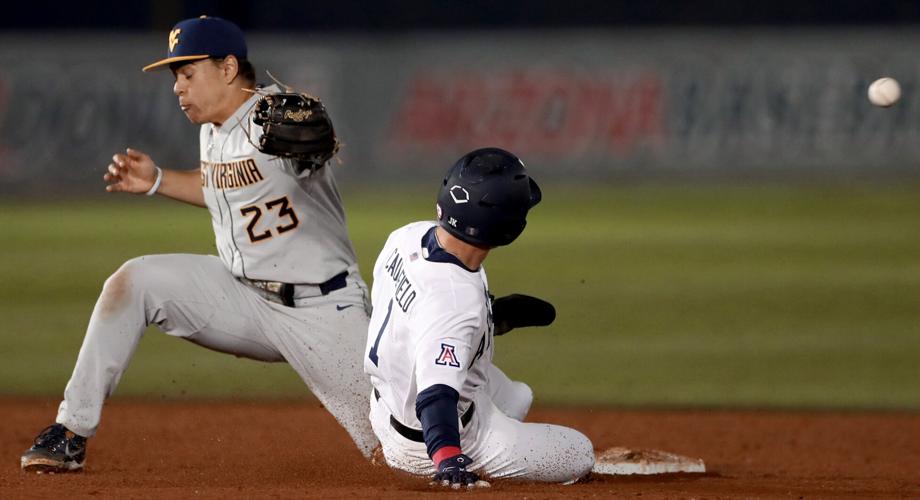
Arizona runner Garen Caulfield (1) swipes second as the the throw gets by West Virginia second baseman Ellis Garcia (23) in the 11th inning of the Wildcats’ matchup with the Mountaineers at Hi Corbett Field in Tucson on Feb. 25, 2023. WVU baseball has been to Tucson twice in the last two years: first for the aforementioned series in early 2023; then just a couple months ago for the NCAA Tournament Tucson Regional, which the Mountaineers won over Arizona, Dallas Baptist and Grand Canyon to advance to a Super Regional for the first time in WVU program history.
As far as I can determine — and I thank you for my handy phone calculator — the most miles an Arizona football team has ever traveled in one season was 16,112 in 1977. That’s when the Wildcats played roadies at Hawaii, Auburn, Iowa, Wyoming, BYU, UTEP and ASU.
Dick Tomey’s 12-1 team of 1998 almost surpassed that road log; the ‘98 Wildcats traveled 15,978 miles for games at Hawaii, Stanford, San Diego State, Washington, Cal and Oregon State.
But a season with a game at Hawaii shouldn’t really count. That adds a better perspective to Arizona’s Big 12 debut season of 10,790 miles. It is the most road mileage of any UA football team in history that doesn’t include Hawaii. In 1999, Arizona traveled 8,348 miles to play Penn State, TCU, WSU, Oregon State and UCLA.
So, yes, the mileage adds up in a hurry, especially with Arizona’s first-season Big 12 games at Utah, BYU, Central Florida, TCU and that odd non-conference matchup at Kansas State.
Most college coaches and administrators downplay the on-the-road kick-back to their young athletes.

Recent Arizona Wildcats like Isis Beh (top) and Esmery Martinez (bottom) are a couple in a handful of recent athletes or coaches to make the jump from West Virginia to Arizona (or vice versa). Beh played three seasons for the Mountaineers before heading to Tucson, and will play her second year with the Wildcats in 2024-25. Martinez similarly spent three seasons in Morgantown, West Virginia, before playing her final two at Arizona. UA women’s basketball assistant coach Bett Shelby is also one who went the Morgantown-to-Tucson route, joining the UA in 2022 after multiple years on staff at WVU.
At the recent Big Ten media day, UCLA athletic director Martin Jarmond said his staff of “sleep doctors’’ have worked with “biorhythms’’ of the athletes and will “adapt and adjust.’’
Said Jarmond: “People forget, if you’re an elite athlete, you are traveling all over the country since you are 13, 14. The kids who play 7-on-7 (football) are everywhere.”
Whatever. Traveling in today’s college athletics will take more of a toll on basketball, baseball and softball players — those who make 10 or 12 road trips per season — than a football team traveling to six games.
For example, Arizona’s 2001 Final Four men’s basketball team traveled an estimated 40,370 miles, which is surely a school record. Lute Olson’s team played in Hawaii, Connecticut, Minnesota, Illinois, Texas and Kansas, as well as its Pac-10 schedule.
Now that’s what UCLA’s Jarmond should study. So-called sleep doctors should be alerted.

Another making recent the switch between WVU and Arizona was Kerr Kriisa, a bundle of energy who played three combined years under Sean Miller and Tommy Lloyd at Arizona before transferring to WVU prior to last year. Kriisa played one season in Morgantown, but has transfered to be a Wildcat again in 2024-25 (albeit not in a return to Tucson; he'll be of the Kentucky variety).
The new Arizona-West Virginia connection comes with a caution or two. Notably, fans wanting to head east, or any teams not on charter flights, can’t get to Morgantown, West Virginia, from here. Not directly. The Morgantown Municipal Airport only has incoming flights from Pittsburgh and Washington D.C., and they are on commuter-prop-plane regional carrier Southern Airways.
Much like Arizona’s day-long Pac-12 trips to Oregon State and Washington State, getting to West Virginia usually requires a 90-minute drive from the Pittsburgh airport.
Still, in the coming years, no UA team, any sport, is likely to experience what the 1949 and 1951 Arizona basketball teams did while playing at West Virginia.
In December of ‘48, coach Fred Enke’s UA basketball team took an exhausting, 13-day journey to play games at St. Louis, West Virginia, Duquesne, Louisville and North Carolina (in Lafayette, Louisiana). They lost all five games, and covered the last 1,000 or so miles from Louisiana via bus.
It was referred to as a barnstorming journey. Whatever, it was still a winless two weeks.
But perhaps the UA-West Virginia relationship comes with good karma. In 1951, the first-ever Arizona NCAA team, 26-5, put together a pre-conference schedule that included four straight road games at Canisius, No. 1-ranked CCNY, West Virginia and Duquesne.
The Wildcats stunned No. 1 CCNY before 18,800 fans at Madison Square Garden, and then traveled eight hours via bus to play heavily favored, 6-1, West Virginia, 48 hours later.
Arizona won 68-67, on a last-second shot by Tucson’s Jack Howell, one of the enduring moments in UA basketball history, one that enabled Arizona to climb to a then-unthinkable No. 12 in the Associated Press Top 25.
Until 2024-25, an Arizona team, any sport, has not played in Morgantown since.
Country roads, take me home, right?
Contact sports columnist Greg Hansen at GHansenAZStar@gmail.com. On X(Twitter): @ghansen711

Greg Hansen
Columnist