

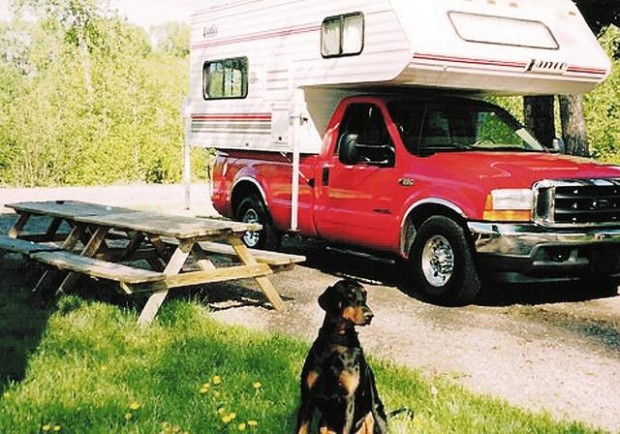
For three years, when a new friend asked Joan Fiske where she and her husband lived, she had a quick answer.
She'd point to the trailer hitched behind their SUV.
"Right there."
Such is the life of an RVer, out on the road.
No check-in times. No breakfast served only until 11 a.m. No convenience store coffee.
After Jim Fiske retired in the late 1980s, the couple decided it was time to leave their home in Virginia and see the country. They hitched their trailer to their Chevy Suburban, loaded it up and started a life of "trailering."
"When we hit the road we had two spinning wheels, a typewriter, sewing machine, golf clubs — you name it, we had it," said Joan Fiske, 82. "We wanted to see the country and this was a way to do it," she said.
People are also reading…
The Fiskes moved into a "park model" — essentially a small, nonmobile home — at Voyager RV Park several years ago, but they still relish the days they could just pick up and go, Joan Fiske said. They started spending time at Voyager in 1987 as they cruised around the country, and when it came time to give up the rambling life, they decided to stay in Tucson.
Some RVers travel without a destination in mind and just tool around the country, seeing what there is to see, while others want a more permanent kind of get-up-and-go lifestyle. Some of those folks get hired on as campground hosts at national and state parks.
The Fiskes spent months at the Cumberland Gap, where Virginia, Tennessee and Kentucky meet. She worked in the visitor center and demonstrated how to spin yarn, while he helped maintain the campgrounds.
Recreational-vehicle travel can be less expensive than staying in motels and dining out. Higher gas prices this summer aren't keeping RVers at home, but in a recent survey, 45 percent of respondents said they plan to reduce the distances they travel and more than half said they planned to spend less time on the road and more time in one place, according to Campfire Canvass, a biannual survey of RV owners by the Recreation Vehicle Industry Association.
Elisa and Joe Kinder have been RVing for 11 years. "I'm a fanatic about sleeping and eating, and I love the freedom of my own food, own pillows, my dogs," she said.
"We've grown from a tent to a camper to a bigger camper to now a Winnebago," Elisa Kinder said. "We went from the tent to a camper probably because we're getting older and it was not as fun to go rustic — we figured we owed it to ourselves to step it up a bit. Now I don't have to worry about the bugs and heat."
She likes to stay active and eat healthy on the road.
"That's extremely unusual and that's one of my pet peeves," Elisa Kinder said. "I look around and see very few people who are fit. It's just too easy to eat and roll in your car."
Because you don't have to pay for airfare, hotels or restaurant meals, a family of four can spend a quarter to three-quarters percent less on an RV trip than on other kinds of trips, according to PKF Consulting, a travel and tourism research firm.
Elisa Kinder said that their motor home gets about 10 miles to a gallon of gas, which means they can spend about $100 a day on gas when they're on the road. "But we also figure if we stayed in a fairly nice hotel — because I'm very picky about mattresses — go out to dinner and have two light meals, have our own privacy and go anywhere we want and that's for the same price, that's how we justify it."
Paula and Barney McCloskey bought a used motor home about eight months ago and just returned from their first extended trip — a three-week voyage to Iowa by way of Texas for an annual seven-day bike ride that goes from the Missouri River to the Mississippi. The couple usually rides a tandem in the event, but this year Paula drove the RV as a support vehicle and set up camp while Barney traveled by bike.
"One of the things we learned was you don't put regular gasoline in an RV that takes diesel," Paula McCloskey said. Evidently the green-pump-handle-is-for-diesel rule around Tucson doesn't hold true everywhere. They had to have their motor home towed and watch as $150 worth of gas was drained out of the tank. "That was an expensive lesson."
They spent part of their time visiting family. Paula McCloskey loved being able to park the RV under a nice tree in her sister's yard in Texas and not have to inconvenience anyone in the house by playing musical beds.
"Normally you move somebody out of their bed," she said. "So visiting family that didn't necessarily have room for you, that worked out well."
While she missed riding in the Iowa race, McCloskey was glad they had the RV. But next year she'll try to get someone to drive it for them for a few days.
"The RV really was convenient because we were able to know we would have a place to sleep," she said.
● If you fancy the idea of packing it all up and essentially driving your house around the country — or have fantasies of weeks of family togetherness as you tour the country in an RV — it might be a good idea to test it out first by renting a motor home.
"If you enjoy camping, you'll enjoy the motor home," said Jim Matthews, an agent at Cruise America, which rents 4,000 RVs nationwide. "Before you invest $50,000 to $100,000, try it out for a week. And try it for a three-day weekend before you sign up for a two-week trip."
You can rent motor homes through Voyager RV Park, too.
"It's a great way to take your family, but we have a good cross-section of people," said Susan Neipert, the Voyager RV rental director. "We rent to people who go to the race track, guys who are going hunting or fishing, people who go to the fairgrounds or the gem show."
Rental fees can run from roughly $65 to $165 a day on a drivable motor home at Cruise America, Matthews said. The good news is the national off-season is the winter, which is prime cruising time in Southern Arizona.
Voyager RV rental rates begin at $600 a week, according to the company Web site.
Be sure to ask about mileage because the flat fees often include a certain number of miles, then a per-mile rate is added to the cost.
● A few other tips
l Start small: Matthews and Neipert suggest renting a smaller motor home for your first time out, unless you have experience driving a large truck or bus. You can always supersize on a later trip.
l Practice driving: Don't hit the road cold. The dealership can offer pointers and take you for a test drive.
l Pay attention during the vehicle orientation. This is when you learn things like how to empty sewer waste, how to hook up utilities at the campground and how to operate the appliances.


