

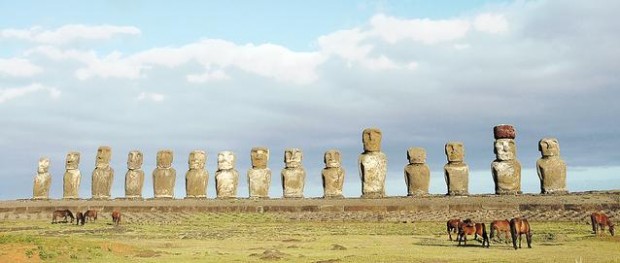
Even in the murk of a sullen, gray afternoon, the massive stone sentinels of Ahu Tongariki seem imperious, an uncompromising guard against the gluttonous sea crashing at its flank.
The shimmer of late afternoon darts through the cloudy drape in a last heady dash before the earth edges darkward. A herd of tawny horses, branded but untamed, gallops into the valley for a late-day graze. For this golden instant, the glory days of the Earth's most remote island return.
How bizarre and otherworldly this rocky outcrop must have seemed to Dutch explorer Jacob Roggeveen, who arrived here on Easter Day 1722. Many of the massive stone statues — called moai — might have been strewn on their backs and bellies across the rugged surface. Treeless and barren, the plot he dubbed Easter Island was — by some accounts — a ruin, more than halfway to dead.
Today, dozens of 12-ton moai have been resurrected with the help of modern technology. But the romance remains, drawing explorers, scientists and tourists to ponder the mysteries of the gargantuan statues and the sophisticated civilization that built them — and all but disappeared.
People are also reading…
Even if you've read the books and seen the films, visiting Easter Island is stepping into a new dimension.
About 28,000 visitors per year hop the five-hour flight from either Santiago, Chile, or Tahiti, to the "navel of the world," as locals call it. Easter Island — Rapa Nui to locals, who call themselves Rapanui — lies farthest from land of any island on Earth: 3,000 miles off the coast of Chile, to which it now belongs, and 1,240 miles from Pitcairn Island, its closest inhabited neighbor. It measures about 63 square miles.
Despite explorer Thor Heyerdahl's famed 1947 Kon-Tiki expedition suggesting Rapa Nui was settled by Latin Americans, scientists now generally agree with local legend, that Rapa Nui was established by seagoing Polynesians sometime between A.D. 400 and 800.
Scientists still debate what followed — the how and why of statue creation, tribal conflict, deforestation, disease. Some researchers, including "Collapse" author Jared Diamond, see Easter's demise as "ecological suicide" by a competition-focused culture burdened by population growth and naturally limited supplies of trees and food. Others argue that rats — brought by settlers as a food source — were the primary cause of deforestation.
Regardless of the details, it's a somber story. By the late 19th century, the local population had plummeted from a one-time swell as high as 15,000 — some say even 30,000 — to a mere 111, says China Pakarati, an island-born guide.
Yes, island-born.
About 3,800 people live here — among them most of Pakarati's 78 first cousins. The town of Hanga Roa bustles with schoolchildren, soda stands, tourist shops, low-key guest houses and hotels, an ATM. Cowboys — sans cows — canter along the main street on ATV or horseback; "We've got more horses than people," Pakarati says.
Since the airport was first built in 1967 and expanded in 1986 as an emergency landing site for the space shuttle, tourism has brought a much-needed boost to a remote isle that once saw only a single supply boat per year.
Still, isolation, far-flung government, paltry natural resources and the aftermath of European ravages — a 19th-century slave raid, disease, over-grazing — mean life isn't easy. Alcoholism, a disintegrating family structure, education limits and abuse are all issues, Pakarati says.
Still, as she shows you her island, she points to progress. Since a British sheep farming company pulled out in the mid-1900s, the land has rebounded. Once locals thought the land sustained only sweet potatoes and sugar cane, but thanks to new methods, she says, they're now farming tomatoes, broccoli, lettuce — a surge toward self-sufficiency.
But it's the statues most visitors come to see: the red-capped moai with the gleaming white eye at Tahai; the seven sea-facing statues of Akivi; the six carved guards at the beach of Anakena; the 12 elders of Tongariki.
Though you can easily rent a car and visit the moai on your own, Pakarati and other local guides offer a more penetrating view, weaving Rapanui legend and local insight with the latest scientific theories.
The statues represent not gods, as some early Europeans believed, but elders, judges, ancestral wise men. The platforms — called ahu — are sacred burial grounds; standing on them is sacrilege.
The seven statues of Ahu Akivi are the only ones to face the sea, you learn, because they represent the seven explorers sent by Polynesian king Hotu Matua "into the sun" to find Rapa Nui — an island he'd seen in a dream.
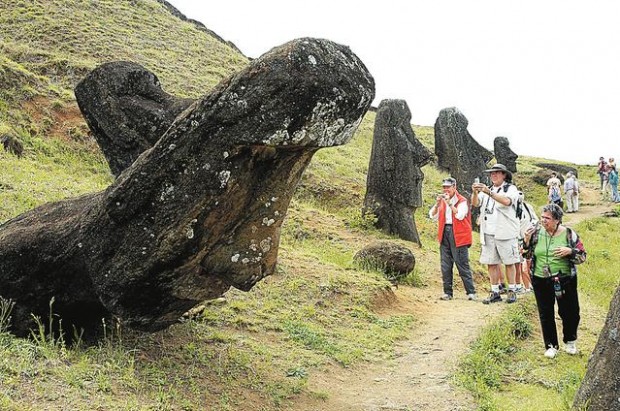
Pakarati takes visitors to Orongo, where petroglyphs mark 150 years of competition to capture the season's first sooty tern egg and to the craters whose volcanic explosions formed the island hundreds of thousands of years ago. But the most mind-jarring stop is at Rano Raraku, whose volcanic obsidian was the test tube lab of the moai.
Almost half of the 887 moai cataloged are still in the quarry. Half-shaped heads protrude above the ground, their finished bodies stretching a dozen feet beneath. Partly carved statues stagger about the slope like drunkards at an out-of-control bash. Others lie still in the rocky womb, weeks shy of final formation. Stone tools found tossed aside bear witness to sudden cultural cardiac arrest.
What happened, say researchers, is something like this: The original settlers developed into a dozen tribes, each competing to carve bigger and more impressive moai, each vying for increasingly rare resources. Once-plentiful seabirds all but disappeared. Huge trees required for fishing canoes became extinct. Farming on the rocky, windswept land became inadequate or was forgotten in the rush to build bigger, bolder moai. Hunger set in; civil war erupted; the religious and social structure failed. The chiefs lost power; statues were toppled. Cannibalism exploded.
For many, it's a cautionary tale of consequences. And one still clouded with questions — especially when it comes to the grand moai.
How did the islanders move the hulking statues from their nursery to their stations miles away, then push them into place?
Theories abound. But as with so much on Easter Island, Pakarati says, "it's still a mystery."
Information: Visit Rapa Nui: www.visitrapanui.cl. Visit Chile: www.visit-chile.org. Guide China Pakarati works with Kia Koe Tour, www. kiakoetour.co.cl.
Polynesian wonders
About Easter Island
Called Rapa Nui by descendants of the Polynesians who first settled here.
• Governed by Chile.
• Area: About 63 square miles.
• Population: About 3,800.
• Earth's most remote island, located 3,000 miles west of Chile; the closest inhabited island is Pitcairn, 1,240 miles away.
• "Discovered" by Dutch explorer Jacob Roggeveen on Easter Day, 1722
• Most of early observations stem from a four-day visit in 1774 by British explorer James Cook.
• Largest statue erected: Over 32 feet tall, 75 tons.
• Largest found: Still at Rano Raraku quarry, more than 60 feet tall and 270 tons.


