Global protests sparked by George Floyd's death at the hands of police in Minneapolis are likely never to be forgotten, but less well known are the race riots that flared across the US 110 years ago.
Those riots weren't sparked by police brutality, but by a boxing match.
In 1908, Jack Johnson became the first Black heavyweight boxing champion of the world, fighting at a time when, despite slavery having been abolished 45 years previously, African Americans were still subjected to widespread segregation and racism.
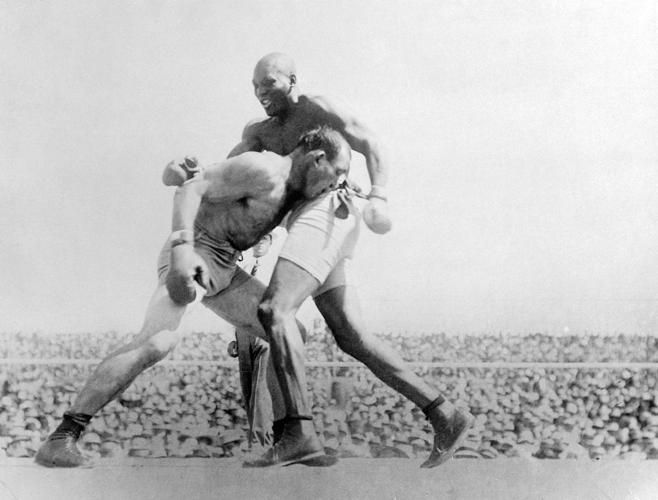
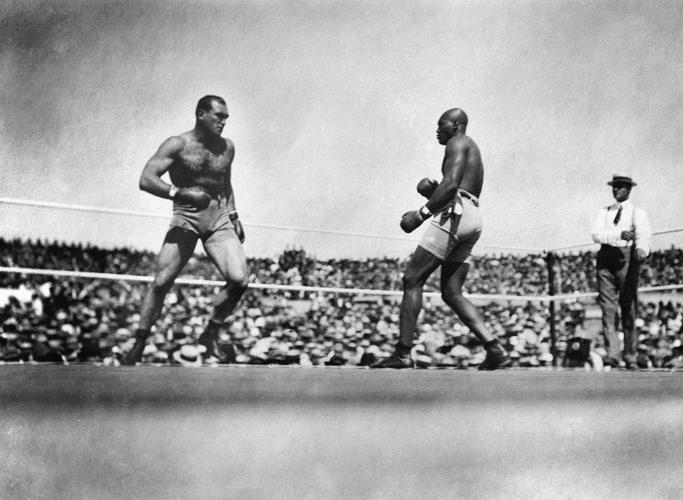
His victory over James J. Jeffries -- in what was billed then as the "Fight of the Century" -- on Independence Day in 1910, sent shockwaves through both the Black and White communities across the world.
People are also reading…
The bout was fought in Reno, Nevada, at the height of the Jim Crow laws era, when racial segregation in the US South was rigorously enforced.
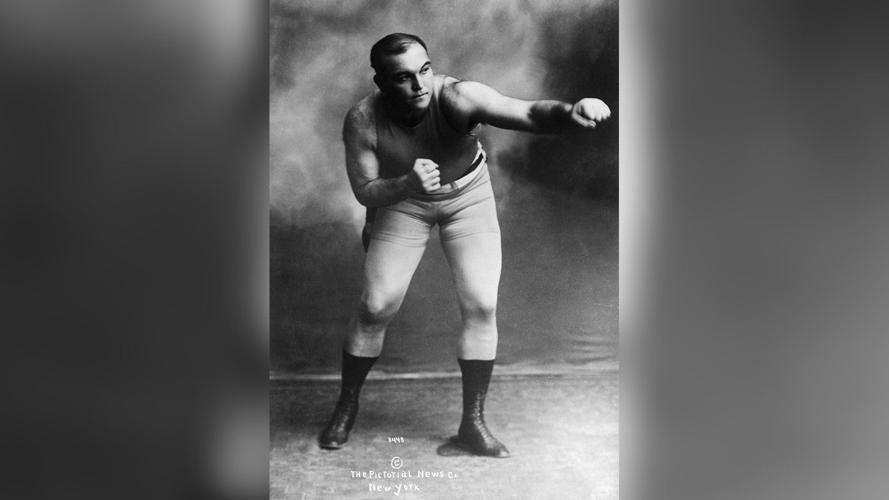
A former undefeated heavyweight champion, Jeffries came out of retirement to "to make an effort to reclaim the heavyweight championship for the White race." He added: "I should step into the ring again and demonstrate that a White man is king of them all."
Johnson's subsequent victory sparked race riots across the US, pitching a Black community -- jubilant that their champion had won -- against their White counterparts, seething with anger at the outcome of the fight. More than 20 people were killed and hundreds were injured. Most of the victims were Black.

Johnson faces Jeffries in the "Fight of the Century" in 1910.
In part due to his refusal to fight Black contenders after beating Jeffries, an extravagant lifestyle and his feud with Joe Louis, Johnson managed to somewhat alienate himself from the Black community and subsequently become something of a forgotten figure.
It wasn't until the rise of Muhammad Ali -- who recognized many similarities between himself and Johnson -- and the arrival of the Black Power era that his career and achievements became more widely appreciated, not just for his sporting prowess but for his trailblazing success in an era when racism was widespread and commonplace.
According to Theresa Runstedtler -- author of 'Jack Johnson, Rebel Sojourner: Boxing in the Shadow of the Global Color Line' -- the boxer's defeat of Jeffries "ripped the veil off of the niceties that were used to cover up the violence of White supremacy."
"[Johnson's rise to champion] signified Black possibilities at a moment when all of the regular channels of Black success, whether it be trying to get a quality education or trying to make it in business or even just trying to be involved in politics -- because there was so much widespread disenfranchisement -- this was an example of a success that couldn't be disputed," Runstedtler told CNN Sport.
"That he had defied social barriers to become the best at something when all of these other barriers were being put up in front of African Americans seeking to improve their social status, symbolically, he was super important."
Reaching the pinnacle
Perhaps what's even more remarkable about Johnson's success is that he was raised by two former slaves.
"To know that somebody in an era of just the most appalling racism decided as a very young boy that he was going to be something unique and special and then set out to do that is, people talk about the American dream, which is largely a myth, but he embodies it," according to Geoffrey C. Ward, author of 'Unforgivable Blackness: The Rise and Fall of Jack Johnson.'
As a Black fighter, he was predominately restricted to facing only Black opponents -- he fought Jeffries' younger brother in 1902 -- competing under the confines of the 'Colored Heavyweight Championship of the World' category which he won in 1903. At the time in some areas of the USA, interracial boxing was banned.

Johnson was the first African American to hold the world heavyweight boxing title when he beat Canadian Tommy Burns in Sydney, Australia.
However, then-current world heavyweight champion Tommy Burns was more open-minded, promising to defend his title against "all comers, none barred. By this I mean Black, Mexican, Indian or any other nationality without regard to color, size or nativity."
Burns initially wanted "to give the White boys a chance" first -- but Johnson finally got his shot and he took it with both hands.
In 1908, in front of a crowd of 20,000, Johnson was handily beating Burns in Sydney, Australia, before police stopped the fight in the 14th round to prevent Johnson from knocking out his opponent. Nevertheless, Johnson's victory was secure, making him the first-ever Black heavyweight boxing champion.
Given the widespread racial animosity within the American population, largely White media outlets sent out the call for a "Great White Hope" to steal the title from Johnson.
After successfully defending his title three times on US soil -- he also drew with Philadelphian Jack O'Brien -- Jeffries, who had since retired to an alfalfa farm, answered the call for a boxer to "demonstrate the superiority of the White race," Ward says.
Jeffries -- who hadn't fought for five years -- said upon accepting the fight: "I am going into this fight for the sole purpose of proving that a White man is better than a negro."

James J. Jeffries was once considered one of the greatest heavyweight champions of all time.
'Fight Of The Century'
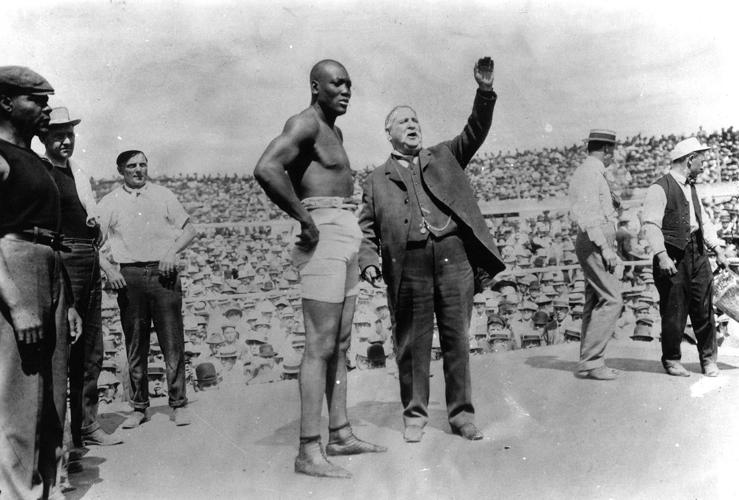
And so on July 4, 1910, in a bespoke, 22,000 capacity stadium in downtown Reno in front of an entirely White crowd, Jeffries went toe-to-toe with Johnson in what turned out to be as one-sided a heavyweight title clash as you are ever likely to see.
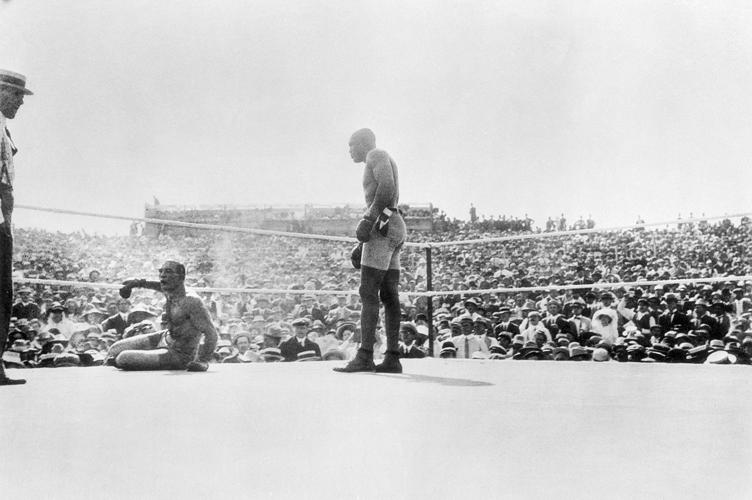
The quicker, more agile Johnson easily evaded Jeffries' lumbering attacks, knocking him down twice. Finally, during the 15th round Jeffries' corner threw in the towel.
"They basically begged [Jeffries] to come out of retirement, pump up his ego and make him think he's gonna win, and he just fails miserably at that," Runstedtler said.
Jeffries indicated after the fight his time out of the ring meant he was no longer able to compete with "The Galveston Giant." "I am not a good fighter any longer," he said. "I could not come back. Ask Johnson if he will give me his gloves."

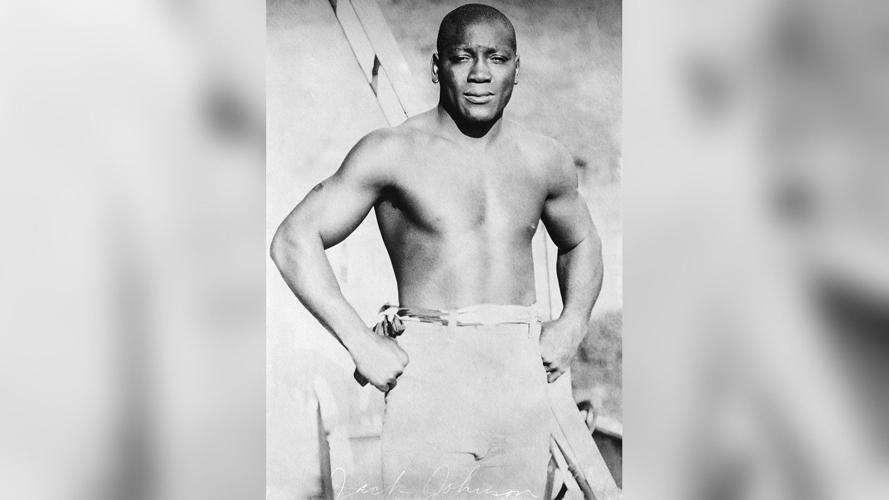
Johnson before his successful title defense against ''The Great White Hope'' Jeffries.
The result of the fight shocked those in attendance. While Johnson and his team celebrated in the ring, the audience streamed out of the stadium in eerie silence, according to Runstedtler.
Around the US though, the reaction wasn't so muted, with Johnson's victory sparking race riots across many states.
The bout was one of the first fights ever to be filmed, meaning that there was a celluloid record for all to watch. However, just days after the fight, many states and cities banned showings of the Johnson-Jeffries film.
Indeed, two weeks after the fight, former US President Theodore Roosevelt, who himself was a boxing fan, wrote an op-ed in which he supported the banning of moving pictures of boxing matches, hoping that the Johnson-Jeffries bout was "the last prize fight to take place in the United States."
From White officials in the US to colonial officials in the British empire, moves were made to prohibit the circulation of the film.
Said Runstedtler, "[They] were terrified about what this film would do to the delicate balance of power in their spaces where, in particular in the British case, often they were outnumbered by people of African descent.
"There was a huge build-up around it and so it wasn't just the fight itself, and the victory on that day, but the reverberations of it across the rest of the US and the world."

Johnson (right) knocks down Jeffries in the 15th round.
'A very flamboyant, ostentatious personal presentation'
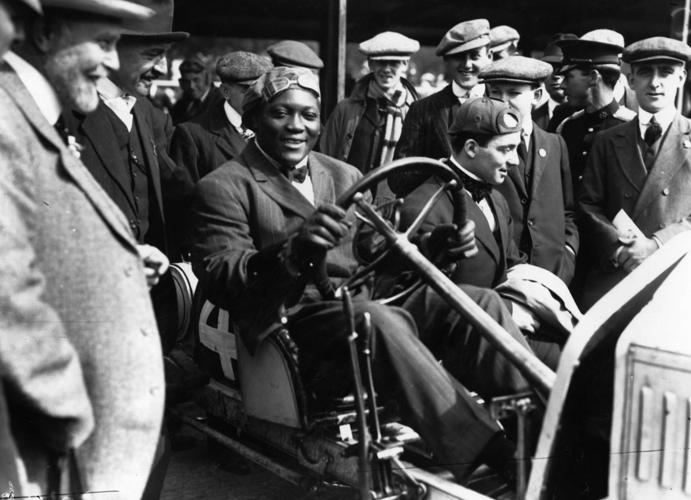
Outside of the ring, Johnson's lavish lifestyle -- notably his collection of expensive cars -- often alienated him from what people at the time perceived to be a "respectable" image of Black leaders of the day, embodied by the term "Talented Tenth," popularized by W.E.B. Du Bois.
"If you've looked at any of the photos of him, he had a very flamboyant, ostentatious personal presentation at a time when African Americans were seen by the rest of society as manual laborers or workers," Runstedtler explained.
"He was known to hang out in the vice districts of Chicago and other cities where he traveled and to cavort with the sporting crowd, the gamblers, the pimps, the prostitutes, etc."
His relationships with Black boxers after he became world heavyweight champion also didn't help. One of his Black challengers at the time, Joe Jeannette, said: "Jack forgot about his old friends after he became champion and drew the color line against his own people."
Johnson's feud with Joe Louis, world heavyweight champion from 1937 to 1949 and one of the greatest heavyweight boxers of all time, further tarnished his reputation.

Future Black fighters often tried to distance themselves from Johnson as they tried to become "paragon's of Black middle class respectability," according to Runstedtler.
"He bet against [Louis], he hoped Billy Conn would beat him, he hoped Max Schmeling would beat him," Ward noted.
"And after the first Schmeling fight in 1936 (which Louis lost), he went down on 120 Fifth Street in Harlem and showed off all the money that he had won betting against Joe Louis and the police had to rescue him from the crowd."
It wasn't until long after Johnson's death in 1946 that people started to revisit his story and the effect that he had on society, primarily because of the success of Ali and the legendary heavyweight's own interest in Johnson's life.
After going to see "The Great White Hope" -- a Broadway show based on Johnson's life, starring James Earl Jones in the lead role -- in 1968, Ali told Jones: "That's my story. You take out the issue of White women and replace it with the issue of religion. That's my story!"
At that time, Ali's refusal to fight in Vietnam after converting to Islam had resulted in his boxing license being suspended and the government taking hold of his passport. These struggles he faced were the reasons why he saw so many similarities between him and Johnson's plights.
As a result, in subsequent fights, Ali's cornerman, Drew "Bundini" Brown, could be heard shouting: "Ghost in the house! Ghost in the house! Jack Johnson's here! Ghost in the house!" to encourage Ali.

Jack Johnson (right) faced James Jeffries in Reno, Nevada in what was billed then as the "Fight of the Century."
"People within the Black community, particularly Black men, revisited his image and said: 'Wow, this guy just did whatever the heck he wanted,'" Runstedtler said. "And he embodied the kind of powerful Black masculinity that appealed to people during the Black Power era."
The Black Power movement began in the 1960's in which activists "boldly challenged the hatred and violence of an intractable system of racism and oppression," the author Joyce Marie Bell wrote.
Ali's revisiting of Johnson's story helped catapult the one-time world champion -- who had had his title stripped because of his refusal to be drafted into army service to fight in the Vietnam War -- back into the public's consciousness and also create a lineage of great Black heavyweight boxers.
Even Lennox Lewis -- three-time heavyweight world champion -- said that he would "never forget that I stand on the shoulders of Jack Johnson."
"To be honest, I knew more about Muhammad Ali," Lewis told the Guardian in 2010. "He was in our time. But I learned about Jack Johnson. Ali's contribution was profound, but Jack Johnson's was the first. It was quite a story. I am a lover of history and it was good to look again at the sort of attitudes that were about back in those days, to see how far we have come.
"Even though Black people were, in some ways, more accepted in American culture, the promoters' dream became to look for controversy. And Jack Johnson was the first great showman.
"He gave them what they wanted. Look at the time he lived. It was remarkable that he was travelling the world, as a Black man, getting arrested, leaving America, going to Europe. In the end he got old, like we all do, and he got knocked out by Jess Willard."

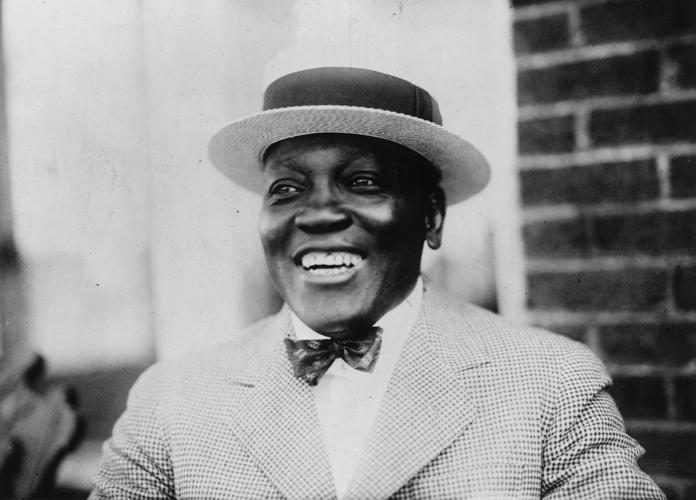
Johnson became world heavyweight champion in 1908.
The pardon
In 1913, Johnson was convicted for violating the Mann Act for transporting women across state lines for immoral purposes.
Johnson fled to Europe in 1913 while free on appeal. But after years of fights overseas, including the eventual loss of his title in Havana, Cuba, in 1915, Johnson came home where he eventually turned himself over to U.S. authorities at the Mexican border in 1920 and served 10 months in prison.
While the law had found him guilty of transporting Belle Schreiber across state lines, his Mann Act conviction was clearly "meant as a lesson to the Black folk, the world around."
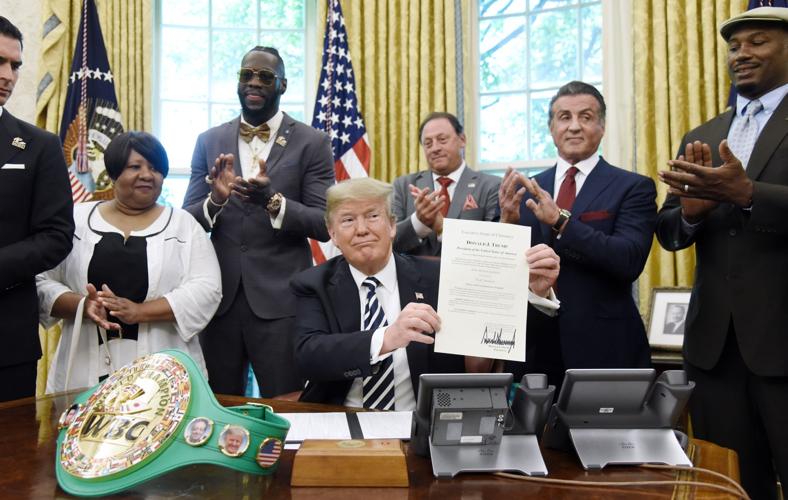
Following a long campaign initiated by documentary maker Ken Burns, and with the support of the late Senator John McCain, Mike Tyson, and Lewis among others, on May 24, 2018, 105 years after being convicted of violating the Mann Act, Johnson was posthumously pardoned by US President Donald Trump.

US President Trump holds a signing Executive Grant of Clemency for Johnson in the Oval Office with Deontay Wilder (second left) and Lennox Lewis (far right) in attendance.
And although Trump's pardoning of Johnson "brought him back into public view," Runstedtler contends Johnson's legacy of rebellion against the status quo wasn't fully acknowledged during the pardon campaign.
"(The White campaigners) don't actually want to embrace a more subversive legacy that he has, which I think is actually the more complicated one and the one that I would hope that he would be remembered for.
"Certainly the campaign to pardon him has brought him back into public view for mainstream White America and potentially folks who are boxing fans in other countries around the world. But there's still a kind of underlying or subversive aspect to his legacy, and I don't think has been fully acknowledged in that pardon campaign."
Today in sports history
A look back at major sports events that happened on July 4:
Today in sports history: The Jimmy Connors-John McEnroe Wimbledon classic in 1982
1910: Jack Johnson KOs Jim Jeffries to retain heavyweight title

1910 — Jack Johnson knocks out Jim Jeffries in the 15th round at Reno, Nev., to retain the world heavyweight title and spoil Jeffries’ comeback.
In this 1932 file photo, boxer Jack Johnson, the first black world heavyweight champion, poses in New York City. (AP Photo/File)
1919 and 1923: Jack Dempsey wins heavyweight title fights

1919 — Jack Dempsey wins the world heavyweight title at Toledo, Ohio, when Jess Willard fails to answer the bell for the fourth round.
1923 — Jack Dempsey beats Tommy Gibbon in 15 for the heavyweight title. The fight almost bankrupts the town of Shelby, Montana, which borrowed heavily to stage it.
Challenger Tommy Gibbons, left, pulled back as heavyweight champion Jack Dempsey, missed with a left during their title bout in Shelby, Montana, on July 4, 1923. The referee was Jim Dougherty, who then lived near Philadelphia, Pennsylvania. (AP Photo)
1975: Billie Jean King wins 6th Wimbledon singles title

1975 — Billie Jean King beats Evonne Goolagong, 6-0, 6-1 for her sixth and final singles title at Wimbledon.
In this July 4, 1975 file photo, U.S. tennis star Billie Jean King holds up the trophy after winning her sixth singles final at the All England Lawn Tennis Championships in Wimbledon, London. (AP Photo, File)
1982: Connors-McEnroe classic at Wimbledon

1982 — Jimmy Connors beats John McEnroe 3-6, 6-3, 6-7, 7-6, 6-4 for the men’s singles championship at Wimbledon. The match lasts 4 hours, 16 minutes.
Jimmy Connors, leaps high as he beats title holder John McEnroe, to take the Wimbledon Men’s Singles Championship title in London on July 4, 1982. He won 3-6, 6-3, 6-7, 7-6, 6-4. (AP Photo/Bob Dear)
1987: Martina Navratilova wins her 8th Wimbledon singles title

1987 — Martina Navratilova wins her eighth Wimbledon singles title and sixth straight, beating Steffi Graf 7-5, 6-3.
Martina Navratilova holds up her trophy after winning the women's singles championship for a record eight times on the Centre Court at Wimbledon, England, Saturday, July 4, 1987. Navratilova defeated Steffi Graf 7-5, 6-4 to win the championship. (AP Photo/Robert Dear)
1999: Pete Sampras beats Andre Agassi to win Wimbledon, tie record for most Slam titles

1999 — Pete Sampras overwhelms Andre Agassi in three sets to capture his sixth Wimbledon title and tie Roy Emerson’s record with his 12th Grand Slam championship. Sampras is the first man in the Open era with six Wimbledon titles.
Pete Sampras, of the United States, holds the trophy after he defeated fellow countryman Andre Agassi in the Men's Singles Final on Wimbledon's Centre Court, Sunday, July 4, 1999. Sampras won 6-3, 6-4, 7-5. (AP Photo/Adam Butler)
2004: Meg Mallon shoots record round to win Women's US Open

2004 — Meg Mallon wins the Women’s U.S. Open with a 6-under 65, the lowest final round by a champion in the 59-year history of the tournament. Mallon finishes at 10-under 274 for a two-shot victory over Annika Sorenstam.
In this July 4, 2004, file photo, Meg Mallon celebrates after putting out on the 18th green as the winner of the U.S. Women's Open Golf Championship at The Orchards in South Hadley, Mass. Mallon is one of four players to be inducted into the World Golf Hall of Fame (AP Photo/Elise Amendola, File)
2008: Dara Torres, at 41, qualifies for 5th Olympics

2008 — Dara Torres completes her improbable Olympic comeback, making the U.S. team for the fifth time by winning the 100 freestyle at the U.S. Olympic trials in Omaha, Neb. The 41-year-old wins in 54.78. A nine-time medalist, she already was the first U.S. swimmer to make four Olympic teams.
Dara Torres waves the US flag after winning the women's 100-meter freestyle final at the US Olympic swimming trials in Omaha, Neb., Friday, July 4, 2008. Torres, 41, qualified for her fifth Olympics. (AP Photo/Nati Harnik)
2009: Serena beats sister Venus Williams for Wimbledon title

2009 — Serena Williams beats her big sister Venus 7-6 (3), 6-2 for her third Wimbledon title and 11th Grand Slam championship.
Serena Williams left, holds the championship trophy, after defeating her sister Venus, who holds the runners-up trophy, in the women's singles final on the Centre Court at Wimbledon, Saturday, July 4, 2009. (AP Photo/Kirsty Wigglesworth)
2010: Rafael Nadal wins his 2nd Wimbledon title

2010 — Rafael Nadal beats Tomas Berdych in straight sets, 6-3, 7-5, 6-4, to win his second Wimbledon title and eighth Grand Slam championship.
Spain's Rafael Nadal smiles as he holds his trophy after defeating Tomas Berdych of the Czech Republic in the men's singles final at the All England Lawn Tennis Championships at Wimbledon, Sunday, July 4, 2010. (AP Photo/Anja Niedringhaus)
2011: Tyler Farrar becomes first American to win July 4 stage at Tour de France

2011 — Tyler Farrar becomes the first American to win a July 4 Tour de France stage, dominating a sprint finish in the third leg as teammate Thor Hushovd of Norway kept the yellow jersey.
Tyler Farrar of the US celebrates as he crosses the finish line ahead of Romain Feillu of France, left, Sebastien Hinault of France, third from left, and Jose Joaquin Rojas of Spain, right, to win the third stage of the Tour de France cycling race over 198 kilometers (123 miles) starting in Olonne sur Mer, Vendee region, and finishing in Redon, Brittany, western France, Monday July 4, 2011. (AP Photo/Laurent Rebours)
2014: Germany reaches World Cup semifinals for 4th straight time

2014 — Germany becomes the first country to reach the semifinals for a fourth straight World Cup by beating France 1-0 in a quarterfinal match settled by a first-half header from Mats Hummels.
Germany's Bastian Schweinsteiger, center, celebrates at the end of the World Cup quarterfinal soccer match between Germany and France at the Maracana Stadium in Rio de Janeiro, Brazil, Friday, July 4, 2014. Germany won the match 1-0. (AP Photo/Martin Meissner)