Every time tension over water shortages on the Colorado River ratchets up, a version of the same question surfaces.
"If the eastern half of the U.S. keeps flooding while the western U.S. is drying up, can't we just build a pipeline and balance it all out?"
At its core, this is a climate change conundrum if ever there was one. In each report released over recent decades by the Intergovernmental Panel on Climate Change, a recurring collaboration between hundreds of scientists from around the world, one of the most consistent and certain findings has been that a warming atmosphere is resulting in wet places getting wetter, and dry places getting drier.
The appealingly simple solution, for a brilliant species with engineering tools, of just refilling the depleted Colorado River system with overflows from eastern rivers has been considered many times. In May 2021, when storage at Lake Powell fell lower than before the reservoir was first filled in 1980, a long-distance water transfer option was confronted and dismissed as "wildly out of touch" by The Arizona Republic's water opinion writer. The concept still hit mainstream channels that September when liberal-leaning commentator Bill Maher floated the idea.
People are also reading…
The following August, as new record lows at Lake Powell failed to rise substantially after snowmelt, the debate about importing Mississippi River water reappeared and was explored at length by The Desert Sun's Janet Wilson. She consulted water experts, conservation groups and government officials who told her that, while technically feasible, a cross-country water pipeline would be prohibitively expensive, legally complex, too slow for near-term relief and would essentially constitute "swapping one ecological catastrophe for another." One of her readers wrote in to advocate for moving dissatisfied desert dwellers east to the water instead.
Yet, as Wilson wrote, the viral and zany proposal refuses to die.

The federal government is making moves to manage basin flows that are predicted to drop Lake Powell below the minimum level needed for hydropower generation by this fall.
So, as Arizona faces its most dire outlook on access to Colorado River water yet, it seemed only a matter of time before the pipeline idea bobbed back into view. With the federal government finally making moves to manage basin flows that, given this year's paltry snowpack, are predicted to drop Lake Powell below the minimum level needed for hydropower generation by this fall, the political and logistical puzzle of western water security hovers at a boiling point.
In March, Lisa Nelson, a Phoenix resident and Arizona Republic reader who okayed us sharing her name, wrote in to ask: "Have AZ leaders approached other states that have an over-abundant amount of water, and possibly flooding zones, to develop a type of channel or aqueduct or pipeline to move water to areas in AZ facing water shortages? This would obviously be a huge investment, but if it can be done with oil or gas then it should be possible with water. It seems like a no brainer solution that addresses two expensive problems: how to deal with a water shortage area and how to manage an area with too much of it. Sure it would be hard, but ancient civilizations did it and other countries are doing it now."
Nelson is right that other countries and civilizations have undertaken piping water long distances to address both flooding and drought. China's South-North Water Transfer Project is currently the world's largest such effort, diverting billions of cubic meters of water over thousands of miles each year via several routes, some still under construction.

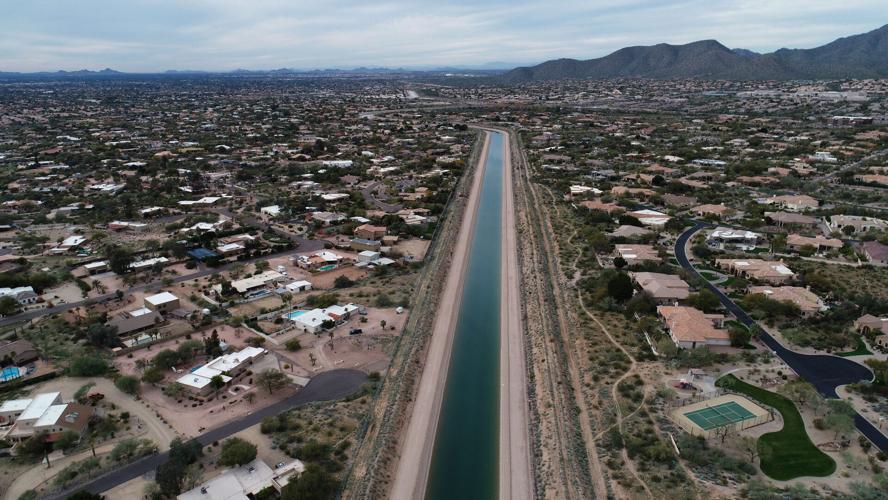
The Central Arizona Project Canal runs through Scottsdale.
At a cost of $70 billion, the project has successfully redistributed water resources to areas in need. Along the way, it has "dramatically altered natural ecosystems," introduced new diseases and parasites to previously unafflicted landscapes and destabilized local fish and aquatic networks in unpredictable ways. The construction also displaced innumerable species and humans to clear the way for a massive infrastructure fix to an even larger atmospheric problem.
Recently published peer-reviewed research papers have determined that, while China's SNWTP has temporarily improved water access for around 150 million people, the project's ever-escalating costs, environmental concerns and water rebound effects that disincentivize smart use may soon outstrip its advantages.
In the United States, traditionally stricter environmental laws that require assessment of potential damages and prevent government initiatives from automatically bulldozing through private and public lands have put domestic guardrails on such large-scale water pipelines. The enormous expense and energy required to pump water, which is heavier and less profitable than oil or gas, up and over mountain ranges have also always penciled out as politically and economically unpalatable.
With the Trump administration currently waiving a long list of environmental laws to scour a thruway over hundreds of miles along the country's border with Mexico for a wall estimated to cost around $20 million per mile, however, it's reasonable to wonder whether the modern political climate might loosen barriers.
Even so, Kyle Roerink, executive director of the Great Basin Water Network, an organization that works to promote water conservation in the West and has opposed several water pipeline projects, says that "exporting water from the Mississippi Delta will never be a sensible or reasonable solution." His list of explanations include the "astronomical cost" stemming from eminent domain, permitting, construction, energy management and staffing fees, and the intractability of managing healthful water quality over such vast distances with so many pollution inputs.
The southeastern states may also not be as eager to get rid of their water as Arizonans might assume. Coastal erosion due to climate-worsened hurricanes, drilling and other factors mean the Mississippi Delta needs all the sediment transported downstream by its major rivers. The Mississippi's flows play a role, too, in diluting agricultural chemicals, causing hypoxic dead zones in the Gulf as the region navigates its own experiences with unpredictable drought.
On top of these broad limitations — which entities across the aisle, including the Goldwater Institute, a conservative policy think tank, have deemed "cost-prohibitive" as well as practically and environmentally infeasible — there are complex legal water rights obstacles that likely run deeper than the Trump administration's ability to override.
"The issue of water rights management would be a Byzantine nightmare for such a large scale project," Roerink told The Republic. "The Mississippi isn't adjudicated under one set of laws. It is governed under many doctrines in many states. Just as in the West, eastern states have differing state laws governing water allocations in their respective jurisdictions. There are mixes of riparian and appropriation doctrines governing use. The legal framework leads me to believe that the only thing this pipeline would be good for are lawyers who practice in the U.S. Supreme Court."
None of this has stopped Arizona leaders, as reader Lisa Nelson asked about, from formally considering cross-country water pipeline proposals. In 2021, the Arizona Legislature voted to appropriate $160 million into a fund to consider importing water from as far as the Mississippi River. In late 2024, Chuck Podolak, director of the Water Infrastructure Finance Authority of Arizona, told KUNC's Alex Hager that the idea still deserves “serious attention.”
Another pipe dream to solve Arizona's water woes — a plan to desalinate and import seawater from coastal California or Mexico, which moved forward most recently in proceedings with the state finance board last fall — has also been undying.
But other elected leaders and environmentalists insist that the real and lasting solutions will be found closer to home.
"We all benefit from the careful management of those who came before us," said Phoenix Mayor Kate Gallego in an April 28 City Council meeting about water resources and drought preparedness. "However, a warming climate means less water in the rivers we depend on, including the Colorado River."
To prepare for this inevitability, Gallego said, Phoenix has partnered with tribal communities and the business and agriculture sectors to store water underground for times of shortage, increase conservation efforts, install new infrastructure to move water to where it's needed, support forest restoration projects to protect critical watersheds, and develop a regional advanced water purification facility that will serve cities across the metro area.
At the statewide level, Gov. Katie Hobbs has made Colorado River resources a centerpiece of her platform, brokering a multistate conservation deal to ease the strain in 2023, among other actions, and making preparations this March for legal action against further cuts for her state. In Congress, Arizona leaders helped negotiate $4 billion in federal funds for western drought mitigation as part of former President Joe Biden's 2022 Inflation Reduction Act.
This focus on gradually improving conservation and access to regional sources has helped keep Arizona afloat and overall water use fairly level, even as recent decades have brought rapid population growth.
"Turf removal, septic removal, water rights retirement, living within system yields, management plans and permit approval moratoriums are the best ways forward," Roerink said. "In the arid West, conservation is the first-, second- and third-cheapest options. We must reduce use in all sectors while doing more with less. There will be no utopias in these urban areas in the nation's hottest places. But we can avoid creating hellscapes."


 Arizona could be hurt by cutbacks in Colorado River water releases