The area, known as Magnolia Park, is one of Houston's oldest Hispanic neighborhoods. First laid out in 1890, it was transformed by Mexican families fleeing revolution and seeking work on the nearby ship channel. Known as "Little Mexico," it's the heart of Houston's Latino community, local leaders say.
The shooting rattled Magnolia Park, named after the 3,750 magnolias that developers planted there, in ways that extend beyond the killing itself, exposing fears in a neighborhood where many residents see stepped-up immigration enforcement as a threat to the community itself, and left them demanding answers.
People are also reading…

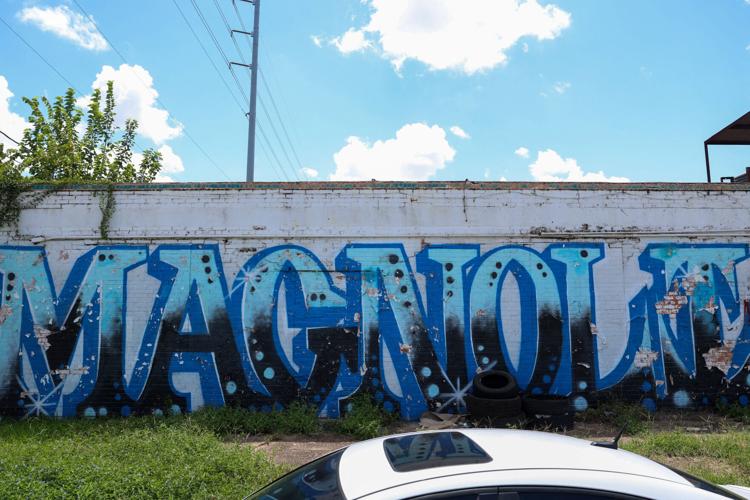
Graffiti that reads "Magnolia," the name of the neighborhood, is seen Thursday near the location where an ICE officer shot and killed Mexican motorist Lorenzo Salgado Araujo in Houston.
"The fear, it's real now … It's something this community has never seen before. It was always a happy community, fun, festive, music, smells of barbecue in the air," said Jesse Rodriguez, an art historian and community leader who, along with his wife, converted one of their ancestral homes to a museum about Magnolia Park.
"This happened here in our yard," he continued, wearing a T-shirt that listed every street in the neighborhood. "What I see is how these people fear every day just to go work," he added, saying that local residents are not planning to be quiet and remain behind closed doors.
Street protests
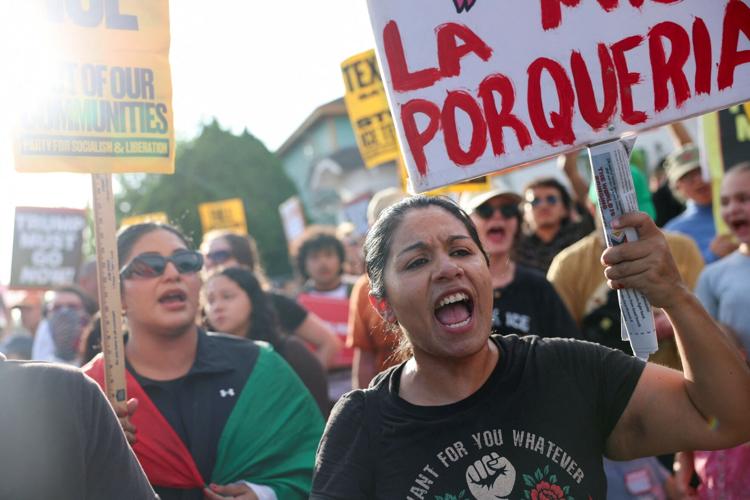
Community anger spilled into the streets. More than 1,000 protesters marched Wednesday near the shooting site before about 100 remained for a candlelight vigil.

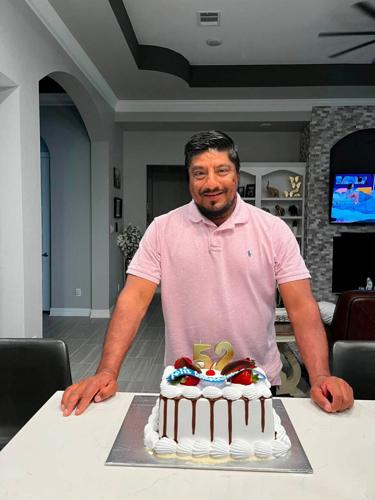
Lorenzo Salgado Araujo stands behind a birthday cake in an unknown location in this this picture obtained from social media and released Wednesday.
ICE claims Salgado, a Mexican national living in the U.S. illegally for three decades, rammed his van into an agency vehicle and tried to run over an officer, who then fired on him.
Salgado's family disputes the ICE account of the shooting and demanded an independent investigation. The father of three and a construction worker lived in Houston for 35 years and was in the process of obtaining a work permit, relatives said at a Wednesday news conference.
The Department of Homeland Security said on Thursday that the officers involved in the incident weren't issued body-worn cameras.
The Mexican government said Thursday it would examine possible criminal complaints in the U.S. involving the deaths of Mexican citizens in immigration custody or enforcement operations. A few FBI agents were seen entering businesses directly across from the scene on Thursday, according to a Reuters witness.

People attend a vigil Wednesday after an ICE officer shot and killed Mexican motorist Lorenzo Salgado Araujo in Houston.
Immigrant roots
When federal agents move through a neighborhood whose identity is rooted in immigration, it can feel "like an invasion of sorts," said Néstor Rodríguez, a sociology professor at the University of Texas at Austin.
"They're not just going into disjointed communities where people don't know each other. These are people whose family history is based there," he continued.
Magnolia Park is 97% Hispanic and 44% are immigrants, according to Houston-based arts nonprofit Magnolia Park Arts & Community. In the broader city of Houston, about 44% of the population is of Hispanic origin, according to U.S. Census Bureau data.
'Just trying to survive'
As calls for independent investigations increase, it remains to be seen if the incident will spark broader protests in Houston of the sort that have emerged in cities like Chicago and Minneapolis.
The city reacted to past events with protest, especially in the 1970s and 1980s, said Brandon Rottinghaus, a political science professor at the University of Houston.
But he said Houston has traditionally leaned more "politically apathetic."
Back in Magnolia Park, the community is upset and frustrated, said Maria Rosas, 32, an accountant who grew up in the neighborhood.
"I think we're all frustrated at the continuing raids and hauling of hardworking people who come here to provide for their families, provide a better future. They're not causing any harm, they're just trying to survive," Rosas said.