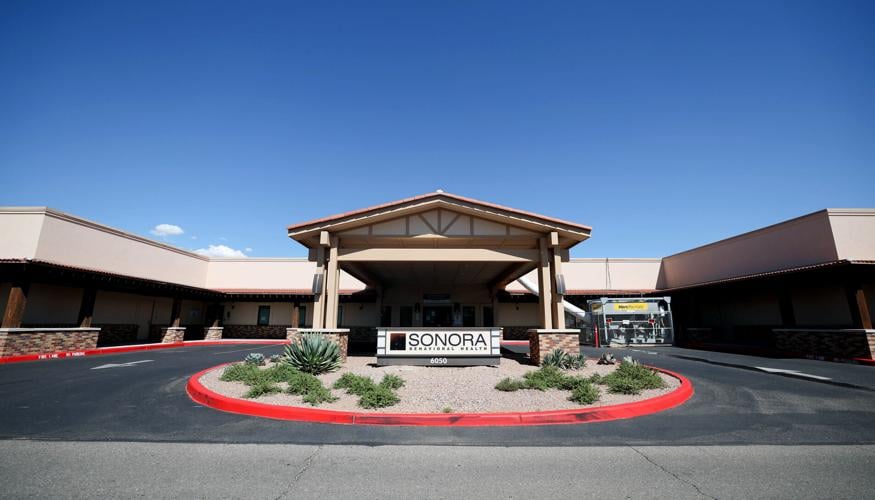
Bluesky Thomas arrived at Sonora Behavioral Health on Oct. 2, 2025. Less than three weeks later, Thomas died of blunt force trauma, and his death was ruled a homicide.
The 44-year-old Thomas was homeless, mostly living outdoors on reservation land, his family told authorities. He had no history of violence, nor did he have any mental health diagnoses that his family was aware of, a Pima County Sheriff’s Department report says.
Prior to being admitted to Sonora, Thomas was held on charges of criminal damage at the Department of Rehabilitation and Supervision, which serves as the jail for Gila River Indian Community police.
Thomas was transferred from jail to the privately-owned 140-bed psychiatric hospital in northwest Tucson after showing signs of psychosis, his autopsy report says.

Sonora Behavioral Health Hospital is one of 11 Arizona special hospitals with a licensed capacity for 100-149 beds.
During his stay, Thomas was cooperative and calm, mostly keeping to himself, multiple staff members told authorities. He had no reported issues with staff or fellow patients.
People are also reading…
Then, on the evening of Oct. 20, 2025, 18 days after being admitted, Sonora staff initiated an emergency code when Thomas became unresponsive.
Sonora staff escorted responding firefighters to Thomas’ room.
Inside, firefighters found an unconscious Thomas bleeding from his mouth with several teeth missing.
When asked what happened, workers told firefighters they had given Thomas a sedation shot, left him alone in his room and came back to find him unresponsive.
Thomas was taken to the nearby Northwest Medical Center.
While Thomas was at Northwest, Sonora staff called about 12 times to request information about him, a Northwest nurse told investigators. The nurse added that the calls were aggressive in nature, and the amount of them was unusual. Hospital staff refused each time on grounds it would be a HIPAA violation.
He died at the hospital the next day.
During the autopsy, examiners found Thomas suffered trauma to the head, neck, torso and extremities, including a broken neck, missing teeth and a lacerated liver. The Pima County Office of the Medical Examiner deemed the death suspicious and notified the sheriff's department.
Detective: Cover up suspected
An 89-page PCSD incident report recently obtained by the Star gives a detailed chronology of what investigators say led up to firefighters' arrival.
When a sheriff’s deputy initially went to Sonora to investigate the incident, staff denied him access to any security footage or information about Thomas.
Instead, a Sonora official told him Jasmine Wiggs, the facility’s director of risk management, would contact the department.
Wiggs told an investigating detective she had called police about the incident, the report says. However, no 911 calls of the sort were documented on that day.
The detective noted there appeared to be a cover up “and stonewall efforts for investigation.”
Through subpoena, investigators accessed security footage from the incident. Combined with witness statements from other staff members, firefighters and hospital staff, investigators put together a timeline of events.
Around dinnertime on Oct. 20, 2025, Thomas’ behavior suddenly changed, the report says. He began checking door handles and pounding on doors.
At about 5:24 p.m., per order of a Sonora doctor, Thomas is given a shot of Haldol, Ativan and Benadryl, a drug cocktail designed to sedate aggressive patients.
“Bluesky took the shot with no issue,” the report says. He then returned to his room alone.
Four minutes later, Thomas left his room and tried to use the patient phone to call 911. He then started throwing crayons, fruit and other small items onto the floor.
Thomas’ actions were not directed at anyone and not intended to harm anyone, the detective noted, adding that his behavior was akin to “a child throwing a tantrum.”
A Sonora worker escorted Thomas back to his room.
As other patients began to return from dinner, the same doctor who ordered giving Thomas the shot instructed staff to keep him in his room.
The worker who escorted Thomas then entered his room and closed the door as a Sonora nurse stood in the hallway. Bryce Coleman, 28, a fellow employee and former University of Arizona running back, joined the nurse by the door.
After the worker stepped out of the room, Coleman moved to block the doorway and pushed Thomas.
Half a minute later, Coleman pushed Thomas again.
After another 30 seconds, Coleman pushed Thomas a third time.
Each time, Coleman’s shoves became more aggressive, the report says. During the fourth and final documented push, the former football player “gets low, drives up, and into the room pushing Bluesky back.”
After the last push, Thomas was not seen to be moving or responsive.
The three stood near the door talking, and the worker mimicked a body slam movement.
Coleman and the nurse then entered Thomas’ room outside of the camera’s view.
Over the following few minutes, more staff showed up.

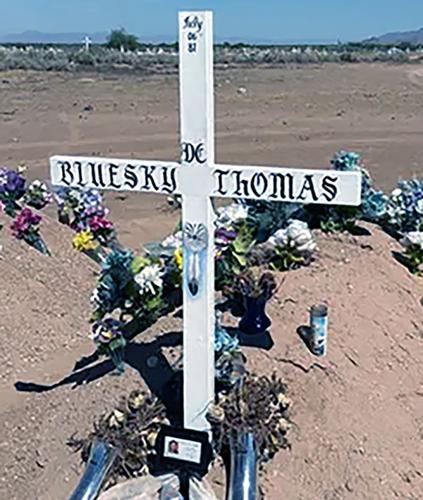
Bluesky Delray Catha Thomas, 44, is buried in the Vah-Ki District of the Gila River Indian Community near Phoenix. He died Oct. 21, 2025, of blunt force injuries after an incident at an Arizona psychiatric hospital where he was a patient.
At 5:49 p.m., roughly 12 minutes after Thomas was last seen responsive, firefighters arrived.
Coleman and the two others who kept Thomas in his room were fired after the incident.
“Bluesky would still be alive today had he not had this encounter with Bryce Coleman and/or the other resources made available to him would have been utilized,” the report concludes.
On June 12, the PCSD issued a warrant for Coleman’s arrest on suspicion of manslaughter.
During the department's repeated attempts to contact Coleman, he told authorities he would check with his lawyer to see what he should do.
On June 15, Coleman turned himself in and was booked into the Pima County jail.
After hearing witness testimony during a preliminary hearing on July 6, a judge ruled there was insufficient evidence, effectively dismissing Coleman's case, court records show.
Despite repeated attempts by the Star to contact Sonora, the facility would not answer any questions or issue a statement.
After Coleman’s arrest last month, a Sonora spokesperson told the Arizona Republic the facility “has cooperated and will continue to fully cooperate with authorities.”
An ongoing pattern
After Thomas’ death, the Arizona Department of Health Services conducted an inspection stretching from Oct. 23 through Nov. 4, 2025.
During its inspection, the department found Sonora had used unapproved restraint techniques and did not comply with state requirements for emergency response.
Sonora is one of 11 Arizona special hospitals with a licensed capacity for 100-149 beds which have had at least one complaint made against them in the past three years, said Madga Rodriguez, a spokesperson for ADHS.
Over the past three years, those 11 facilities averaged 11.7 complaints, which is just over half of the 23 complaints made against Sonora during that same time. Following each complaint, ADHS inspects the facility.
In those three years alone, Sonora was fined $19,000 for policy violations.
The most recent of those penalties came in February when Sonora was fined $10,000 for using improper restraint monitoring and techniques, not completing proper medical screen examinations, not giving patients the right medications, not taking vitals of restrained patients, not conducting proper observation of patients, not accurately documenting patients’ medical information and failing to train nurses to appropriately respond to an emergency.
The state deemed that Sonora’s violations caused harm to patients and ultimately a patient’s death.
Earlier violations which resulted in fines include not reporting the sexual assault of a minor patient to law enforcement, not treating or examining a patient following a suicide attempt, admitting patients beyond licensed unit capacity and not monitoring patients who were “sexually acting out.”
In addition to state inspections, Sonora has faced numerous civil lawsuits, including at least five wrongful death lawsuits.
In 2016, a recently widowed man sued after his wife died in an apparent suicide during a stay at Sonora. While the on-shift nurse was getting coffee, the plaintiff's wife, who had been labeled at risk for self-harm, hung herself with bedsheets, a civil complaint alleged.
Many behavioral health facilities use breakaway sheets to prevent patient self-harm.
After a two-year legal battle, the plaintiff and Sonora came to a confidential, out-of-court settlement.
Several other lawsuits stemmed from claims that negligent care resulted in patients facing ongoing trauma.
An 8-year-old patient, who suffered from PTSD after being sexually assaulted two years earlier, was sexually assaulted by his roommate at Sonora in 2018. Despite the young boy screaming out for help, no employees came to stop the assault, a civil complaint alleged.
That case was settled out of court, too.
In another suit, a 6-year-old patient reported being sexually assaulted by his roommate during a 2024 stay at Sonora. In the ongoing case, Sonora’s lawyer's response to the civil complaint denies any negligence on the facility's part.
In May 2024, a woman involuntarily committed to Sonora fell into a deteriorated state stemming from lithium toxicity, an ongoing lawsuit from this year alleges. After 16 days at Sonora, she was transferred to the emergency department of a local hospital, where she was put into a medically induced coma and underwent emergency dialysis.
Hospital workers found injuries consistent with rape and physical abuse, the civil complaint says. When she awoke from the induced coma, she had memory of being raped while in the vulnerable state.
While she was in the facility, a Sonora employee reported to a supervisor that another employee physically abused the plaintiff, the complaint says.
Acadia Healthcare, Sonora’s parent company, has also fallen under scrutiny for negligent and unethical practices. The widespread allegations seemingly contradict the Delaware corporation's publicly facing ethos of being a “standard for excellence” and delivering “superior, evidence-based care with an unparalleled commitment to” patients.
In 2024, the company paid $19.85 million to the federal and state governments to resolve allegations of providing medically unnecessary services.
The accusations against Acadia included admitting patients who did not need treatment and keeping patients for excessive stays. Acadia also allegedly failed to provide adequate staff training and supervision, leading to assaults, suicide and other harm to patients, the U.S. Attorney's Office said in a news release.
Similar to Sonora, Acadia did not respond to the Star's request for comment.