

Erie County has blown past its daily record for confirmed Covid-19 cases, just days after the highly contagious Omicron variant was detected here and just in time for holiday gatherings that could send numbers surging even higher.
The county's Health Department confirmed 1,137 cases for Thursday, crushing the previous pandemic daily high of 981 cases on Dec. 3. The county's positive test rate was 11.3%. It advised residents to "please take prudent precautions with holiday gatherings" after it reported Thursday's numbers.
"The Omicron variant has definitely taken hold in Erie County," County Executive Mark Poloncarz tweeted after seeing the numbers.
The county had recently reported progress in both Covid-19 infections and hospitalizations, a decline that officials and public health experts attributed to a countywide mask mandate that was reinstituted late last month.
People are also reading…
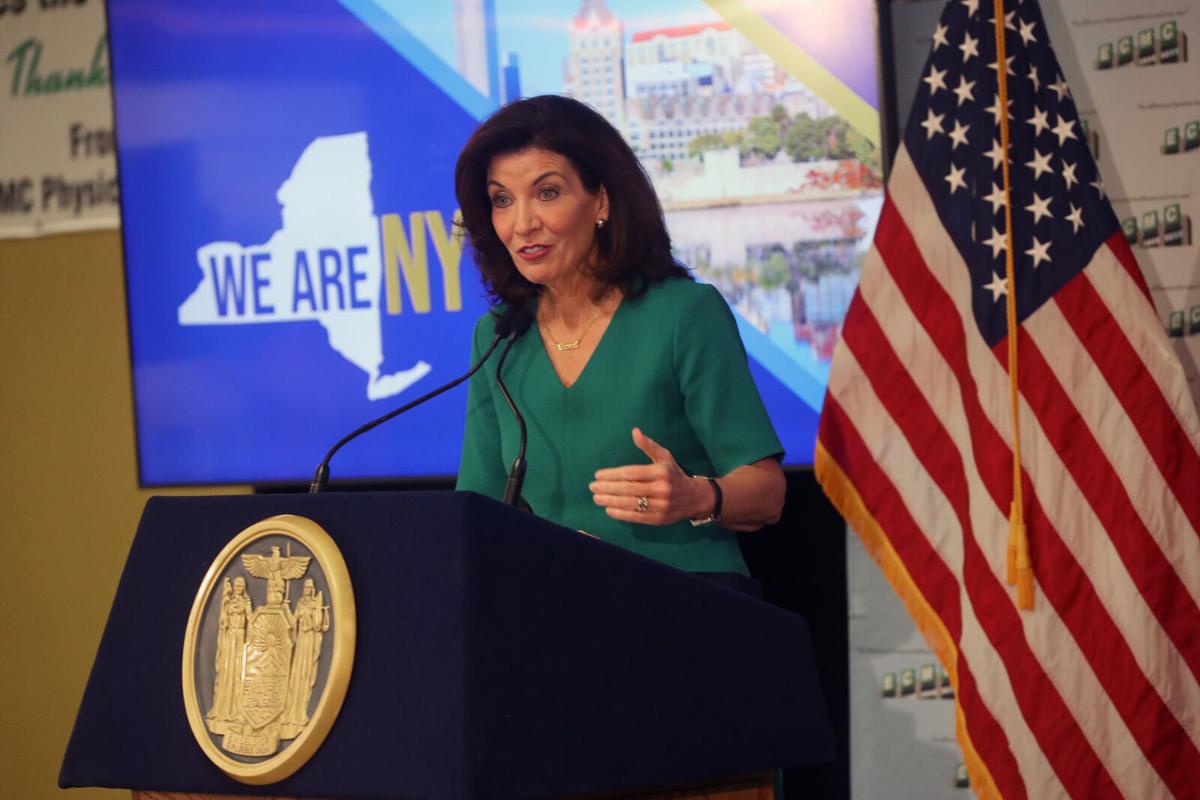
"We've had a dramatic decline in cases here in Western New York," Gov. Kathy Hochul said Wednesday during a Covid-19 briefing at Erie County Medical Center.
Just hours after that news conference, however, University at Buffalo researchers confirmed what was widely expected by medical experts: The first case of the hyper-transmissible Omicron variant had been detected in Western New York.
Omicron now threatens to reverse the region's recent progress in fighting the virus, as evidenced by Thursday's numbers.
In a matter of days, Omicron overtook Delta as the dominant strain of the virus in New York City, which has consistently fueled single-day caseload records across the state.
"As we knew, the numbers would continue to climb," Hochul said Friday. "We foresaw this; this is not a surprise. And this is a very, very contagious variant. And I will repeat this once again, this is not the same situation we had in March of 2020, or even last winter's surge. We've had more testing. We've had more opportunities, but also we know that hospitalizations are continuing to rise."
She said the state's "winter surge plan" that made vaccines, boosters and testing readily available "continues in full throttle here."
There were 44,431 new cases across the state Thursday, which was out of nearly 360,000 completed tests. Testing demand continues to increase, Hochul noted, pointing out that 200,000 tests were requested a little over a month ago.
In addition, there were 4,744 Covid-19 patients hospitalized across the state Thursday, which is up from about 3,800 just one week earlier. Still, Hochul said, that is less than the roughly 7,000 people who were hospitalized with the virus one year ago.
Shortening isolation period
New York on Friday issued new guidance that reduces the isolation period for workers in critical industries who test positive for Covid-19, seeking to avoid worsening the staffing challenges already plaguing hospitals and nursing homes as Omicron causes breakthrough infections of the fully vaccinated.
That guidance, specific to "limited circumstances where there is a critical staffing shortage," permits employers in essential industries to allow a fully vaccinated employee to return to work five days after a positive test as long as that worker is asymptomatic or, if they had mild symptoms, and has not had a fever for at least 72 hours.
In addition to essential health care operations, the guidance applies to industries that include critical infrastructure, food manufacturing, retail such as grocery stores, and education, among others.
The announcement, made by Hochul exactly four months after she was sworn in, came one day after the Centers for Disease Control and Prevention provided similar guidance amid concerns that the more transmissible Omicron could exacerbate worker shortages in health care settings. Hochul said her announcement Friday translated the CDC's recommendations to New York's critical workforce.
"You know you're the ones that got us through the first many months of anxiety," Hochul said of frontline workers. "We need you again. We need you to be able to go to work."
The news surely comes as a sigh of relief to health care employers across the state. Many hospitals, for one, already have struggled to staff enough beds, which has stretched capacity amid rising Covid-19 hospitalizations, sicker-than-ever non-Covid patients who put off care earlier in the pandemic and a difficulty discharging certain patients into nursing homes.
Dr. Brian Murray, chief medical officer at Erie County Medical Center, told The Buffalo News on Wednesday that the organization was concerned with more Covid-19 cases among staff members with the arrival of Omicron, which is expected to lead to more breakthrough infections and has already caused cases to skyrocket in New York City. Before the guidance issued Friday, a health care worker who tested positive could be out up to 10 days.
"We have actually seen with the announcement of the Omicron that we're seeing more and more people getting boosters," said Murray, noting that 40% of ECMC's staff had received boosters as of Wednesday.

New York is considering a booster shot mandate for health care workers, Gov. Kathy Hochul said Wednesday, as the state fights a surge of Covid-19 cases driven by the highly contagious Omicron variant.
During a visit to ECMC on Wednesday, Hochul said the state was considering a booster mandate for health care workers, similar to what California and New Mexico have announced. New York's existing vaccination mandate for health care workers required employees in hospitals, nursing homes and other health facilities to get their first dose of a Covid-19 vaccine by Sept. 27, unless they had a medical exemption.
Hospital capacity update
On Nov. 26, the same day the World Health Organization designated Omicron a variant of concern, Hochul signed an executive order allowing the Health Department to limit nonessential procedures at hospitals across the state with 10% staffed bed capacity or less.
The protocols, which started Dec. 3 and will be reassessed Jan. 15, early this month affected 32 New York hospitals, including six in the five-county Western New York region – preserving some staffed beds but also dealing a huge financial blow via the pause of moneymaking elective surgeries.
As of Friday, the order is now affecting 25 hospitals, including seven in Western New York that have had to stop in-hospital elective surgeries because their staffed bed occupancy is above 90%, according to the Health Department.
Three of those hospitals – ECMC, Catholic Health's Sisters Hospital and UPMC Chautauqua – have occupancy rates of more than 95% and have had to stop all elective surgeries, including nonessential ambulatory procedures, the Health Department said Friday.
In Western New York, a seven-day average of state data shows 12% of staffed hospital beds are available, while just 8% of intensive care unit beds are open.
Capacity here is more stressed than it is statewide, where 21% of hospital beds and 18% of ICU beds are available.
Straining capacity the most are staffing challenges at hospitals across the state. Murray, of ECMC, said Wednesday that the hospital doesn't have enough employees to staff all the beds that are available.
"It's not about how many beds they have," Hochul said Friday. "It's about whether those beds are staffed, and that's been a challenge throughout this whole process."


