

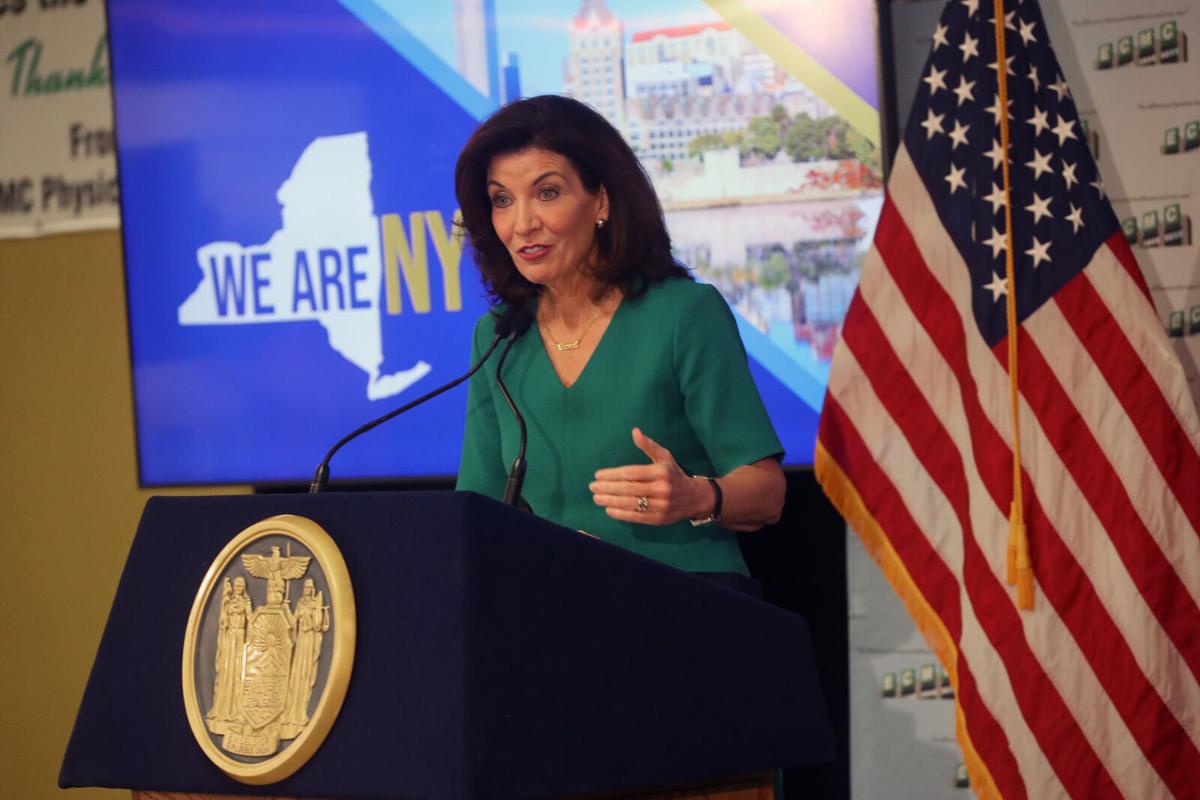
As new Covid-19 cases fueled by the Omicron variant continue to rise in New York, Gov. Kathy Hochul is getting ready to unveil a revised winter surge strategy.
"Winter Surge 2.0," she called it. Details, which are being ironed out this week, will be discussed Friday.

The county's Health Department confirmed 1,137 cases for Thursday, crushing the previous pandemic daily high of 981 cases on Dec. 3.
During a briefing Monday morning, Hochul urged calm amid the spread of Omicron and made clear that her ultimate goal is to avoid shutting down New York's economy and institutions, especially schools.
"We're preparing for all scenarios, including the worst-case scenarios, which we're not at. But, I have said from the very beginning, I want to have the ability to deploy whatever actions need to be taken if we get to a crisis situation," Hochul said. "We are not there yet."
Statistics for new daily cases were skewed because of the Christmas holidays, Hochul said. But they remain high, with 36,000 new cases reported on Christmas, and 26,737 reported Sunday. More accurate numbers will be released Tuesday, she added.
People are also reading…

As 2021 draws to a close, one thing is indisputable: There were stories in Western New York that will live on in our memories for a long time.
The numbers are "continuing to climb," the governor said. "This has not been a surprise to us."
She noted that states surrounding and near New York are also getting hit hard by the latest surge, including Rhode Island, Delaware and Maryland. But she emphasized that this winter surge is different in many ways from last year's deadly wave.
"We have tools at our disposal and the question is how we're deploying them," Hochul said.
Ramping up testing and getting more people vaccinated and boosted are key to the state's strategy.
The federal government is expected to provide 37 million tests to New York.
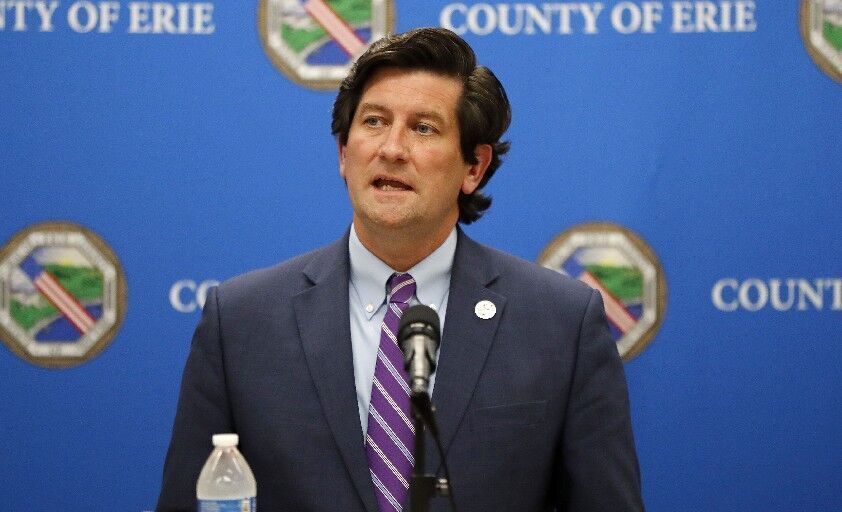
Both Gov. Kathy Hochul and County Executive Mark Poloncarz have announced that the state would provide more rapid tests for schools to move the test-to-stay program forward, as well providing them to counties to distribute to the general public.
Schools
Hochul and acting Health Commissioner Dr. Mary Bassett said their top priority was keeping kids in school.
"All of us agree we have a strong public interest in keeping our kids in school," Hochul said. "We went through the social experiment of keeping them isolated, and what teachers had to go through and parents and the children was extraordinary."
Earlier this month, Hochul announced a statewide "test-to-stay" option that would allow children who are potentially exposed to a person with Covid-19 to remain in school if they test negative and show no symptoms.
Plans are underway to distribute 3 to 3.5 million tests to the state's 731 school districts this week, before children return to classes Jan. 3, Hochul said.
Hochul said she is holding a conference call with all of the state's school superintendents Tuesday to discuss the return of children to school after the break.
Buffalo Schools Superintendent Dr. Kriner Cash previously said he would make an announcement Tuesday about whether Buffalo students would resume in person or remotely Jan. 3.
"No one wants to go back to remote learning,” Cash said before the holiday break. “If we learned anything this past year, it was that remote learning was a necessity, but it was not ideal.”
To prevent Covid-19 from spreading in schools, Hochul urged parents to take advantage of the break to get their children vaccinated. As of this week, 16.4% of children ages 5 to 11 have received their first dose.

Orchard Park resident Connor Kolb has been trying to get his grandparents in the same Western New York nursing home for more than six months. But that has proven difficult, if not nearly impossible, amid severe staffing issues at the region's nursing homes.
Nursing homes
Out of the state's 608 nursing homes, about a third have at least one resident who has Covid-19, Bassett said Monday.
She said about 90% of nursing home residents are fully vaccinated, but added: "We're not doing as well as we would like in getting people boosted, and this seems to be particularly important in protecting against adverse outcomes of Omicron infection."
So far, about two-thirds of nursing home residents have received the booster.
Nursing homes were a hot bed for Covid-19 during the earlier part of the pandemic, with nearly 15,000 residents dying with the virus.
Hochul said, in some cases, the residents are suffering from advanced dementia and cannot consent to the shots. In others, family members are declining to give consent.
"It's not access. It's not availability. It's not the fact that they weren't required to bring boosters to the nursing homes," Hochul said. "It's an area we want to continue focusing on and we'd love to get those numbers up even higher."


