

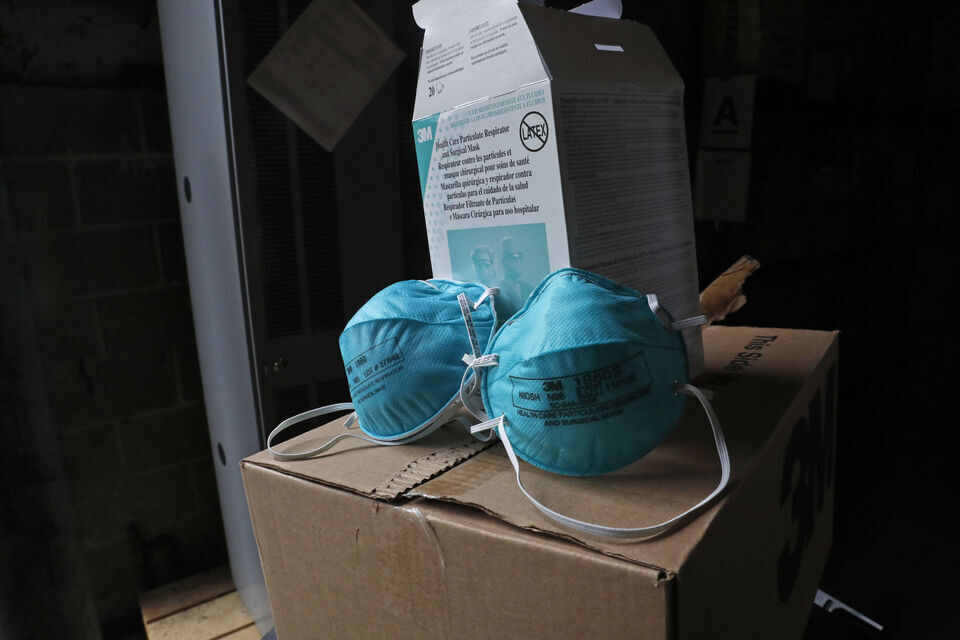
There is little appetite in Western New York for governments to enforce the state mask mandate, or to penalize businesses that violate the regulation, especially outside Erie County.
It's left to county public health workers to check that restaurants, churches and other entities are following this rule.
But the burden directly falls on the venues to make sure guests and customers wear a mask. While this has spurred a backlash, particularly online, those that run public places say most patrons have complied.
"Most of the people who attend are thankful," said the Rev. Darius G. Pridgen, pastor of True Bethel Baptist Church. "When you're talking about 400 to 500 people in a building, you know, most people want to be safe."

Erie County’s falling hospitalizations have proved a bright spot in an otherwise uncertain period. Across the region, the number of hospitalized patients rose from a low of fewer than 20 in the summer to a seasonal high of 537 on Dec. 9 before falling again.
Erie County, which put in place its own mask mandate before the statewide edict took effect, credits that policy for beginning to lower Covid-19 hospitalizations in the county in recent weeks.
People are also reading…
Since then, New York has seen a dramatic rise in Covid-19 cases, including some serious enough to require hospitalization, as Omicron becomes the dominant variant across the state and nationally.
On Thursday, a day after University at Buffalo researchers confirmed what was already assumed – that the Omicron variant is circulating here – Erie County set a one-day record for Covid-19 cases.
With this backdrop, Gov. Kathy Hochul in the days before Christmas announced the state would provide $65 million to help counties find "innovative" ways to enforce her mask mandate.
It's not yet clear what counties will do with this aid.
"Will we see that money? I don't know," said Chautauqua County Executive Paul M. Wendel Jr.
Counties lean on education, not fines
Hochul on Dec. 10 announced her mask mandate to limit the spread of Covid-19 for all indoor public places in New York, effective three days later and running through Jan. 15, when it will be re-evaluated.
Businesses and other venues face fines, up to $1,000, for violations of the rule by their patrons, who are not similarly at risk of punishment.
Read the full story here.
The state left it to county governments to enforce the policy, a responsibility that some counties didn't welcome.
Public Health Director Daniel J. Stapleton said Niagara County is not fining, or threatening to fine, businesses for violating the mask-or-vax mandate, adding his staff is kept busy with testing and vaccination clinics.
Instead, he said, the county is following up on complaints with educational outreach to businesses.
"I think people are trying to do the best they can with the situation," said Stapleton. "People haven't been, 'I refuse to do this. I'm going to fight this.' "
Chautauqua County officials encourage residents to wear masks when indoors, in public spaces, but the Health Department is not proactively checking for compliance with the state mandate.
Instead, Wendel said, if the county receives a complaint about a mask violation, someone in the department will call the location to discuss the matter.
"The enforcement piece we are not following through with is the penalties on businesses," Wendel said.
Even in Erie County, which had its own mask mandate in place beginning Nov. 23, penalties for violations were rare.
Kara Kane, a Health Department spokeswoman, previously said the county as of Dec. 2 had sent out about 4,000 educational letters and emails to offending businesses but had not fined anyone for a violation. She did not immediately provide an update late this week.
Erie County Executive Mark C. Poloncarz partly credits the county's mask mandate for the reduction seen in Erie between Dec. 6 and Monday, a period when Covid-19 hospitalizations fell from 375 to 339.
"It's been a full month," Poloncarz said this week. "It's had an impact."
'Businesses are still responsible'
On the ground, it's staff at grocery stores, restaurants, churches and other places who must ask forgetful or recalcitrant guests to follow the state mask policy. "The businesses are still responsible," Wendel said.
Bob Syracuse, co-owner of the Pizza Plant chain, said his customers for the most part have gone along with the rule, even when they have to be reminded to put one on while walking around.
"I haven't had a problem. People are generally abiding by it," Syracuse said, attributing this to his smaller customer count, compared to a big-box store, and the fact people can unmask while dining.
The two largest grocery chains in the area, Tops Markets and Wegmans, have taken different approaches.
"If someone happens to not be wearing a mask, a manager will approach them with a disposable mask and a copy of the mandate and kindly remind them of the policy," Tops spokesman Kathy Sautter said.
Wegmans, though, does not ask its employees to confront unmasked customers.
"In today's world, asking our people to approach an unmasked person could be unsafe for them, and we’re not going to put them in that position," spokeswoman Michele Mehaffy. "Our service desks will continue offering free masks to customers who need one."
Pridgen, who is also the Buffalo Common Council president, said his church throughout the pandemic has required anyone attending services, including funerals, to wear a mask.
He said ushers and other staff check temperatures and masks as people enter the church and during the service in the sanctuary.
Most readily comply with the requirement, Pridgen said, with the notable exception of someone who called Buffalo police a couple of months ago because he thought the church was infringing on his right to go maskless.
That's foolish, Pridgen said, in light of the toll Covid-19 has taken. "I continue to bury people who have passed from Covid," he said, at least one funeral every other week.
Divisive rule magnified at public meetings
The debate over the mask mandate has grown especially virulent at some local school board and government meetings, with mask protests forcing the Clarence and Orchard Park school boards to shift to virtual meetings for a time.

Two local school boards are switching to fully remote meetings, after meetings last month were interrupted when audience members refused to wear face masks.
A number of mask critics attended the most recent Williamsville Village Board meeting where, according to the Amherst Bee, Mayor Deb Rogers, an Amherst police officer and other attendees did not wear masks in violation of the state mandate.
The Grand Island Town Board earlier this month passed a resolution opposing mask and vaccine mandates and urging county and state health workers not to come onto the island to enforce the requirements.
"I do look at the data and do have serious questions on effectiveness – valid questions that anyone who critically thinks should be questioning why these mandates still are being pursued," Grand Island Councilman Michael Madigan said in an email.
Despite the criticism, Hochul isn't backing off. Instead, she announced this week the state will provide $65 million to help counties find innovative, creative ways to boost mask enforcement. She said $2 million will go to larger counties and $1 million to smaller counties.
She did not provide specifics on what new strategies the counties could pursue and it's not clear what exactly counties here will do with the aid.
Erie County leaders did not respond to a request for comment. Niagara and Chautauqua officials say they're awaiting more information on the program.
"If there's money available to help us with what we're doing, we welcome it," Stapleton said.


