

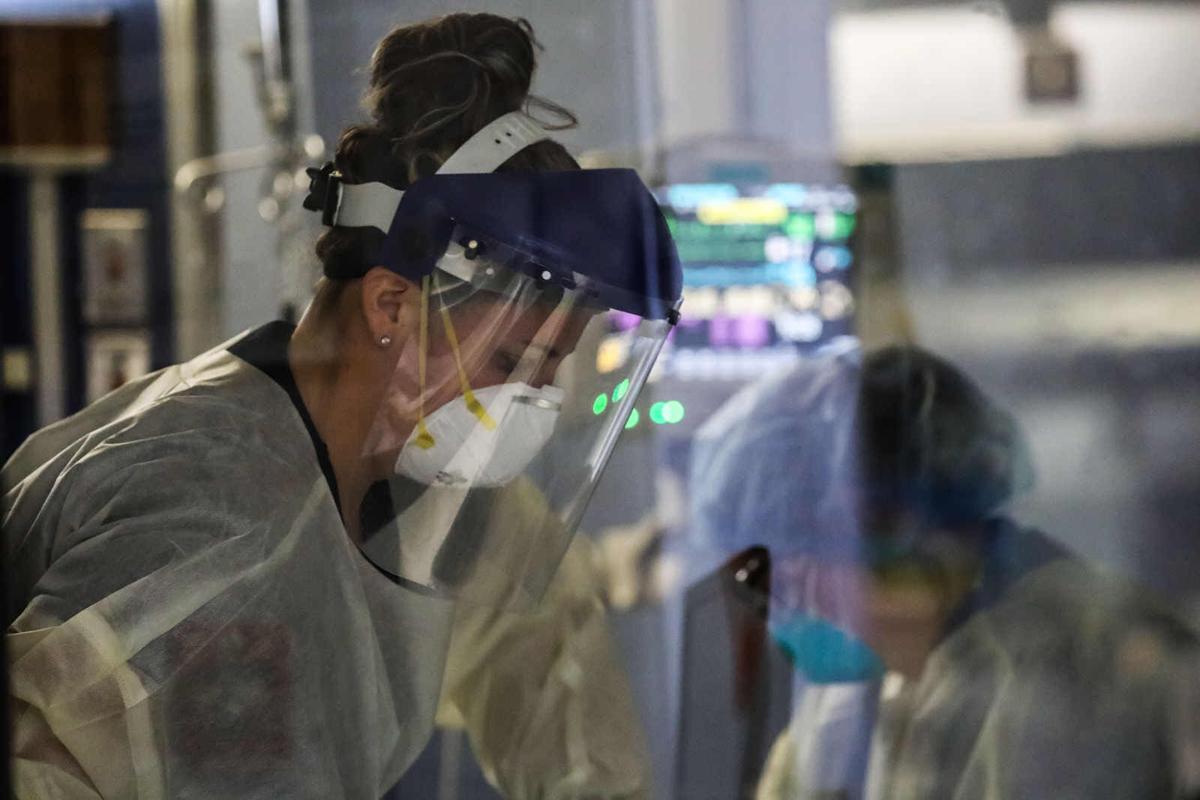
Western New York's health care workers are testing positive for Covid-19 in greater numbers than ever before, dealing another blow to a battered industry already grappling with major staffing issues.
More than 700 local health care employees – and likely more – were not at work Tuesday due to Covid-19, forcing providers to weigh further service reductions if the situation worsens while relying even more heavily on their healthy, but overtaxed, staff.
At Erie County Medical Center, nearly 100 employees are out with Covid-19. More than 300 are on the shelf at the much-larger Kaleida Health, while about 200 Catholic Health employees are out.
Roswell Park Comprehensive Cancer Center also is dealing with what one executive called "an unprecedented level" of cases, with 60 employees testing positive in just a three-day span last week.
People are also reading…
At Buffalo Medical Group, a multispecialty medical practice, more than 60 of its 1,000 employees are out with Covid-19.
Those cases have a lingering effect, too, since workers who test positive must isolate for at least five days – possibly longer if their cases are severe. That isolation period was shortened late last month by state and federal officials, who sought to avoid exacerbating staffing challenges already plaguing hospitals, nursing homes and other critical industries.

The county's Health Department confirmed 1,137 cases for Thursday, crushing the previous pandemic daily high of 981 cases on Dec. 3.
Concerns remain, however, especially as New York tries to preserve staffed hospital bed capacity.
It is why Gov. Kathy Hochul on Friday announced the state Health Department and New York National Guard will partner to train soldiers to become certified emergency medical technicians.
But that will take time: Two pilot classes for 80 National Guard personnel start Wednesday, which means those service members won't be available for clinical deployment until February once they complete the required 180 hours of training.
More immediately, the state has received some federal help and is sending a 23-member Department of Defense medical response team to ECMC.
As it is, the highly contagious Omicron variant already is driving Covid-19 cases to record levels and, in turn, pushing hospitalizations at or near last winter's peak.
And it is not yet clear when this wave will crest.
What providers are seeing
Even before researchers identified the first case of Omicron in Western New York on Dec. 22, area health care executives had expressed concern about the highly transmissible Omicron's ability to cause breakthrough infections within a burnt-out workforce.
That is exactly what's happened.
"We're having more positives, more work absences and necessitated quarantines than we've ever had," said Dr. Robert Zielinski, associate medical director of Buffalo Medical Group. "That's pretty much been everybody else's experience, I think, as well."
The more than 60 employees out in quarantine as of Monday is "way more than we've had at any point in the pandemic," he noted.
That's put a strain on the medical group's operations department, which is monitoring employees who test positive and checking in on their symptoms. Zielinski noted that the group has a nurse who is maintaining a database to keep track of those workers.
"They can't just tell people, 'OK, it's Monday, you're out this week. We'll see you next Monday,' " he said. "They have to be reassessed and monitored."
In good news: Zielinski said 90% of the medical group's staff is vaccinated, and the employee cases tend to be brief and relatively mild. Therefore, the group isn't seeing long-term absences or illnesses so far, he noted.
ECMC, which employs more than 3,000 people, also is seeing a record number of cases among workers.
ECMC had 94 employees out Monday due to Covid-19, spokesperson Peter Cutler said. Just a few days earlier, on Dec. 30, 106 ECMC employees were out due to the virus.
During previous waves, Cutler said, the Buffalo hospital usually never saw more than 50 employees out at a given time.
At Kaleida Health, 318 of its roughly 10,000 employees were out due to Covid-19 as of Tuesday, said Michael Hughes, the system's chief administrative officer.
At Catholic Health, which had about 200 employees out Tuesday, spokesperson JoAnn Cavanaugh said positive cases among the health system's almost 10,000 workers “more than doubled from week to week” during the last three weeks of December.
"Hospital staffing is also a challenge as, like other hospitals nationwide, more caregivers are testing positive for Covid-19," she said.
Roswell Park Comprehensive Cancer Center also is experiencing "an unprecedented level of Covid-19 positive cases among our clinical staff, including providers, nursing and patient support services," Chief Medical Officer Dr. Boris Kuvshinoff wrote in an email to employees Monday, which was reviewed by The Buffalo News.
In a prior email Dec. 29, Kuvshinoff advised employees that Roswell Park had 60 workers test positive since Dec. 26.
"As with all other organizations in our region, we are not immune to the impact of the rising number of cases in the community," Roswell Park said in a statement. "We continue to meet the needs of our cancer patients by taking diligent steps to keep our campus safe, including aggressive testing of our staff and patients, as we've done from the beginning of the pandemic."
How providers are adapting
The pandemic has repeatedly forced employers, especially those in health care, to pivot on a dime.
The rapid increase in employee cases is the latest hurdle.
At Roswell Park, it is constraining the center's ability to provide the typical staffing levels, especially in its inpatient units, Kuvshinoff said in the email Monday.
He advised providers to "please make every attempt to discharge patients as soon as clinically feasible," consider whether outpatient-in-a-bed cases could be sent home the same day and identify elective procedures or treatments that could be deferred for the next few weeks.
Many hospitals across Western New York, and the state, have been in that position for quite some time.
For example, ECMC in September voluntarily suspended inpatient elective surgeries and reduced hours at its outpatient clinics, so staff could support inpatient care in the main hospital. It also closed two units at its Terrace View Long-Term Care Facility, also struggling to staff as many beds.
ECMC, which has had an average of just 2% of its staffed hospital beds available over the last seven days, per state data, also is one of the 21 hospitals across the state currently subject to a state order pausing nonessential procedures to preserve bed capacity.
In a new measure, ECMC shifted to a more restrictive visitor policy Friday – suspending almost all inpatient visitation with the exception of medically necessary or end-of-life situations – in an effort to protect vulnerable patients, as well as frontline employees from avoidable exposure.

The medical facility announced Wednesday that it will suspend all inpatient visitation, starting Friday, except when it is medically necessary or for family members or legal representatives of patients in imminent end-of-life situations.
At Buffalo Medical Group, the increased employee cases have further strained staffing and forced some workers to scramble to cover more responsibilities, Zielinski noted. But so far, the group hasn't had any major service disruptions.
A big reason why: Buffalo Medical Group has been invested in telehealth since the beginning of the pandemic, he said, and it can now leverage that capability immediately.
For example, Zielinksi said providers who have tested positive but only have minor symptoms canceled in-person visits but have been able to work from home and do telehealth visits. Similarly, patients who have been ill have been able to flip their scheduled visit over to a virtual appointment, where appropriate.
"That's been a help in being able to maintain a reasonable level of services," he said.
But Zielinski also believes this wave's peak hasn't been reached yet, with the region in for a rough few weeks as it reckons with a post-holiday surge.
The key for employers will be flexibility, a theme throughout the pandemic.
"There's a certain amount of guarded optimism that it's going to be really rough in January, but it's also hopefully the beginning of the end," Zielinski said. "And we'll get into a more steady state, lower-level endemic phase rather than this pandemic crisis we've had."


