

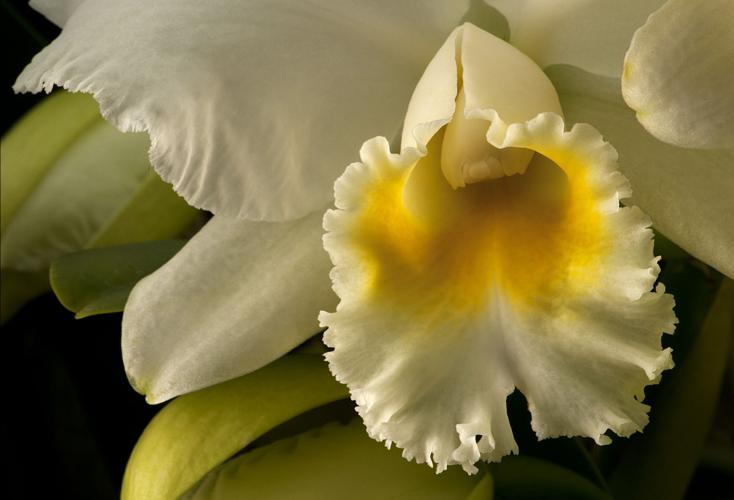
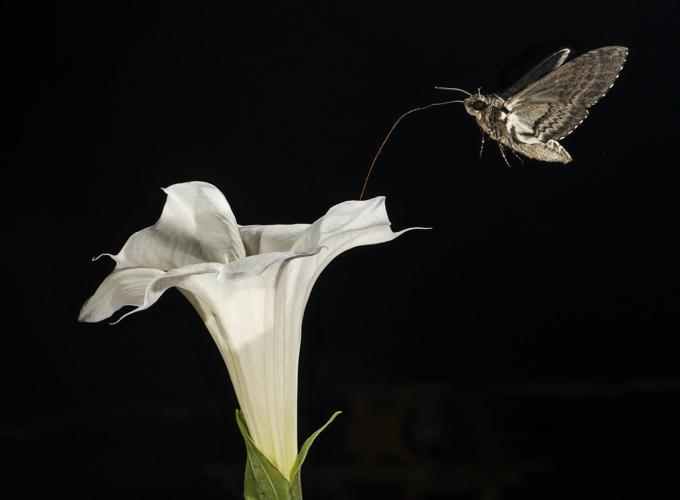
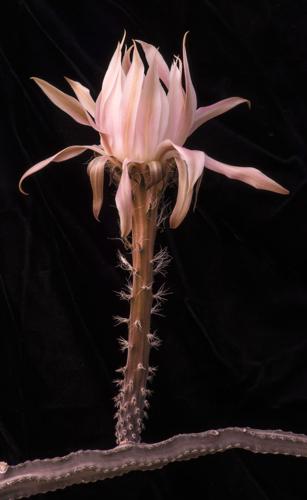
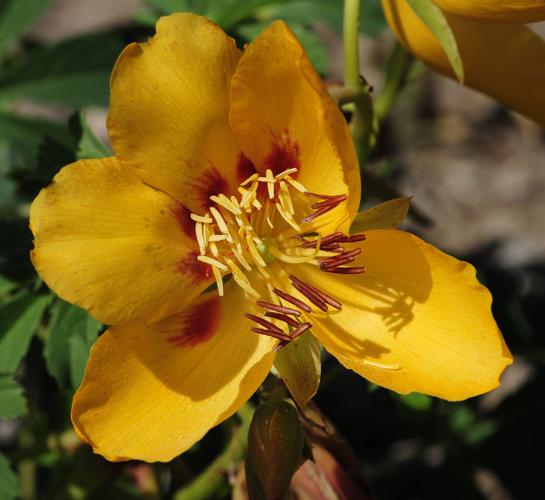
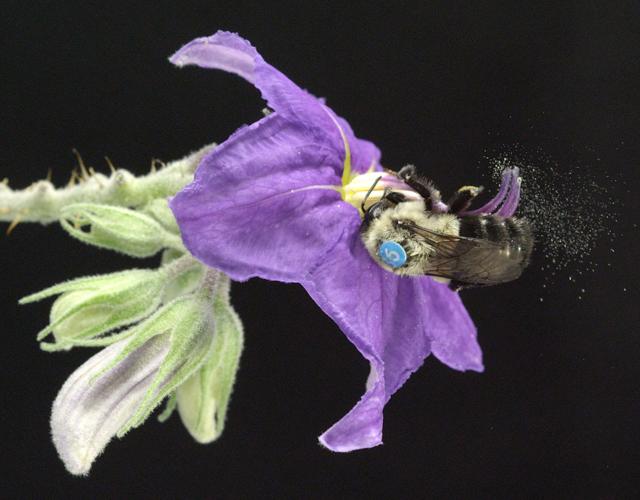
“The Reason for Flowers,” a new book by pollination scientist Stephen Buchmann, is all about sex.
Flowers exist as lures for reproduction.
Some lures are big and and rank, like the giant corpse flower of Borneo. Others are tiny, like the nearly microscopic blooms of the salt-grain-sized Wolffia that dot the still waters of creeks.
They can be nondescript but fragrant or both fragrant and showy, like the highly perfumed Stargazer lily that Buchmann calls a “big, brash beauty.”
Buchmann knew the “obvious answer” for the question of why flowers exist long before he began writing this book.
“Flowers are living billboards for sex,” he said Tuesday in an interview at his home in the Catalina Foothills, where the art on the walls depicts plants and their pollinators, and an arrangement of Stargazer lilies perfumes the living room.
People are also reading…
Buchmann has been fascinated by the pollination of flowers for decades, beginning with his California childhood.
He was a honeybee keeper as a kid. Then he became more fascinated by their solitary cousins, the bumblebees.
He apprenticed to a university professor who studied the subject and published his first journal paper on bee pollination while still in high school.
{p class=”p1”}Buchmann earned his master’s degree at Cal State Fullerton from that same professor, with a journal article in which he coined the term “buzz pollination.”
{p class=”p1”}He earned his doctorate in entomology from the University of California Davis.
{p class=”p1”}Buchmann still holds appointments at the University of Arizona in Entomology and Ecology and Evolutionary Biology where he mentors several graduate students.
{p class=”p1”}Research and writing take up most of his time these days, in addition to photography and art. He created most of the illustrations for the book.
While in college, Buchmann figured out the mechanism used by certain species of bumblebees to extract pollen and nectar from recalcitrant flowers. He called it “buzz pollination.”
The bee essentially turns itself into a tuning fork, grabbing the flower’s cone of five anthers and using its thoracic muscles to vibrate 300 to 500 times per second. The sound waves force open the anthers in an explosion of pollen.
About 6 percent of the 300,000 or so species of flowers in the world require this special treatment in order to reproduce. Tomato flowers are among them. If your tomatoes aren’t producing fruit, you can do the same thing with an electric toothbrush, Buchmann writes.
Buchmann has roamed the globe to investigate the methods by which flowers and their pollinators co-exist and has written 10 books on the subject, including “The Forgotten Pollinators,” written with ecologist Gary Paul Nabhan.
That book is still his favorite and is still having an impact on public policy, Buchmann said.
Plants and their flowers were more than bit players in the previous books, but for this one, Buchmann wanted to focus directly on flowers.
“I wanted to bring people into the picture. Flowers are important in human culture and history.”
Archaeologists have uncovered evidence of flowers in burial ceremonies 13,000 years ago and they are essential elements of ritual in all of the world’s major religions.
Civilizations around the world have brought flowering plants and wildflowers into urban gardens for more than 3,500 years, and modern breeding techniques created a profusion of blooms that would be unrecognizable to earlier humans — or to the pollinators.
Buchmann delves into the history of gardens and the development of perfume.
He writes about the economic value of flowers, taking us to the Aalsmeer flower auctions, where the world’s largest building (by footprint), the 10,750,000-square-foot FloraHolland complex, exists simply as a place to buy and sell 21 million flowers daily.
Saffron, he notes, is worth more than its weight in gold.
He writes about flowers as food, even offering a few recipes. His favorite edible flower is the marigold, for its spicy flavor.
He explores their medicinal uses. Chamomile calms stomachs. Honey heals wounds.
He explores flowers in song, poetry and verse and in mythology.
Buchmann said he was most surprised, in his research for the book, by research being done by Rutgers University psychologist Jeanette Haviland-Jones.
In experiments with aromas so subtle they can’t be consciously recognized, her team found that true floral scents enhanced mood more than synthetic perfumes or the perceived comforting aroma of baby powder.
She proposed that the pollinators aren’t the only ones whose behavior is manipulated by flowers. Perhaps the flowers have beguiled we humans into helping them breed and prosper.
In the book, Buchmann, at least partially, agrees.
“Perhaps it is the flowers who have led us along garden paths, using their seductive, petaled beauty ...”
Buchmann, whose backyard blooms in every season and who always keeps at least two arrangements of cut flowers on hand, including roses for life partner Kay Richter, says the phenomenon is easily recognized.
“Give somebody a single flower or a bouquet, they immediately bring it up to their face, they inhale deeply without guilt — and they smile.”


