
WASHINGTON — The United States will be "out of Iran pretty quickly" and could return for "spot hits" if needed, President Donald Trump told Reuters on Wednesday, hours before he was scheduled to make a primetime address to the nation about the war.
With the conflict in its fifth week and Trump under pressure for an off-ramp amid rising gasoline prices, the president scheduled a 9 p.m. EDT speech to discuss the way forward. His address will end a day that began with his historic visit to the Supreme Court.
Trump, in a phone interview with Reuters, said one element of his speech would be to express his disgust with NATO for what he considers the alliance's lack of support for U.S. objectives in Iran.

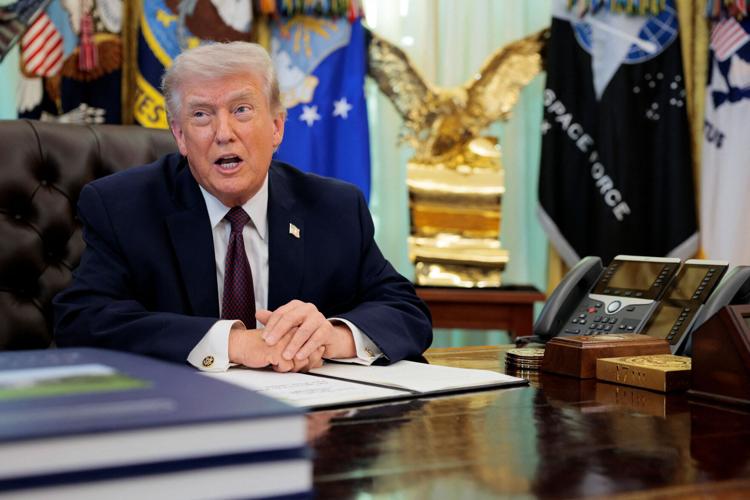
U.S. President Donald Trump speaks Tuesday in the Oval Office of the White House in Washington, D.C.
A transatlantic rift in Trump's second term deepened after European allies rebuffed his request to help maintain safe passage for oil traffic through the Strait of Hormuz.
People are also reading…
The Republican president said he "absolutely" was considering withdrawing the United States from NATO, a treaty organization ratified by the U.S. Senate in 1949. He flirted with a withdrawal in the past and successfully pressured NATO members to increase their defense spending.
"They haven't been friends when we needed them," he said. "We've never asked them for much … it's a one-way street."
Trump and his top officials offered a variety of timelines for ending the war. He said Tuesday that the U.S. could end its military campaign against Iran within two to three weeks.
In the Reuters interview, he declined to provide a timeline.
"I can't tell you exactly … we're going to be out pretty quickly," he said, adding that "we'll come back to do spot hits" on Iranian targets as needed.

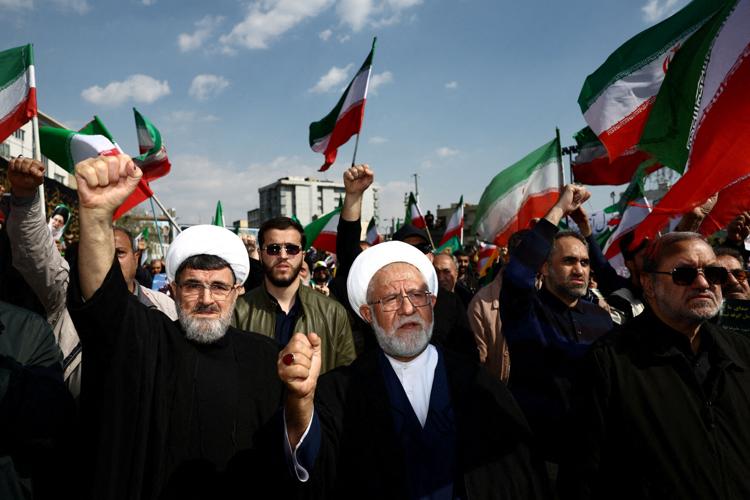
People attend a funeral ceremony Wednesday in Tehran, Iran, for the Revolutionary Guard's Navy Commander Alireza Tangsiri, who was killed in strikes amid the U.S.-Israeli conflict with Iran.
'We got regime change'
The war spread across the Middle East, killing thousands of people and causing soaring energy prices that fueled global inflation fears.
Two-thirds of Americans believe the U.S. should work to end its involvement in the Iran war quickly, even if that means not achieving the Trump administration's goals, a Reuters/Ipsos poll conducted from Friday to Sunday found.
Trump said he hoped for a deal with Iran after the first wave of airstrikes killed Supreme Leader Ayatollah Ali Khamenei. A number of other senior Iranian figures also were killed.
Mojtaba Khamenei replaced his father as Iran's supreme leader; the U.S. said it believes he was wounded and likely disfigured. The country's president and foreign minister remain the same as before the conflict.

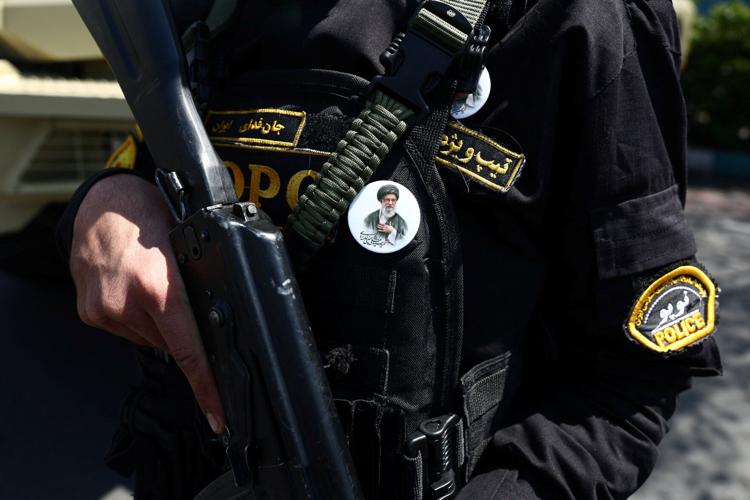
A member of a police force wears a badge with a picture of the late Supreme Leader of Iran, Ayatollah Ali Khamenei, as he stands guard on a street Wednesday in Tehran, Iran.
Trump said Iran's leadership was now "totally different people."
"I didn't need regime change, but we got it because of the casualties of war. We got it. So we have regime change and the big thing we have is they're not going to have a nuclear weapon," Trump said, adding, "Nor do they want one."
The White House said behind-the-scenes negotiations are ongoing with Iran, which Tehran denies. A source briefed on the matter said Vice President JD Vance talked to intermediaries from Pakistan about the conflict as recently as Tuesday.
At Trump's direction, Vance signaled privately that Trump was open to a ceasefire as long as certain U.S. demands are met, the source told Reuters on Wednesday.
"We have had full regime change," Trump said. "I'm dealing with a very good chance that we'll make a deal because they don't want to be blasted anymore."

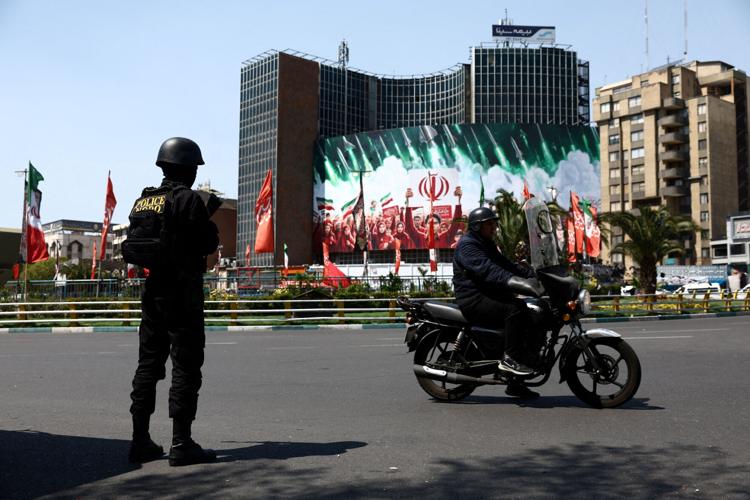
A member of a police force stands guard on a street Wednesday in Tehran, Iran.
Nuclear weapons
Trump said a primary aim of launching the war was to prevent Iran from developing a nuclear weapon.
Almost half of Iran's uranium enriched to up to 60% purity, a short step from weapons-grade, was stored in a tunnel complex at Isfahan and is probably still there, the U.N. nuclear watchdog chief Rafael Grossi said.
The tunnel complex is the only target that appears not to have been badly damaged in attacks last June by Israel and the U.S. on Iran's nuclear facilities.
Trump said the objective of preventing a nuclear weapon was achieved. Of the enriched uranium, he said: "That's so far underground, I don't care about that."
"We'll always be watching it by satellite," he added.
He said Iran was "incapable" of developing a weapon now.
Iran long denied wanting to develop a nuclear weapon and says its nuclear program is peaceful.
The International Atomic Energy Agency estimates that when Israel launched its first attacks in June, Iran had 440.9 kg of 60% uranium. If enriched further, that would provide the explosive needed for 10 nuclear weapons, according to an IAEA yardstick.