
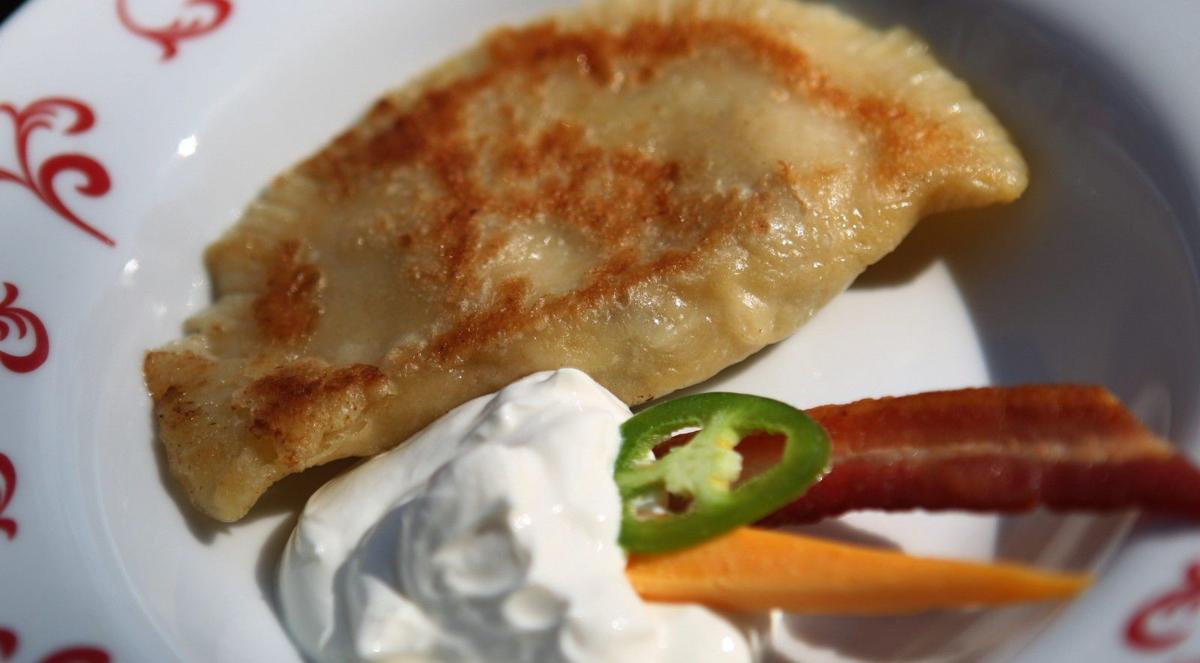
This article was originally published in the print publication of The Buffalo News on Dec. 24, 2008
For years, it was a scribble in the back of a spiral-bound schoolgirl's notebook.
"Pierogi," the title read, and then a brief recipe, just a few lines long. Nothing more, nothing less. How it got there, that little recipe, is a longer story -- one about grandmothers and granddaughters, family and tradition, food and faith.
It's a story especially suited to Christmas Eve.
After all, this is, for Polish-Americans, the night when pierogi reign supreme.
We'll get to that in a minute. But first let's back up, to where the recipe began.
To understand that, you'd have to know my grandmother.
People are also reading…
But maybe you already do: If you have any older Polish-American women in your family, any ancestral roots that took hold on the East Side of Buffalo, any family tradition that centers around culture and food.
My grandmother, born Stanislawa Barabasz in 1914 but called by the Americanized "Estelle" for most of her life, was the type of woman that built the East Side of Buffalo in the busy middle of the last century.
She had a ladylike exterior -- this was a woman who never wore pants in her life, and who was famous for her collection of hats for all seasons, social events and weather forecasts.
But that outward appearance hid an iron will and a work ethic that was second to none.
As a girl, she took her first full-time job at 14 -- using an older sister's birth certificate to get hired at Grennan Bakery -- and spent the rest of her life laboring in one way or another.
She raised four children on Buffalo's East Side; helped the success of her husband, Aloysius Zoladz, with the tavern the family lived above; and, later, took care of a magnificent summer home in Derby, on the shore of Lake Erie.
Family and faith were paramount to my grandmother, all her life, and they were deeply intertwined.
Those passions culminated each year on Dec. 24, when "Grandma Z," as we grandkids called her out of respect and the mild but real fear she would give our ears or noses a twist, would put up big tables in the kitchen and parlor of her home and invite everyone to Wigilia, the traditional Polish celebration of Christmas Eve.
Wigilia is, in its essence, a meatless meal eaten on the night before the arrival of the Christ Child. The name comes from the Latin, "vigilare," meaning "to await."
But -- in my family, as in many families -- it was so much more. Wigilia was a night to anticipate in itself, all year long.
It meant helping my grandmother prepare the traditional dishes that we ate just once a year: rich dark mushroom soup, made with mushrooms that had grown in the forests of Poland; boiled potatoes with onions; a dish of pickled herring; and pierogi.
As we made those dishes together, my grandmother talked to me, and told me stories about her life. I learned a lot that way.
About the history of her big family -- 10 kids -- and the similarly sprawling family she had married into, in 1942, in a glorious wedding at St. John Kanty church.
About Buffalo in the Depression era and during World War II, and about the glory days of Buffalo as a city, when the East Side was an exciting, energizing place in which to live and work.
My grandmother was shaped by those decades, and those city streets, and she remembered everything. She also had subtle wisdom of a deeply feminine, maternal nature, which meant she was willing to spend time listening to a kid -- me -- talk.
God bless her, she never once made me feel like I was boring her.
When it came to actually eating the meal, I was in heaven.
I've never been big on meat anyway, and the dishes we sampled on Christmas Eve seemed both exotic and comfortingly familiar. (My sister Rebecca, at that stage a picky eater, used to call Wigilia her "rye bread night," because she didn't like anything else on the table. So opinions did vary.)
All this is why, one Christmas Eve, I copied down the recipe for my grandmother's pierogi into a spiral-bound school notebook, as she was standing beside me, gently coaching me through the steps necessary to preparing a perfect batch.
Like so many ethnic foods, pierogi are for both the beginner and the expert. They are easy to make, but deceptively hard to make well.
This is your night to try for yourself -- whether or not you share a Polish heritage.
Get out your canister of flour, eggs and sugar. If you can't get farmer's cheese -- although that's sacrosanct in my family -- you can certainly substitute another cheese, or even sauerkraut or potato, for the filling.
But try to keep it meat-free. That's the whole idea of Wigilia -- it's meant to seem like a deprivation, not to eat meat, so that on Christmas Day you can have a fancy cut of beef or ham and feel luxurious.
Below you'll find Grandma Z's pierogi recipe. It's a fitting year to share it; my grandmother died earlier this month, peacefully at home, at 94.
She would have taken tremendous enjoyment from the thought that some new families might sample her dish this holiday season.
Also, as a practical woman, she would advise you -- as she did me, my first time -- not to worry if you don't own a pierogi cutter, or even a biscuit ring. "Just use a drinking glass," she told me. "Flip it over and cut them with the rim -- nobody will know the difference."
Now that's the kind of can-do spirit that made Buffalo great.
Estelle Zoladz's pierogi
Dough:
- 2 cups flour
- 1 tsp. salt
- 2 eggs
- 1/4 cup water
Filling:
- 1 pound farmer's cheese (a soft, somewhat tart cheese; shop for it at the Broadway Market or in your larger grocery store; look in the dairy aisle)
- 1/2 cup sugar (or more to taste)
- 2 egg yolks
To make: Stir the dough together in a mixing bowl, roll it out flat on a floured surface, then cut the pierogi circles with a pierogi cutter (or rim of a glass; it helps if you dip the rim in flour), filling them with a dab of the cheese mixture and pressing to close.
To cook: Boil a pot of water, then drop your pierogi in, letting them boil until they float to the surface of the pot -- that means they are done, so scoop them out and lay them on a plate to cool and dry a bit.
To make them better: Saute in a frying pan with a little butter and some sauteed onions, if you like those. Or, if you are making a lot for a crowd, put them in a baking dish with butter pats throughout, and put in a warm oven to heat.