

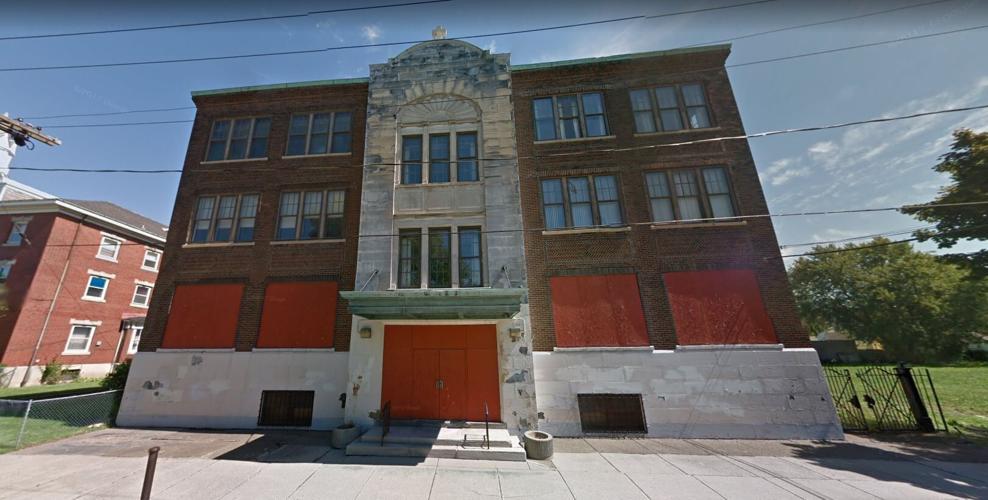

A nonprofit social services agency focused on individuals with developmental disabilities wants to turn an underused East Side church school building into 37 affordable housing units.
Community Services for Every1, together with Edgemere Development, wants to convert the academic building of St. John Kanty Roman Catholic Church – known as the Lyceum – into a mixed-use project for low-income residents.
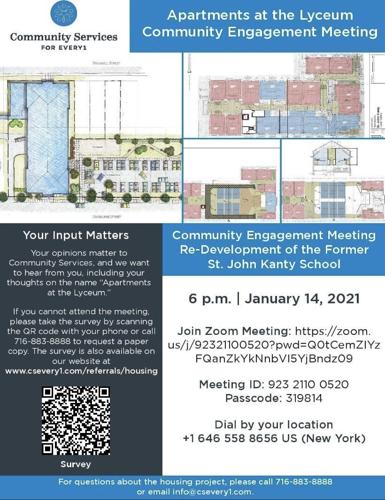
The $18 million Apartments at the Lyceum project would create 26 one-bedroom and 11 two-bedroom apartments in the building at 101 Swinburne St., in the Broadway-Fillmore neighborhood.
According to a summary project brochure on the nonprofit's website, 12 apartments would be set aside as permanent supportive housing for survivors of domestic violence, with "flexible" services available to help them. Four units will be accessible for those with mobility impairments, while two would be designed for those with hearing or visual impairments.
People are also reading…
The project is designed to address the city's "dire need for affordable housing," the group said in the project brochure. But the plans by Carmina Wood Morris PC also include "modest renovations" to the kitchen, cafeteria and gymnasium.
That would also give the social services agency – which is based downtown on Oak Street – a location for delivering services to East Side residents through community programming. That could include skills building, vocational training and recreational programs for youth.
It's also in an area targeted for revitalization, including through the state's new $50 million East Side Corridor Economic Development Fund and the East Side Avenues partnership. The project will include gardens, patios and playgrounds to beautify the surrounding neighborhood.
"This project could help save this portion of St. John Kanty's church, while providing housing and increasing those that live in Broadway-Fillmore," said Fillmore Common Councilmember Mitch Nowakowski.
The current building consists of two-story and four-story sections, with 69,280 square feet of space on two-thirds of an acre of land. It now has classrooms, offices and the auditorium with a stage on the upper floor.
The project came in response to a request for proposals issued by the church in October 2019, seeking a buyer to redevelop the building, which has been "severely underutilized" for over 30 years, according to the nonprofit's brochure. That's when it ceased operating as a school.
St. John Kanty dates back to the 1890s, when leaders of St. Stanislaus Roman Catholic Church felt that the parish had grown so large – 20,000 members – that another parish was needed. The school opened in 1894 and had grown to 1,574 students by 1925, when the parish decided to build a new school, which was built from 1930 to 1933.
Constructed from 1930 to 1933, the Lyceum is located behind the church, rectory and parish center, near Broadway. It functioned as a neighborhood community center, and included a main hall that could hold 2,000 people for concerts, movies, dances, plays and meetings, as well as classrooms, six bowling alleys, club rooms, meeting rooms and the gym.
It also served adults and teachers in the 1930s, and was renovated in 1967 into a new school building. It later also housed a senior citizens community center and a dining room to "feed the poor and hungry of the area." In 1990, St. John Kanty School merged with five other parish schools, and the building was emptied.
It was briefly leased to the city school district for use as an elementary school in the mid-1990s, and about 10% of the building has been used annually by St. Luke's Mission of Mercy. The church also continued to use the building for events and functions, but most of it remains vacant, so the church decided two years ago to seek a buyer, according to the church website.
Various developers, architects and other organizations toured the site before St. John Kanty chose Community Services for Every1. Proceeds from the sale will benefit the church, which also reached an agreement with the social services agency for access to the commercial kitchen.


